.webp&w=384&q=75)

Loading, please wait...
Loading, please wait...
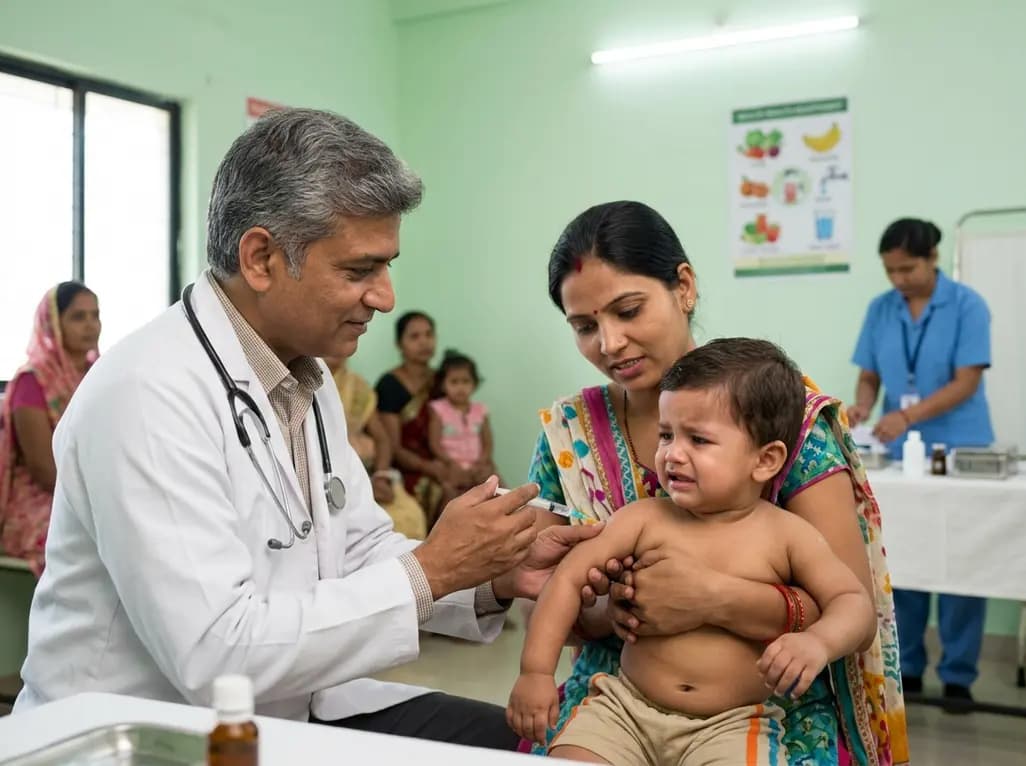
Crucially, the latest National Family Health Survey (NFHS-6) shows that childhood immunization coverage in India has reached 87.1 per cent. Consequently, this rise indicates a strong positive trend in pediatric healthcare. The Ministry of Health and Family Welfare coordinated the survey across 715 districts.
Furthermore, the survey recorded substantial improvements across major vaccines. Specifically, rotavirus vaccination coverage rose sharply from 36.4 per cent to 85.4 per cent. Additionally, coverage for the second dose of the measles-containing vaccine increased significantly from 58.6 per cent to 71.8 per cent. Most families chose public health facilities for these immunizations. In fact, public clinics administered 95.6 per cent of these childhood vaccines.
Besides immunization gains, India also made remarkable progress in reducing childhood malnutrition. For instance, stunting among children under five years declined substantially from 35.5 per cent to 29.3 per cent. Indeed, this reduction represents a massive 17 per cent improvement in long-term nutrition. Similarly, severe wasting among children fell from 7.7 per cent to 5.2 per cent. Consequently, these trends reflect the success of convergent public health campaigns.
Moreover, key digital initiatives and maternal health interventions drove these positive outcomes. For example, the U-WIN digital portal significantly enhanced vaccine tracking and last-mile service delivery. Additionally, flagship programs like POSHAN Abhiyaan and Saksham Anganwadi played crucial roles in addressing child undernutrition. Ultimately, these integrated efforts continue to build a healthier foundation for the country's youth.
Q1: What is the current status of childhood immunization coverage in India?
Specifically, full immunization coverage among children aged 12-23 months has risen to 87.1 per cent. This shows a steady increase from the 83.8 per cent recorded in NFHS-5.
Q2: How much did child stunting decrease in the latest survey?
In addition, stunting among children under five years declined from 35.5 per cent to 29.3 per cent. Consequently, this marks a significant 17 per cent improvement in nutritional outcomes.
Q3: Which public programs contributed to these health improvements?
Finally, key programs like the Universal Immunisation Programme, POSHAN Abhiyaan, and the U-WIN digital tracking platform drove these health gains.
Disclaimer: This content is for informational and educational purposes only. It does not constitute medical advice or replace professional judgment. Refer to the latest local and national guidelines for clinical practice.
References

Read summarized clinical updates, watch expert medical content, and earn CME certifications right from your smartphone.
Open your smartphone camera to scan and install.





The sixth National Family Health Survey (NFHS-6) reveals major improvements in India's child health, immunization rates, and nutritional outcomes....
4 months ago

As monsoon seasons elevate arboviral disease threats, Tamil Nadu has initiated an ICMR-monitored evaluation of the tetravalent dengue vaccine in Tenkasi district. Clinicians emphasize clinical monitoring, public prevention, and high-quality early pediatric care to reduce disease morbidity across endemic regions.
Today

A comparative cohort study evaluates vNOTES vs TLH hysterectomy for benign conditions, demonstrating shorter operative duration, faster return to daily activities, and equivalent female sexual function scores without increased dyspareunia.
Today

Review how tailored exercise programs benefit frail older patients with heart failure. Explore pathophysiological mechanisms, individualized training prescriptions, and strategies to overcome adherence barriers in clinical practice.
Today

This comparative study evaluates posterior labral tears with and without glenohumeral instability, highlighting distinct demographic patterns, MRI underestimation in stable shoulders, and successful arthroscopic repair outcomes.
Today

A clinical study demonstrates that early intervention with tocilizumab, either as monotherapy or bridged with corticosteroids, achieves significant proptosis reduction and resolves active inflammation in treatment-naive thyroid eye disease.
Today
