.webp&w=384&q=75)

Loading, please wait...
Loading, please wait...

Anxiety serves as an adaptive emotional response that protects developing children from environmental dangers. However, when fear becomes persistent, excessive, and functionally impairing, it signals the onset of childhood anxiety disorders. Epidemiological surveys indicate a point prevalence of approximately 7% across pediatric cohorts. Furthermore, lifetime prevalence rates approach 25% to 30% by late adolescence. Despite this burden, many affected youths never receive timely clinical care. Primary care physicians occupy an essential frontline position to bridge this diagnostic gap.
Clinicians frequently struggle to differentiate transient, normative fears from pathological anxiety. For example, separation distress represents a healthy milestone during toddlerhood, whereas school refusal during middle childhood reflects pathology. Moreover, anxiety operates as an internalizing disorder. Affected children rarely display disruptive behaviors that immediately draw teacher attention. Instead, these youths often present as compliant, quiet, and eager to please adults. Consequently, caregivers frequently overlook their severe emotional distress until academic performance declines or social withdrawal becomes acute.
In addition, somatic complaints often disguise psychiatric distress during routine consultations. Pediatric patients repeatedly present with recurrent abdominal pain, tension headaches, nausea, or sleep disturbances. Primary care physicians often perform extensive diagnostic evaluations before considering an emotional cause. Therefore, clinicians must maintain high clinical suspicion when evaluating children with recurrent somatic symptoms. Routine surveillance during health checkups empowers doctors to identify emotional distress before functional impairment paralyses the child.
Early clinical intervention provides an invaluable opportunity to alter long-term psychiatric trajectories. Secondary prevention focuses on identifying youth with subthreshold symptoms before conditions consolidate into chronic illness. Furthermore, untreated pediatric anxiety substantially increases the future risk of major depression, substance misuse, and academic failure. Therefore, targeting at-risk children halts downstream psychiatric comorbidity.
Clinicians can identify predisposing risk factors during developmental reviews. For instance, behavioral inhibition in toddlerhood marks heightened vulnerability to social anxiety. Similarly, children with a family history of affective disorders demonstrate elevated neurobiological susceptibility. When clinicians recognize these early temperamental markers, they can initiate proactive, light-touch interventions. In addition, secondary prevention shifts the clinical paradigm toward proactive resilience training. Proactive parental guidance reduces maladaptive family accommodations that inadvertently sustain anxiety loops. Consequently, early support preserves normal social participation and emotional development during formative school years.
Although evidence-based therapies exist, profound systemic bottlenecks restrict pediatric mental health access. Globally, child psychiatrists and specialized psychologists remain critically scarce. In rural and semi-urban communities, specialized behavioral health services are virtually nonexistent. Consequently, families encounter grueling waitlists that frequently stretch beyond twelve months. During these protracted delays, mild anxiety symptoms frequently escalate into severe functional disabilities.
Moreover, traditional treatment models demand substantial personal resources, time commitments, and transport costs. Weekly in-person psychotherapy sessions pose severe logistical barriers for working parents. Therefore, health systems cannot rely exclusively on specialist referrals to resolve this crisis. Primary care pediatricians and family physicians must shoulder frontline management. Collaborative care models offer a practical solution to this workforce dilemma. In this framework, clinics integrate behavioral health managers who receive remote psychiatric supervision. As a result, primary care providers deliver evidence-based interventions directly within medical homes, eliminating referral bottlenecks.
To overcome specialist constraints, healthcare systems must adopt tiered, stepped-care models for anxiety management. Stepped care begins with the least intensive, most accessible intervention that offers clinical benefit. For instance, children presenting with mild anxiety benefit significantly from low-intensity psychoeducation and guided self-help programs. Clinicians reserve resource-intensive individual cognitive-behavioral therapy for non-responders or severely impaired youths.
Furthermore, parent-mediated interventions represent an exceptionally powerful, scalable therapeutic avenue. Anxious children frequently solicit reassurance, and well-intentioned parents routinely accommodate avoidant behaviors. Consequently, family accommodation paradoxically maintains and worsens childhood fears over time. Parent-led behavioral training programs teach caregivers structured methods to reduce accommodation and reward courageous behaviors. Moreover, digital mental health applications and internet-delivered therapy demonstrate promising efficacy in clinical trials. These digital modalities provide structured cognitive restructuring and exposure exercises at low cost. Therefore, stepped-care algorithms optimize scarce resources while delivering scalable clinical care.
When anxiety causes moderate to severe functional impairment, multimodal treatment provides optimal symptom relief. Clinical guidelines strongly recommend combining cognitive-behavioral therapy with evidence-based pharmacotherapy for severe presentations. Specifically, selective serotonin reuptake inhibitors represent the established first-line pharmacological treatment for pediatric anxiety disorders. Fluoxetine, sertraline, and escitalopram demonstrate robust efficacy across randomized controlled trials. In addition, serotonin-norepinephrine reuptake inhibitors, such as duloxetine, serve as valuable alternative options.
However, clinicians must initiate pharmacotherapy at low doses and titrate gradually to minimize adverse effects. Common transient side effects include gastrointestinal distress, motor restlessness, headaches, and sleep disturbances. Furthermore, practitioners must closely monitor children for behavioral activation and rare treatment-emergent suicidal ideation. Clinicians must educate families thoroughly regarding delayed therapeutic onset, which typically requires six to eight weeks. Therefore, pharmacotherapy should never operate in isolation from supportive behavioral coaching. Combining medication with exposure-based therapy produces superior long-term response rates and prevents symptom relapse.
Primary care physicians can readily integrate proactive anxiety management strategies into everyday clinical workflows. First, clinics should incorporate validated screening questionnaires into routine preventive health visits. Tools such as the Screen for Child Anxiety Related Disorders provide rapid, standardized symptom assessment across domains. Second, clinicians must educate parents about the counterproductive nature of parental overprotection. Instead of shielding children from distress, caregivers must encourage graduated exposure to feared situations.
Third, practices should establish clear stepped-care protocols that identify specific referral thresholds. For example, children exhibiting severe functional disability, depression comorbidity, or active suicidal thoughts require urgent psychiatric evaluation. Meanwhile, primary care teams can safely manage mild cases using brief guided interventions. Furthermore, physicians must build collaborative relationships with local school counselors and community behavioral health providers. Schools offer valuable real-world behavioral observations. Ultimately, primary care clinicians serve as pivotal anchors who transform early detection into sustained emotional recovery.
Clinicians differentiate normal developmental fears from anxiety disorders by evaluating symptom duration, intensity, and functional impairment. Normal fears are transient and age-appropriate, such as toddler separation distress. In contrast, pathological anxiety persists beyond developmental stages, triggers severe emotional distress, and impairs school attendance, social interactions, or family routines.
Selective serotonin reuptake inhibitors represent the first-line pharmacological treatment for moderate to severe pediatric anxiety disorders. Medications such as fluoxetine, sertraline, and escitalopram demonstrate proven efficacy and safety. Clinicians typically initiate treatment at low doses, titrate slowly, and monitor closely for behavioral activation or adverse effects during early weeks.
Family accommodation occurs when parents modify daily routines or facilitate avoidance to reduce a child's distress. Although well-intended, accommodation prevents children from developing distress tolerance and learning that feared situations are manageable. Consequently, it perpetuates the anxiety cycle. Behavioral treatments actively train parents to decrease accommodation and reinforce courageous behavior.
Disclaimer: This content is for informational and educational purposes only... Refer to the latest local and national guidelines for clinical practice.
References

Read summarized clinical updates, watch expert medical content, and earn CME certifications right from your smartphone.
Open your smartphone camera to scan and install.





Childhood anxiety disorders affect up to 30% of youths, yet many remain undiagnosed. This review highlights novel assessment paradigms, early secondary prevention, and scalable stepped-care models designed to bridge behavioral health workforce shortages in pediatric primary care.
Today

Discover how advanced clinical trial designs, including treat-through, randomized withdrawal, and continuous sequential parallel comparison designs (SPCD), evaluate induction and maintenance efficacy in chronic disease drug development.
Today

Meghalaya recorded a historic 55% reduction in maternal deaths, dropping from 244 to 107 over five years. Through the MOTHER app, dedicated transit homes, and expanded infrastructure like the 150-bed Tura Maternity Hospital with its first public NICU, the state demonstrates an effective public health model.
Today

A multicenter propensity-matched study evaluated DOAC plus single versus dual antiplatelet therapy after carotid artery stenting. Findings revealed comparable intracranial hemorrhage and ischemic stroke rates, supporting DOAC plus SAPT as a viable antithrombotic strategy in high-risk patients.
Today

A cross-sectional study reveals that sarcopenic obesity independently increases functional impairment and severe disc degeneration in patients with degenerative lumbar spinal stenosis, highlighting the need for body composition assessment.
Today
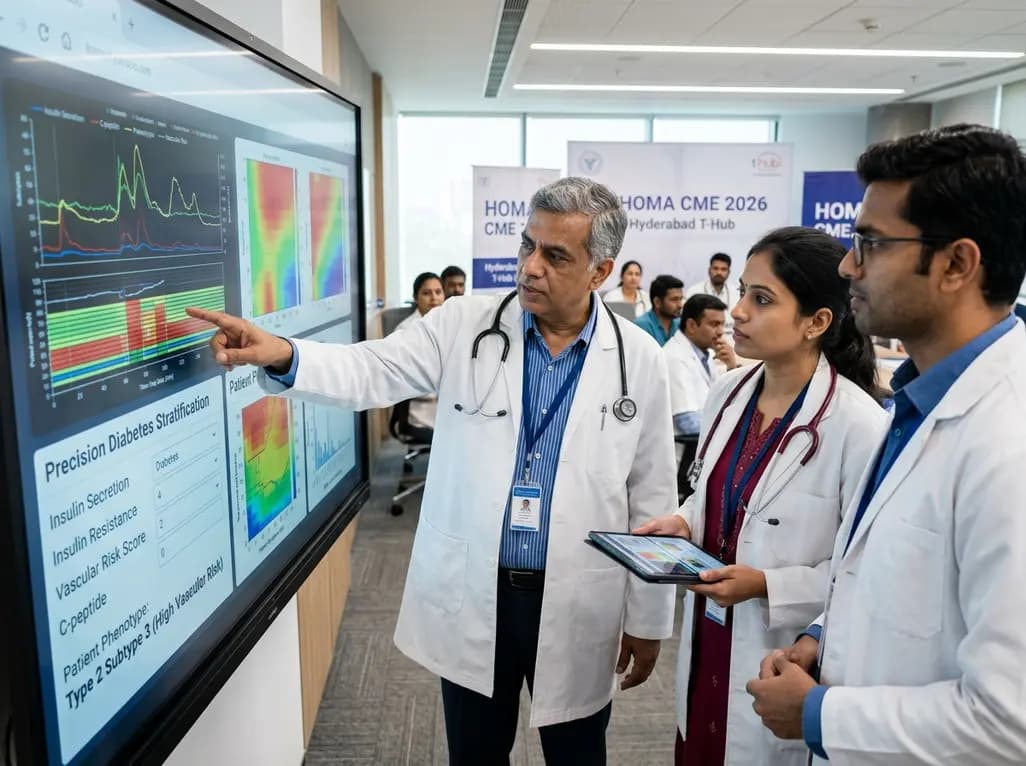
At Homa CME 2026 at Hyderabad's T-Hub, healthcare leaders emphasized moving beyond routine metrics through digital calculators and precision stratification. Discover why characterizing individual insulin secretion, resistance patterns, and vascular risks transforms chronic metabolic care in India.
Yesterday
