

Loading, please wait...
Loading, please wait...

Artificial intelligence has catalyzed profound changes across healthcare training environments, prompting faculty and clinicians to evaluate innovative digital instructional tools. Specifically, research evaluating ChatGPT in medical education has proliferated rapidly since the platform emerged in late 2022. Early scholarship predominantly examined whether large language models could pass licensing examinations. However, modern medical curricula demand far more than basic algorithmic recall or standardized test proficiency. Therefore, investigators recently conducted a comprehensive bibliometric and knowledge-mapping study to evaluate 637 peer-reviewed articles published between 2023 and 2025. This critical evaluation illustrates how academic inquiries have matured over time. Consequently, the findings offer educators a socio-technical framework to interpret generative artificial intelligence as a multidimensional teaching and governance instrument rather than a mere computational curiosity.
The academic literature on generative artificial intelligence has expanded at an extraordinary pace across medical institutions worldwide. Annual publication volume surged remarkably from 123 articles in 2023 to 240 in 2024, reaching 274 investigations by 2025. This steep upward trajectory demonstrates sustained academic interest and urgent institutional curiosity. Using CiteSpace mapping, researchers analyzed collaborative networks and identified significant geographic contributions from institutions across North America, East Asia, and Europe. Nevertheless, the analysis revealed that international collaboration remains somewhat fragmented, with distinct regional pockets pursuing separate research agendas. Furthermore, research output reflects an uneven geographic distribution, suggesting that low-resource healthcare education settings participate less frequently in published scholarly trials. In response, academic leaders must actively cultivate global research consortia to ensure that generative technologies benefit diverse learning environments. Consequently, understanding these bibliometric trends allows curriculum planners to contextualize localized findings within broader international developments, encouraging cross-border dialogue and shared pedagogical frameworks.
To synthesize the algorithmic keyword clusters, the study categorized research into three interconnected dimensions: technological efficacy, pedagogical transformation, and ecosystem governance. Technological efficacy encompasses early studies that benchmarked factual recall, language fluency, and multiple-choice examination performance. However, pedagogical transformation accounted for six distinct keyword clusters, representing the largest proportion of recent academic attention. These clusters highlight curriculum co-design, diagnostic reasoning practice, simulated patient encounters, and personalized tutoring. Furthermore, educators now leverage conversational agents to facilitate complex case discussions and deliberate practice in simulated environments. In contrast, ecosystem governance represents an emerging cluster that addresses ethical boundaries, academic integrity, automated feedback oversight, and institutional liability. This socio-technical model emphasizes that software algorithms cannot function in isolation from institutional values. Therefore, curriculum designers must address all three dimensions collaboratively when formulating digital instruction strategies.
Initial studies captured global headlines by reporting that artificial intelligence achieved passing scores on standardized medical licensing exams. Although those benchmark studies established fundamental linguistic fluency, they provided limited practical insight into clinical judgment, situational communication, or empathy. Fortunately, bibliometric burst pattern analysis demonstrates an intellectual transition away from simple score reporting toward authentic classroom and ward integration. Researchers increasingly examine how medical trainees interact with natural language models during complex clinical reasoning exercises. Additionally, investigators evaluate whether interactive prompting helps novice students synthesize disparate pathophysiological principles into structured differential diagnoses. Consequently, modern scholarship focuses heavily on metacognitive scaffolding, clinical role-play, and the mitigation of automated factual hallucinations. Thus, educators no longer view the model merely as an electronic examinee, but rather as an interactive interlocutor that demands rigorous analytical scrutiny from trainees.
As artificial intelligence becomes deeply integrated into healthcare learning, institutional oversight must expand beyond traditional plagiarism detection. Consequently, ecosystem governance has surfaced as a critical thematic pillar within the modern scholarly literature. Faculty members express persistent concerns regarding data privacy, bias propagation, and intellectual dependency among trainees. Moreover, reliance on unverified generative outputs could erode essential diagnostic skepticism if students accept algorithmic assertions uncritically. Institutional governing boards therefore advocate for clear curriculum guidelines that outline acceptable boundaries for artificial intelligence usage. These regulatory frameworks emphasize mandatory attribution, verification of peer-reviewed sources, and rigorous faculty supervision during case formulation. Furthermore, ethical training must educate future clinicians on systemic algorithmic bias, socio-cultural blind spots, and patient privacy hazards. By implementing proactive governance protocols, academic medical centers can preserve scholarly rigor while harnessing innovative digital capabilities.
The bibliometric synthesis provides concrete pedagogical lessons for program directors, department chairs, and medical students adapting to modern healthcare training. First, faculty development programs must equip clinical teachers to evaluate generative tools constructively rather than implementing outright bans. Second, residency programs should introduce structured prompt-engineering workshops to teach residents how to interrogate algorithmic outputs safely. Trainees must treat generative summaries as preliminary hypotheses that require corroboration through validated clinical references and real-world bedside findings. Additionally, institutions should encourage learner-driven assessments that reward transparent reflective reasoning rather than rote memory regurgitation. Ultimately, this comprehensive bibliometric framework reminds educators that successful technological integration depends on human-centered mentorship, institutional culture, and continuous quality appraisal. By treating generative systems as collaborative educational aids, academic medical centers can cultivate resilient, technologically fluent physicians prepared for complex healthcare systems.
The authors analyzed 637 peer-reviewed articles published between 2023 and 2025 to track scholarly trends surrounding generative artificial intelligence in medical education. By mapping author networks, keyword bursts, and thematic clusters, the researchers created a conceptual socio-technical framework to guide future curriculum development, educational policy, and institutional governance.
Scholarly investigations initially concentrated on technological benchmarking, such as testing whether chatbots could pass standardized medical licensing exams. Over time, research broadened considerably into pedagogical transformation and ecosystem governance, prioritizing real-world classroom integration, simulated clinical problem-solving, patient communication practice, and institutional policy formation.
Key governance challenges include algorithmic hallucinations, potential academic dishonesty, biased training data, and data privacy vulnerabilities. Furthermore, researchers emphasize the danger of cognitive over-reliance among junior trainees, recommending structured institutional policies, active faculty mentorship, and transparent usage disclosure during educational assignments.
Disclaimer: This content is for informational and educational purposes only and should not be considered medical advice or relied upon for clinical decisions. The views expressed represent recent scientific literature and not necessarily institutional endorsements. Refer to the latest local and national guidelines for clinical practice.
References
Hu W et al. Mapping the evolution of ChatGPT research in medical education: a bibliometric analysis and conceptual framework. Med Educ Online. 2026 Dec 31. doi: 10.1080/10872981.2026.2762588. PMID: 43055740.
Xu Q, Zhang Y, Xie X. ChatGPT in Medical Education: Bibliometric and Visual Analysis. JMIR Med Educ. 2025;11:e72356. doi: 10.2196/72356.
Lee H. The rise of artificial intelligence in healthcare education: opportunities and challenges. Korean J Med Educ. 2024;36(1):1-10. doi: 10.3946/kjme.2024.281.

Read summarized clinical updates, watch expert medical content, and earn CME certifications right from your smartphone.
Open your smartphone camera to scan and install.





A comprehensive bibliometric analysis reveals how research on ChatGPT in medical education is expanding from basic exam performance to complex pedagogical integration, interactive clinical simulations, and institutional governance models.
Today

A clinical decision-support framework using health checkup data from 231,683 adults predicts incident obesity with high discrimination (AUROC 0.918). The system integrates temporal survival analysis and risk-factor explanations to prioritize individualized preventive interventions.
Today

A large cohort study demonstrates that fetal growth restriction in a first pregnancy raises maternal cardiovascular risk within five years postpartum, including elevated rates of heart failure, stroke, and myocardial infarction. Clinicians must initiate proactive postpartum screening and cardiovascular prevention.
Yesterday
A multicenter observational study evaluated an 8-week digital health monitoring platform using wearable sensors in ambulatory heart failure. While participants achieved high daily wear-time of 11.7 hours and 80% completion, initial recruitment revealed significant technology-related onboarding barriers.
Today

A paired cadaveric study compared triple and quintuple percutaneous Achilles tendon lengthening. While quintuple hemisection showed numerically greater elongation, differences were not statistically significant.
Yesterday
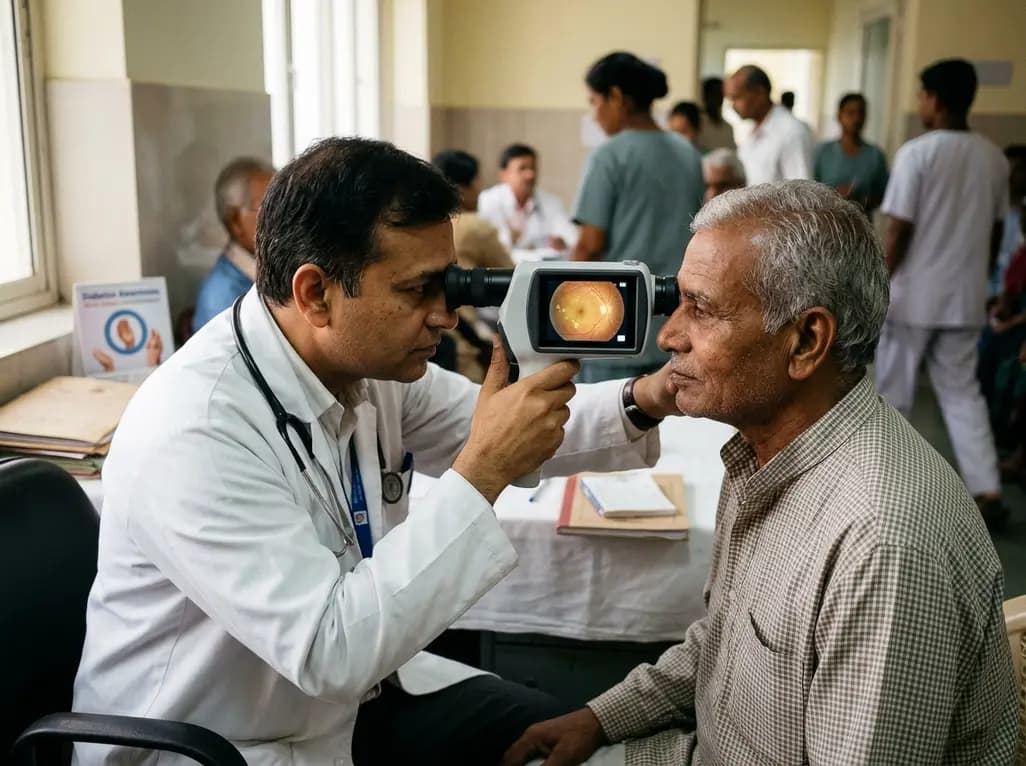
Diabetic retinopathy remains a leading cause of preventable visual impairment. This review outlines key strategies for screening, systemic risk factor control, advanced diagnostic imaging, and timely specialist referrals within primary and multidisciplinary care models.
Today
