.webp&w=384&q=75)

Loading, please wait...
Loading, please wait...
The latest CAG health report has brought to light significant operational and administrative deficiencies within the public healthcare infrastructure of West Bengal. The audit examined critical resource utilization during and after the COVID-19 pandemic, focusing specifically on life-saving medical equipment and emergency financial grants. Consequently, the findings indicate that a substantial portion of public healthcare resources remained underutilized, delayed, or entirely non-functional. Furthermore, these revelations emphasize the vital necessity of ongoing oversight in public health management, particularly when emergency responses require rapid deployment of complex biomedical machinery. Healthcare administrators and clinical leaders must examine these systemic gaps to safeguard future public health crises effectively.
Additionally, the audit reviewed capital investments provided through central relief funds, state allocations, and corporate social responsibility grants. While emergency provisions aimed to fortify intensive care capabilities across peripheral and tertiary hospitals, the practical operationalization fell remarkably short. As a result, critical infrastructure intended for immediate relief failed to reach full operational status. Furthermore, this assessment provides crucial insights for medical professionals, public health planners, and policymakers who strive to establish resilient medical systems across India.
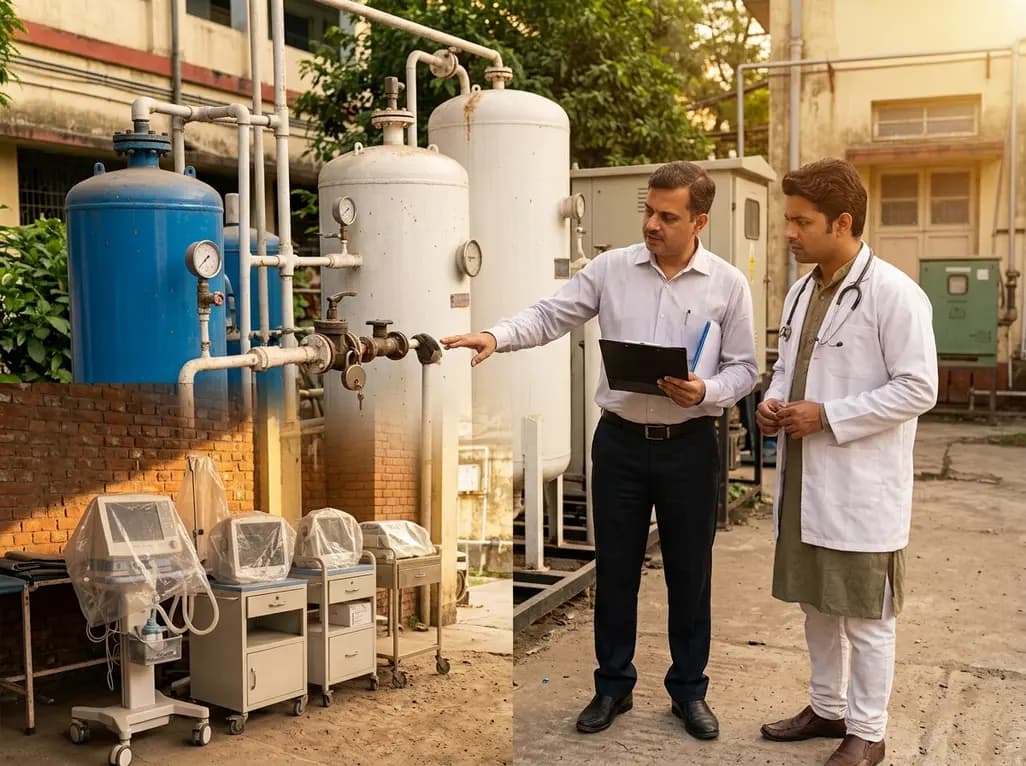
According to the comprehensive evaluation in the CAG health report, more than half of the Pressure Swing Adsorption oxygen plants installed across West Bengal were non-operational or uncommissioned as of December 2023. Specifically, out of seventy-five oxygen generation plants supplied through the PM CARES initiative and corporate social responsibility funds, only thirty-two were operational. Thus, forty-three plants remained completely inactive long after the acute phase of the pandemic had passed.
Moreover, the detailed breakdown illustrates distinct variations between funding sources. Among the forty-six plants funded directly by PM CARES, twenty-three were functional at the time of the audit. Conversely, only nine out of twenty-nine plants established through corporate social responsibility initiatives were working. Therefore, these figures demonstrate significant execution bottlenecks in commissioning and sustaining localized medical gas supply systems. Consequently, medical facilities continued to face operational vulnerabilities despite substantial capital investments in pressure swing adsorption technology.
Beyond bulk oxygen generation, the performance audit highlighted severe lapses in the deployment of essential respiratory equipment, including ventilators and oxygen concentrators. At SSKM Medical College and Hospital, auditors discovered five ventilators supplied under PM CARES sitting idle in stock as of March 2022. Hospital authorities stated that initial consumable packs had been completely exhausted during peak infection waves, rendering the units unusable without fresh replacements. Additionally, three other ventilators remained packed inside original shipping containers within the hospital warehouse.
Similarly, at Raiganj Medical College and Hospital, seventeen intensive care unit ventilators received through central support remained non-functional through March 2022 due to the non-operation of the High Dependency Unit. Furthermore, five oxygen concentrators remained stored away rather than supporting patient care. Therefore, these operational failures demonstrate how supply chain breaks and localized infrastructure delays prevent life-saving equipment from reaching bed-bound patients in critical care settings.
In addition to hardware inefficiencies, the CAG report revealed major financial underutilization regarding emergency relief packages. Specifically, under the Emergency COVID Response Package-II, West Bengal received substantial central support to expand healthcare capacity. However, Rs 659.28 crore, representing sixty-five percent of the total released package, remained completely unspent as of March 2022. Consequently, vital upgrades in clinical infrastructure and staffing support were significantly delayed.
Furthermore, state-level contingency mechanisms exhibited similar financial sluggishness. Approximately Rs 462.05 crore allocated as State COVID untied funds remained unutilized over the same period. These untied grants were intended to offer flexible gap funding for rapid local interventions that fell outside central funding parameters. Therefore, the failure to disburse these financial resources created avoidable barriers in strengthening secondary and tertiary healthcare centers during a historic health crisis.
In response to audit queries regarding the non-functional oxygen generation units, the West Bengal Medical Services Corporation Limited stated that installation and initial commissioning were managed directly by Union government agencies and donor corporations. Moreover, state officials noted that floating tenders had subsequently been initiated to restore the remaining non-operational plants to working condition. However, the auditor observed that no firm timelines or binding guarantees were provided to ensure when these facilities would become fully functional.
Additionally, the audit report noted significant procedural delays in public reporting. The comprehensive performance audit on public health infrastructure was tabled in the state assembly after missing four consecutive fiscal reporting periods. Consequently, transparent institutional accountability was delayed, limiting timely corrective measures by legislative oversight bodies. Therefore, establishing proactive maintenance protocols and transparent administrative tracking remains essential for sustainable healthcare governance.
The insights compiled in this audit highlight systemic challenges in public healthcare management across India. Procuring sophisticated medical equipment represents only the initial step in building clinical resilience. Furthermore, long-term operational success requires dedicated biomedical engineering support, regular maintenance contracts, continuous supply lines for specialized consumables, and adequate technical personnel. Without these integrated support systems, costly medical assets risk rapid deterioration.
Moreover, public health institutions must harmonize central allocation mechanisms with state-level execution frameworks. When administrative ambiguities arise over maintenance responsibilities between donor agencies and local health departments, patient care ultimately suffers. Therefore, health systems must adopt robust asset management protocols, ensuring that emergency equipment remains operational long after initial crisis periods conclude.
Q1: What were the key findings regarding oxygen plants in the West Bengal CAG audit?
The audit revealed that out of 75 PSA oxygen plants supplied through PM CARES and CSR initiatives, 43 were non-functional or uncommissioned as of December 2023. Only 32 plants were operational, demonstrating significant long-term maintenance and commissioning gaps across the state's healthcare infrastructure.
Q2: Why were ventilators and oxygen concentrators lying unused in government hospitals?
Ventilators and concentrators remained idle primarily due to a lack of necessary consumables, uncommissioned high-dependency units, and administrative delays. At major teaching hospitals, machines remained packed in storage because replacement consumable kits were not procured after initial supplies were exhausted during peak pandemic waves.
Q3: How much pandemic emergency funding remained unspent according to the report?
The report highlighted that Rs 659.28 crore (65%) of the Emergency COVID Response Package-II funds remained unspent as of March 2022. Additionally, Rs 462.05 crore in State COVID untied funds remained completely unutilized, hindering essential infrastructure upgrades.
Disclaimer: This content is for informational and educational purposes only. It does not constitute medical advice or replace professional judgment. Refer to the latest local and national guidelines for clinical practice.
References

Read summarized clinical updates, watch expert medical content, and earn CME certifications right from your smartphone.
Open your smartphone camera to scan and install.





A recent Comptroller and Auditor General audit reveals that over 50% of PM CARES and CSR-funded oxygen plants in West Bengal remained non-functional after the pandemic. The audit also highlighted unutilised ECRP-II emergency healthcare funds and idle hospital critical care equipment across public facilities.
2 months ago

Discover the crucial role of glymphatic dysfunction in stroke, where perivascular clearance failure and neuroinflammation exacerbate cerebral edema and post-stroke brain injury.
Today

A prenatal case highlights severe glutaric acidemia type II presenting as bilateral hyperechoic cystic kidneys at 18 weeks. Whole-exome sequencing revealed a novel homozygous ETFDH frameshift variant, demonstrating the power of rapid genetic testing in fetal renal anomalies.
Today

Review how tailored exercise programs benefit frail older patients with heart failure. Explore pathophysiological mechanisms, individualized training prescriptions, and strategies to overcome adherence barriers in clinical practice.
Yesterday

This comparative study evaluates posterior labral tears with and without glenohumeral instability, highlighting distinct demographic patterns, MRI underestimation in stable shoulders, and successful arthroscopic repair outcomes.
Yesterday

A clinical study demonstrates that early intervention with tocilizumab, either as monotherapy or bridged with corticosteroids, achieves significant proptosis reduction and resolves active inflammation in treatment-naive thyroid eye disease.
Yesterday
