.webp&w=384&q=75)

Loading, please wait...
Loading, please wait...
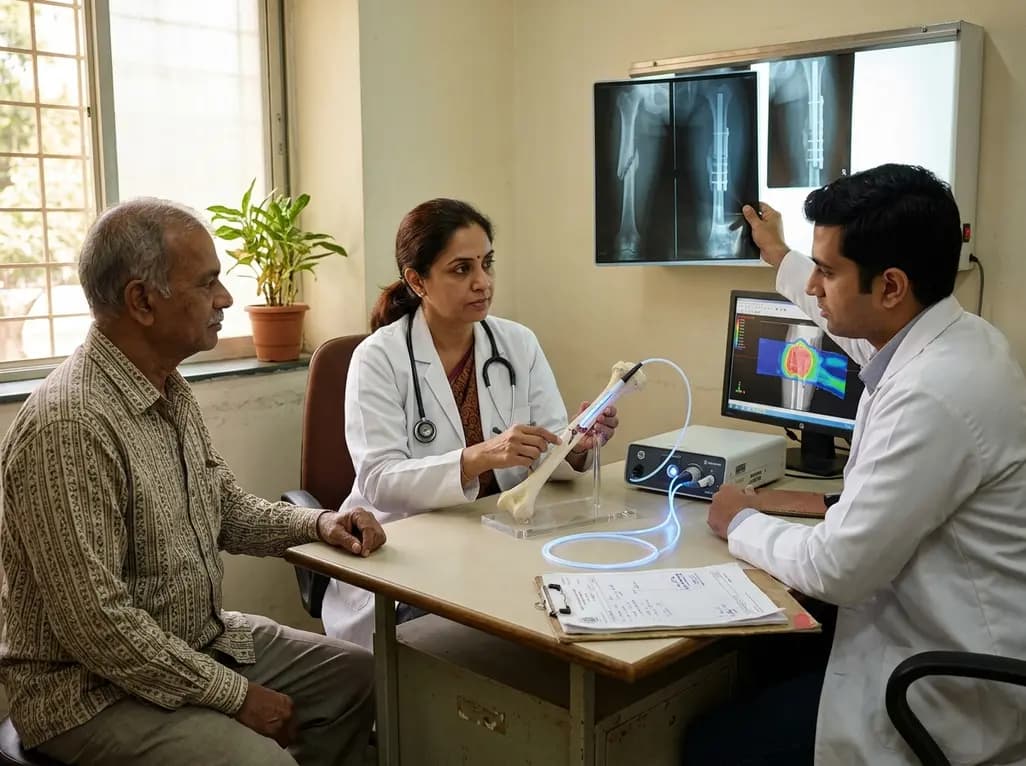
Bone stabilization systems play a vital role in managing patients who face significant fracture risks during cancer treatment. Specifically, researchers recently evaluated the safety and feasibility of the IlluminOss Photodynamic Bone Stabilisation System (IS) following stereotactic body radiation therapy (SBRT). Since high-dose radiation can severely weaken bone structure, clinicians are exploring prophylactic implants to preserve limb function. Therefore, this study investigated six subjects with appendicular osteosarcoma to determine if this light-curable polymer could provide a durable palliative solution.
Specifically, the surgical team placed the patient-specific intramedullary implant the day after subjects completed SBRT. Furthermore, most subjects received adjuvant carboplatin chemotherapy to target systemic disease. Notably, the subjects tolerated the implant well, and the team observed no immediate post-operative complications or infections. Consequently, the findings suggest that the IS offers a feasible method for internal bone reinforcement in high-risk oncology cases. Moreover, the radiolucent properties of the polymer allow for clearer post-operative imaging compared to traditional metallic implants.
However, despite the benefits of these bone stabilization systems, pathologic fractures occurred in four subjects with a median interval of 107 days. Therefore, three subjects eventually required amputation to manage the resulting instability. Although the median survival time reached 156 days, the researchers highlighted the need for further technique optimization. For instance, combining the photodynamic system with ancillary fixation might enhance rotational stability in weight-bearing bones. Similarly, ongoing orthopedic research continues to refine how these innovative implants support fragile bone tissue during and after intensive radiotherapy.
Unlike traditional metal hardware, these systems use a light-curable polymer contained within an inflatable balloon. This allows the implant to conform to the unique internal anatomy of the bone, providing immediate structural support with minimal surgical trauma.
Yes, in the referenced study, most subjects successfully underwent carboplatin chemotherapy while the implant was in place. The procedure showed no adverse interactions between the medical device and the adjuvant medical therapy.
SBRT delivers precise, high-dose radiation that effectively treats tumors but can cause late-stage bone weakening. Consequently, the incidence of pathologic fractures can reach 80% without some form of internal reinforcement or stabilization.
Disclaimer: This content is for informational and educational purposes only. It does not constitute professional medical advice, diagnosis, or treatment. Always seek the advice of your physician or other qualified health provider with any questions you may have regarding a medical condition. Refer to the latest local and national guidelines for clinical practice.
References
Pope EA et al. Use of the IlluminOss Photodynamic Bone Stabilisation System Following Stereotactic Body Radiation Therapy for Limb-Sparing in Six Dogs With Presumptive Appendicular Osteosarcoma. Vet Comp Oncol. 2026 Jun 12. doi: 10.1111/vco.70082. PMID: 42283139.
Vegt P, et al. Photodynamic bone stabilization system: A minimally invasive, patient-conforming intramedullary implant for pathological fractures. J Orthop Surg Res. 2024;19(1):45.
Gundle KR, et al. SBRT and the risk of pathologic fracture in primary bone tumors. Curr Oncol Rep. 2023;25(5):451-459.

Read summarized clinical updates, watch expert medical content, and earn CME certifications right from your smartphone.
Open your smartphone camera to scan and install.





This study evaluates the IlluminOss Photodynamic Bone Stabilisation System following stereotactic body radiation therapy (SBRT). While the system is safe and well-tolerated as a palliative option for managing fractures in osteosarcoma, findings suggest that additional fixation may be required for optimal stability.
4 months ago

Novel diimide and hydrazone scaffolds, particularly compound #C4, synergistically reactivate latent HIV-1 when combined with JQ1 or PKC activators. Demonstrating donor-matched proviral transcription ex vivo and non-canonical signaling, these findings advance shock and kill strategies toward reservoir eradication.
Today

A cross-sectional study reveals that maternal RSV vaccination coverage reached only 43.7% in Argentina, with maternal vaccine knowledge being the sole independent predictor of uptake. Clinicians play a crucial role in eliminating informational and structural barriers to optimize infant health.
Today

Review how tailored exercise programs benefit frail older patients with heart failure. Explore pathophysiological mechanisms, individualized training prescriptions, and strategies to overcome adherence barriers in clinical practice.
Yesterday

This comparative study evaluates posterior labral tears with and without glenohumeral instability, highlighting distinct demographic patterns, MRI underestimation in stable shoulders, and successful arthroscopic repair outcomes.
Yesterday

A clinical study demonstrates that early intervention with tocilizumab, either as monotherapy or bridged with corticosteroids, achieves significant proptosis reduction and resolves active inflammation in treatment-naive thyroid eye disease.
Yesterday
