.webp&w=384&q=75)

Loading, please wait...
Loading, please wait...

Pediatric hearing rehabilitation aims to restore sound perception while supporting comprehensive social development. Auditory emotion recognition represents a crucial developmental milestone, enabling children to interpret social intent, empathy, and interpersonal nuances. While bilateral cochlear implants successfully improve spoken language comprehension, the accurate transmission of subtle affective acoustic cues remains a significant clinical challenge. Cochlear implant processors deliver temporal envelope cues effectively; however, fine-structure temporal details and harmonic spectral resolution remain restricted. Consequently, young recipients must interpret complex emotional expressions through degraded auditory signals. Evaluating how children with bilateral cochlear implants process nonlinguistic vocalizations and musical excerpts provides essential insight for designing targeted auditory rehabilitation strategies.
Children acquire social competence largely through the accurate interpretation of vocal affect, intonation, and speech prosody. However, auditory emotion recognition requires precise perception of dynamic fundamental frequency variations, harmonic distributions, and intensity contours. Bilateral cochlear implants enhance binaural summation and spatial listening compared to unilateral devices. Even so, current device strategies do not fully preserve fine pitch variations. Therefore, pediatric cochlear implant recipients encounter distinct perceptual challenges when decoding affective signals in everyday environments.
Recent clinical studies have evaluated these affective processing abilities in controlled settings. Researchers assessed twenty-nine children aged six to twelve years with bilateral cochlear implants alongside twenty-nine age-matched normal-hearing peers. The evaluation utilized standardized nonlinguistic vocalizations from the Montreal Affective Voices set and instrumental cues from the Music and Emotion Stimulus set. Specifically, investigators tested five distinct emotions: happiness, sadness, anger, fear, and surprise. The findings demonstrated that implanted children show significantly lower emotion recognition accuracy compared to normal-hearing controls across vocal and musical domains.
Nonlinguistic vocalizations and musical passages share fundamental acoustic parameters, including tempo, rhythm, loudness dynamics, and pitch contours. In this clinical study, researchers identified strong positive correlations between vocal emotion scores and musical emotion scores across all conditions. This robust relationship indicates that children recruit shared central auditory mechanisms to extract emotional valence from human voices and musical compositions. Therefore, children who identify vocal emotions accurately tend to demonstrate similar proficiency when evaluating musical melodies.
Nevertheless, acoustic characteristics influence how easily pediatric listeners identify distinct emotional expressions. Musical stimuli frequently feature prominent rhythmic patterns, tempo variations, and wide pitch intervals that simplify affective categorization. In contrast, nonverbal vocalizations rely heavily on subtle voice quality changes and rapid spectral transitions. Because cochlear implants transmit temporal envelope dynamics effectively, children readily capitalize on tempo and rhythm in music. However, limited spectral resolution impairs the detection of subtle vocal timbre. Consequently, pediatric recipients often achieve higher perceptual consistency when evaluating structured musical melodies than brief vocal sounds.
The clinical evaluation revealed a distinct perceptual hierarchy across both vocal and musical emotional stimuli. Specifically, children with bilateral cochlear implants achieved the highest recognition scores for happiness, followed sequentially by sadness, anger, surprise, and fear. Happiness features elevated fundamental frequency, wide pitch excursions, bright timbre, and rapid tempo, making its acoustic profile exceptionally salient. As a result, pediatric cochlear implant users detect positive affective cues with relative ease.
Conversely, distinguishing nuanced negative emotions proved substantially more difficult for pediatric implant recipients. Sadness involves a slower tempo and lower energy, which helps children differentiate it from energetic emotional states. However, negative emotions like anger, fear, and surprise share overlapping acoustic features, including rapid acoustic onset and elevated pitch. In particular, fear and surprise both present with brief acoustic bursts and fluctuating frequency contours. Because cochlear implants degrade fine harmonic cues, pediatric listeners frequently confuse these high-arousal negative states during daily social interactions.
Spoken language comprehension and auditory emotion recognition share common neurobiological pathways in the developing brain. To examine this connection, investigators evaluated speech reception thresholds and word recognition scores in the study cohort. The analyses revealed significant positive correlations between standard speech perception measures and auditory emotion recognition accuracy. Specifically, children who achieved superior word recognition scores consistently demonstrated higher accuracy in identifying vocal and musical emotions.
This association emphasizes the fundamental importance of spectral and temporal fidelity in overall auditory performance. Word recognition requires accurate phonemic discrimination, formant tracking, and envelope interpretation. Similarly, emotion identification requires listeners to track subtle prosodic contours and dynamic intensity fluctuations. Therefore, children who develop strong speech perception skills are better prepared to extract subtle affective nuances from acoustic signals. Furthermore, prolonged implant experience and earlier age at implantation substantially strengthen both speech discrimination and affective listening abilities over time.
These clinical findings provide practical guidance for optimizing post-implantation auditory therapy protocols in pediatric audiology. Traditional auditory-verbal rehabilitation programs primarily emphasize lexical acquisition, phonological discrimination, and sentence comprehension. However, comprehensive social integration requires fluent affective communication and social awareness. Therefore, pediatric audiologists and speech-language pathologists should actively incorporate structured auditory emotion recognition training into standard rehabilitation regimens.
Therapists can effectively introduce multi-modal training exercises that combine melodic contours, rhythmic variations, and nonverbal affective vocalizations. Furthermore, incorporating visual cues, such as facial expression cards and digital interactive games, facilitates beneficial cross-modal learning pathways. Pediatric audiologists must also optimize sound processor programming to preserve spectral resolution and acoustic dynamic range. Additionally, encouraging active participation in music therapy accelerates emotional prosody development. As pediatric cochlear implant technology continues to advance, comprehensive auditory training will empower children to build stronger interpersonal relationships and achieve greater socio-emotional well-being.
Children with bilateral cochlear implants generally achieve lower emotion recognition accuracy compared to normal-hearing peers. Cochlear implants deliver effective temporal envelope cues but provide limited spectral resolution and fine-structure pitch details. Consequently, implanted children often struggle to decode subtle prosodic variations and voice quality shifts. While normal-hearing children effortlessly distinguish nuanced affective states, cochlear implant recipients rely heavily on gross tempo and intensity cues to classify emotional sounds.
Happiness features distinct acoustic characteristics, including elevated pitch, wide frequency excursions, bright timbre, and rapid tempo. These exaggerated acoustic dynamics are easily transmitted through the temporal envelopes of cochlear implants. In contrast, negative emotions such as fear, anger, and surprise share overlapping acoustic parameters and require fine harmonic discrimination. Therefore, pediatric cochlear implant users identify happiness with high accuracy while frequently confusing complex negative emotional stimuli.
Structured music training significantly improves auditory emotion perception in pediatric cochlear implant recipients. Because vocal and musical affective processing share common acoustic cues, practicing with rhythm, pitch contours, and melodies strengthens central auditory processing. Furthermore, music activities enhance listening attention, spectral discrimination, and auditory memory. Consequently, incorporating active music making and listening exercises into speech therapy protocols facilitates better identification of affective cues in everyday spoken conversations.
Disclaimer: This content is for informational and educational purposes only... Refer to the latest local and national guidelines for clinical practice.
References
Degirmenci Uzun E et al. Auditory Emotion Recognition in Children With Bilateral Cochlear Implants: Vocal and Musical Stimuli. Am J Audiol. 2026 Aug 28. doi: 10.1044/2026_AJA-25-00266. PMID: 42663609.
Chatterjee M et al. Voice emotion perception and production in cochlear implant users. Hear Res. 2017;352:30-39.
Rachman L et al. Vocal emotion recognition in children with cochlear implants and with hearing aids. Trends Hear. 2024;28:23312165241254321.
Volkova A et al. Experience Changes How Emotion in Music Is Judged: Evidence from Children Listening with Bilateral Cochlear Implants, Bimodal Devices, and Normal Hearing. PLoS One. 2015;10(8):e0136685.

Read summarized clinical updates, watch expert medical content, and earn CME certifications right from your smartphone.
Open your smartphone camera to scan and install.





Study evaluates auditory emotion recognition in children with bilateral cochlear implants across vocal and musical stimuli, highlighting acoustic hierarchies and speech links.
4 weeks back

With post-monsoon dengue surges threatening South Asian health systems, physicians must refine triage and management. This guide covers vital warning signs, plasma leakage detection, crystalloid titration, and vector containment strategies to prevent mortality during seasonal arboviral epidemics.
Today

Findings from Project Viva indicate that sustained postpartum weight retention, rather than excessive gestational weight gain alone, directly worsens women's mid-life cardiovascular health, degrading blood pressure and glycemic parameters decades after delivery.
Today
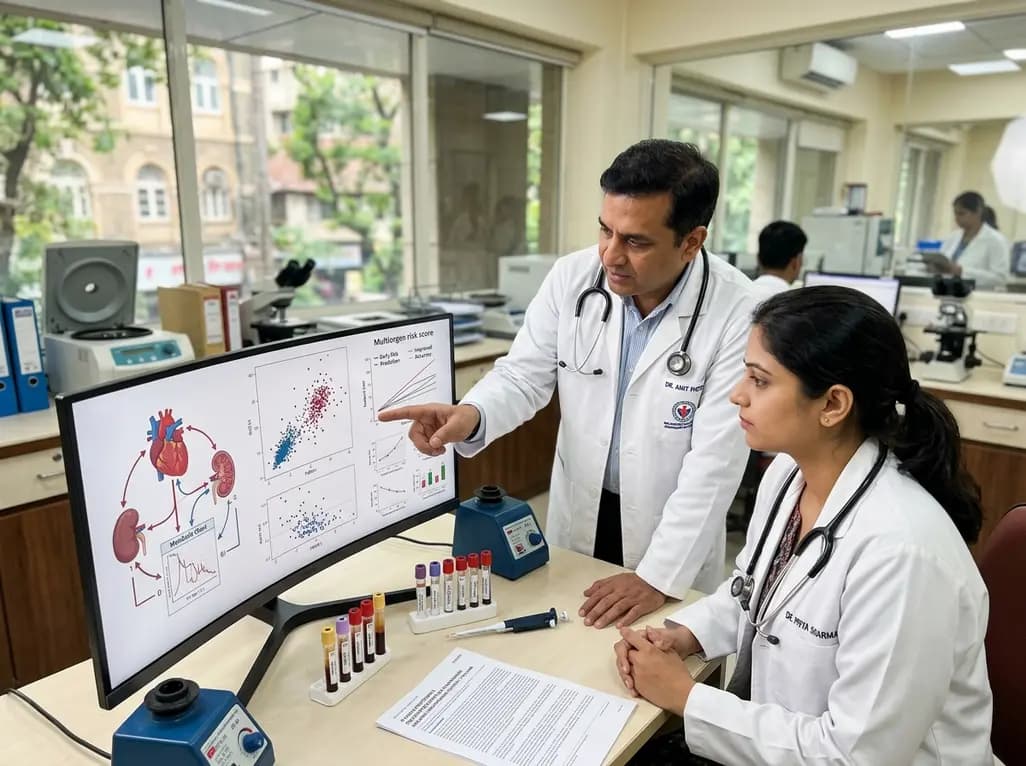
A large UK Biobank study reveals that plasma proteomic signatures capture preclinical organ damage and improve multiorgan risk prediction across early CKM syndrome stages 0 to 2 beyond traditional PREVENT clinical models.
Today

A retrospective CBCT study reveals that superior TMJ space asymmetry correlates moderately with occipital condyle-atlas-axis asymmetry in unilateral TMJ osteoarthritis, highlighting an imaging correlate between jaw biomechanics and upper cervical alignment rather than a standalone diagnostic marker.
Today

A Bayesian multilevel meta-analysis reveals that aerobic training combined with moderate carbohydrate restriction modestly lowers HbA1c in type 2 diabetes. However, sparse data and very low certainty leave incremental benefits over exercise or diet alone unproven, highlighting the need for individualized care.
Today
