.webp&w=384&q=75)

Loading, please wait...
Loading, please wait...
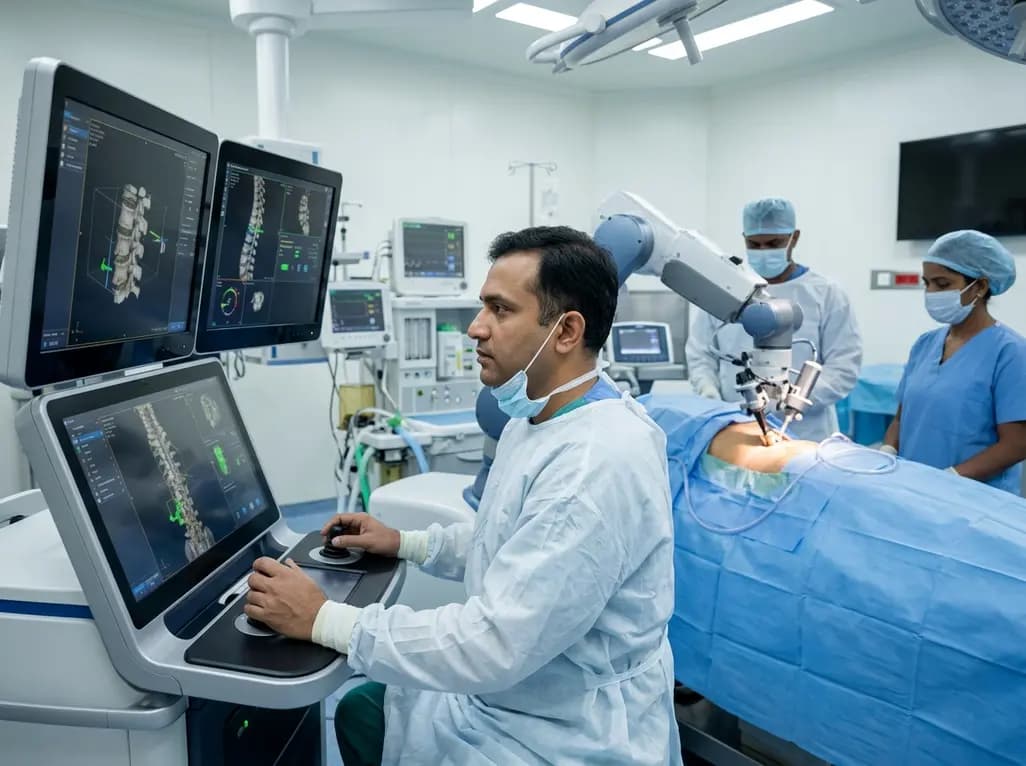
The healthcare landscape in India is undergoing a massive technological transformation. Specifically, the introduction of robotic spine surgery is redefining complex clinical procedures. Recently, Aster CMI Hospital in Bengaluru made headlines by launching a dedicated institute to advance this field. This landmark initiative aims to elevate the standard of clinical excellence nationwide. Consequently, patients suffering from debilitating spinal conditions will now have access to state-of-the-art care. Through this launch, the hospital reinforces its commitment to patient-centric innovation and advanced medicine.
Today, modern technology provides surgeons with unprecedented accuracy during delicate procedures. Indeed, robotic spine surgery represents a paradigm shift in how clinicians approach complex spinal pathologies. In the past, traditional open surgeries often carried substantial risk and required long recovery periods. However, the integration of robotic guidance systems has mitigated many of these clinical challenges. By utilizing 3D imaging and real-time computer navigation, specialists can execute procedures with remarkable precision. Furthermore, this technological synergy allows for highly customized surgical planning tailored to individual patient anatomy. As a result, surgeons can navigate around delicate nerve structures without causing unnecessary tissue damage. Additionally, the robotic arm acts as a steady guide, eliminating human hand tremors entirely. Consequently, this advancement enhances safety and dramatically reduces the margin of error during operations. Therefore, medical communities worldwide are rapidly adopting these robotic systems as a standard of care. This transition not only elevates surgical outcomes but also redefines the patient experience. Ultimately, the future of neurosurgery lies in these collaborative robotic platforms.
To address the growing demand for advanced neurosciences, Aster CMI Hospital has established a specialized institute. Specifically, they launched the Aster Robotic Institute for Spine Excellence, widely known as ARISE. This center brings together multidisciplinary expertise under one unified platform. Consequently, patients with complex spinal disorders can receive comprehensive, evidence-based care. The institute aims to set new benchmarks in robotic spine surgery across India. Additionally, the program combines advanced technology with rigorous clinical training for the next generation of surgeons. By integrating research, education, and patient care, ARISE hopes to spearhead clinical innovation. Moreover, the facility provides an ideal environment for testing next-generation surgical devices. Leading specialists at Aster emphasize that ARISE is not just a surgical center. Instead, it represents a long-term vision to make high-tech medical care more accessible. Thus, the institute represents a significant milestone in Bengaluru's journey toward becoming a global healthcare destination. Through this launch, Aster CMI Hospital strengthens its leadership in the Indian medical sector.
The establishment of ARISE coincides with the introduction of cutting-edge robotic platforms. Particularly, Aster CMI Hospital has integrated the Mazor X system for spine care and the ROSA system for brain procedures. These systems offer surgeons an unparalleled degree of visualization and control. For instance, the Mazor X robotic guidance system helps doctors plan surgeries with sub-millimetric accuracy. Subsequently, the robotic arm guides the surgeon's tools along the pre-planned pathway during the actual operation. Likewise, the ROSA platform enables frameless brain surgery, which enhances patient comfort. Previously, brain procedures required rigid, uncomfortable frames that specialists attached directly to the skull. Now, however, the frameless ROSA technology allows for a highly precise and minimally invasive approach. Additionally, these technologies significantly reduce radiation exposure for both patients and medical staff. By utilizing real-time feedback, the surgical team can verify implant placement instantly. Therefore, the hospital has drastically minimized the likelihood of secondary revision surgeries. These innovations undoubtedly mark a massive leap forward for neurosciences in the region.
For patients, the clinical benefits of robotic-assisted spine surgery are truly life-changing. First, this technology enables minimally invasive procedures, which require much smaller incisions. Consequently, patients experience significantly less muscle damage and reduced blood loss during surgery. Furthermore, smaller wounds naturally lower the risk of post-operative infections in the hospital. As a result, patients recover much faster and can return to their daily routines quickly. Additionally, the precise placement of implants minimizes post-operative pain and discomfort. Therefore, individuals require fewer prescription pain medications during their recovery phase. Shorter hospital stays also reduce the financial and emotional burden on families. Indeed, patients often report higher satisfaction rates following robotic-assisted procedures compared to conventional open surgery. Moreover, long-term outcomes show a lower rate of complications and spinal instability. By choosing robotic-assisted care, individuals can expect a safer, smoother journey back to health. This patient-centric approach remains at the heart of Aster's medical philosophy.
Beyond patient care, ARISE emphasizes the importance of clinical education and research. Indeed, the institute aims to train the next generation of spine surgeons in robotic techniques. Because robotic surgery requires specialized skills, structured training programs are absolutely essential. Consequently, Aster CMI Hospital offers comprehensive fellowships and workshops for young medical professionals. These programs combine hands-on simulator training with real-time clinical observation. Furthermore, trainees learn from highly experienced mentors who have pioneered robotic procedures in India. This mentorship ensures that the next generation of surgeons can operate with high confidence and precision. Additionally, ARISE supports ongoing research projects to evaluate and refine surgical methodologies. By publishing clinical data, the institute contributes to the global database of neurosurgical science. Therefore, the medical community benefits from the shared knowledge and technological insights generated at the center. Ultimately, this focus on education ensures the sustainability of high-quality spine care in the region.
Q1: Why choose robotic spine surgery?
Robotic spine surgery provides outstanding surgical precision, which leads to smaller incisions and minimized tissue damage. Consequently, patients experience significantly reduced blood loss and less post-operative discomfort. Furthermore, this advanced approach ensures shorter hospital stays and a faster return to daily life. Ultimately, robotic guidance systems optimize implant placement accuracy, greatly improving patient safety and overall clinical success.
Q2: What is the Mazor X platform?
The Mazor X platform serves as an advanced robotic guidance system for complex operations. Specifically, it enables specialists to create a precise three-dimensional surgical plan before entering the operating room. During the procedure, the robotic arm guides the surgeon's instruments along this pre-planned pathway with sub-millimetric accuracy. Therefore, this technology minimizes critical anatomical damage and enhances overall surgical consistency.
Q3: Who is eligible for ARISE treatment?
Patients with complex spinal disorders, such as degenerative disc disease or severe spinal deformities, are ideal candidates. Additionally, individuals needing complex reconstruction procedures can benefit significantly from this technology. However, the multidisciplinary medical team must thoroughly evaluate each patient's clinical history to determine suitability. Generally, this approach is suitable for individuals seeking minimally invasive options with faster rehabilitation times.
Disclaimer: This content is for informational and educational purposes only. It does not constitute medical advice or replace professional judgment. Refer to the latest local and national guidelines for clinical practice.
References

Read summarized clinical updates, watch expert medical content, and earn CME certifications right from your smartphone.
Open your smartphone camera to scan and install.





Aster CMI Hospital in Bengaluru has launched the Aster Robotic Institute for Spine Excellence (ARISE). This state-of-the-art facility integrates advanced robotics like Mazor X to deliver highly precise, minimally invasive care, reducing recovery times and improving patient outcomes across India.
3 months ago

Discover the crucial role of glymphatic dysfunction in stroke, where perivascular clearance failure and neuroinflammation exacerbate cerebral edema and post-stroke brain injury.
Today

A prenatal case highlights severe glutaric acidemia type II presenting as bilateral hyperechoic cystic kidneys at 18 weeks. Whole-exome sequencing revealed a novel homozygous ETFDH frameshift variant, demonstrating the power of rapid genetic testing in fetal renal anomalies.
Today

Review how tailored exercise programs benefit frail older patients with heart failure. Explore pathophysiological mechanisms, individualized training prescriptions, and strategies to overcome adherence barriers in clinical practice.
Yesterday

This comparative study evaluates posterior labral tears with and without glenohumeral instability, highlighting distinct demographic patterns, MRI underestimation in stable shoulders, and successful arthroscopic repair outcomes.
Yesterday

A clinical study demonstrates that early intervention with tocilizumab, either as monotherapy or bridged with corticosteroids, achieves significant proptosis reduction and resolves active inflammation in treatment-naive thyroid eye disease.
Yesterday
