.webp&w=384&q=75)

Loading, please wait...
Loading, please wait...
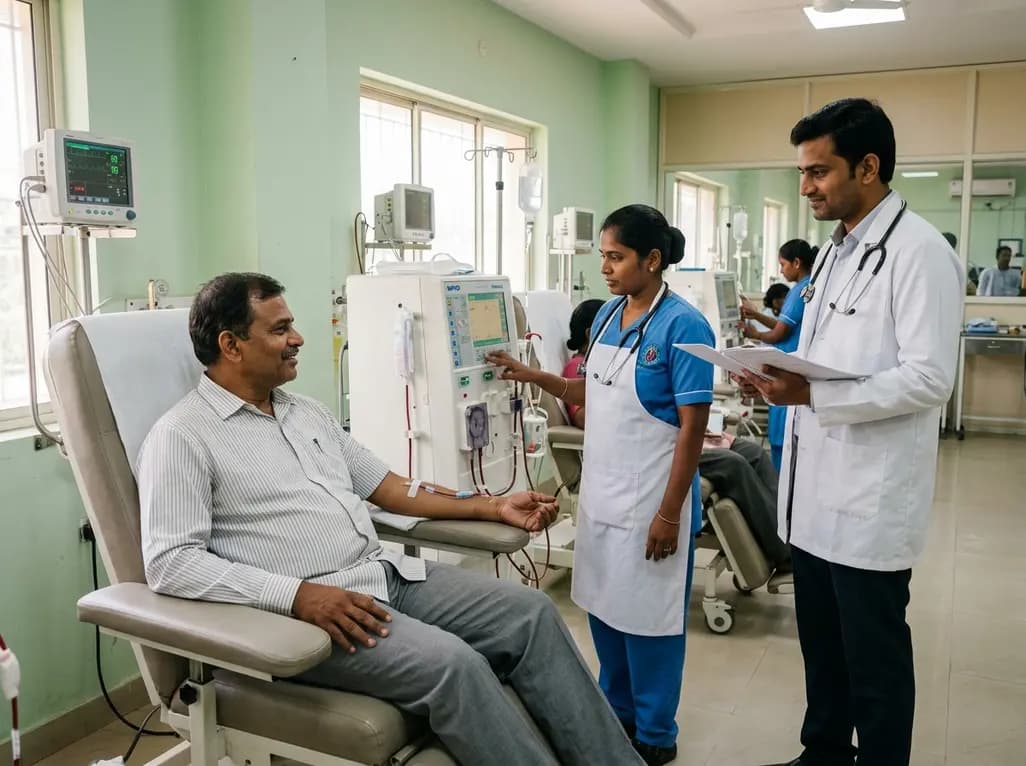
The Andhra Pradesh government recently announced the addition of 22 new dialysis centres under PMNDP to expand life-saving renal replacement therapy across underserved regions. Health Minister Satya Kumar Yadav confirmed that this operational initiative will increase the state tally of national programme facilities to 83. Consequently, vulnerable families battling end-stage kidney failure will gain direct access to localized, fully subsidized maintenance hemodialysis. In addition, this strategic expansion directly addresses regional healthcare disparities across rural communities while strengthening secondary hospital clinical capabilities.
Chronic kidney disease represents an escalating public health crisis throughout modern India. Epidemiological estimates indicate that approximately 2.2 lakh citizens develop end-stage renal disease annually. Consequently, this staggering incidence generates a nationwide requirement for more than 3.4 crore dialysis sessions every year. In addition, hypertension and type 2 diabetes mellitus remain the predominant drivers of progressing nephropathy. Therefore, clinicians frequently encounter patients presenting with advanced uremic complications and irreversible organ damage. Early detection remains difficult because initial renal insufficiency typically develops without noticeable clinical symptoms. As a result, numerous patients require urgent maintenance hemodialysis upon their first clinical evaluation. Furthermore, inadequate local infrastructure forces vulnerable individuals to undertake exhausting travel to urban medical centers. Such recurrent journeys place heavy physical debility on frail patients and disrupt household employment. Similarly, transportation expenses place an unbearable strain on impoverished household budgets. Expanding secondary hospital capacity therefore plays a decisive role in stabilizing these vulnerable cohorts. Ultimately, public health authorities must prioritize decentralized care models to mitigate tertiary hospital congestion. Systematic capacity building effectively bridges the clinical divide between metropolitan hubs and rural districts. Moreover, routine outpatient screening at peripheral centers can identify progressive nephropathy before terminal renal failure develops.
The strategic rollout of dialysis centres under PMNDP illustrates a sustainable public-private partnership framework. Under this collaborative model, state authorities provide dedicated clinical space within established public hospital complexes. Meanwhile, specialized private partners supply certified hemodialysis machines, advanced water purification systems, and trained professionals. Historically, Andhra Pradesh operated 28 national units prior to 2019. Subsequently, the state government commissioned 19 additional units between 2019 and 2024. Furthermore, authorities inaugurated 14 new facilities during the 2024-25 fiscal period. With the newly approved 22 units, the state network expands to 83 operational PMNDP centers. Each incoming unit will house five modern hemodialysis stations. Consequently, each unit represents a targeted capital investment of 85 lakh rupees. In addition, every facility can safely conduct 15 treatment sessions daily across staggered shifts. Currently, 754 dialysis machines maintain active clinical service across existing state centers. Moreover, 170 centers function under the Dr. NTR Vaidya Seva Trust network. Therefore, this integrated ecosystem establishes comprehensive infrastructure capable of supporting thousands of maintenance sessions weekly. This massive infrastructure expansion guarantees dependable and equitable therapeutic access for socially marginalized populations. Additionally, dedicated administrative oversight ensures that machine procurement and facility readiness proceed without operational delays.
Decentralization forms the structural cornerstone of this healthcare infrastructure initiative. Crucially, state planners selected Area Hospitals and Community Health Centres rather than concentrating resources in urban centers. For example, West Godavari district will open a dedicated unit at Bhimavaram Area Hospital. Similarly, Chittoor district will house a new clinical facility at Pileru Area Hospital. In YSR Kadapa district, facilities will establish operations at Jammalamadugu and Mydukur. Furthermore, Krishna district will integrate new dialysis beds at Gannavaram and Gudivada. In Nellore district, community hospitals in Venkatagiri and Udayagiri will initiate specialized renal therapy. Additionally, Bapatla district will establish units at Addanki and Repalle. Tirupati district will expand care to Railway Koduru and Satyavedu. Planners also selected Kondapi, Kovvur, Nandigama, Vinukonda, Sattenapalli, Bobbili, Done, Sunnipenta, Penukonda, and Madakasira. As a result, rural residents will no longer travel to distant municipal corporations for thrice-weekly regimens. In addition, this geographical proximity preserves vital vascular access integrity and reduces catastrophic treatment interruptions. Consequently, clinical teams observe fewer missed sessions and improved overall survival metrics among rural beneficiaries. Localized treatment centers also permit family caregivers to maintain their daily vocational responsibilities without disruption. Therefore, regional health networks can deliver uninterrupted maintenance therapy while keeping families socially and economically stable.
Chronic maintenance hemodialysis frequently precipitates catastrophic health expenditure that exhausts household financial resources. In corporate and private tertiary hospitals, a single hemodialysis session typically costs between 3,000 and 4,000 rupees. Because standard management requires multiple sessions weekly, monthly out-of-pocket expenses rapidly overwhelm underprivileged families. In contrast, the government spends only 999 rupees per session under the subsidized national framework. Furthermore, eligible patients receive these vital clinical treatments entirely free of charge at government facilities. The state spent 126.5 crore rupees on universal dialysis provision across combined programs during 2024-25. Subsequently, programmatic investment expanded to 197.8 crore rupees during the 2025-26 fiscal cycle. Moreover, spending has already crossed 90.09 crore rupees during early 2026-27 operations. The prospective operating expenditure for the 22 upcoming facilities will demand an estimated 11 crore rupees annually. Therefore, state funding shields vulnerable families from liquidating productive assets or abandoning necessary medical therapy. Consequently, eliminating user fees ensures that socio-economic status does not dictate clinical longevity or therapeutic dignity. In addition, public investment yields substantial social dividends by restoring productive capacity to working-age chronic patients. Thus, comprehensive fiscal coverage prevents debt cycles and sustains long-term adherence to maintenance renal replacement therapy.
Sustaining long-term clinical efficacy demands meticulous infection surveillance and adherence to strict operational guidelines. Because maintenance hemodialysis patients experience substantial immunosuppression, cross-contamination risks remain persistently elevated. Consequently, national operational guidelines mandate dedicated machine isolation for patients carrying blood-borne viral pathogens. Furthermore, operating teams must conduct routine microbiological cultures from reverse osmosis systems to avoid endotoxin-induced pyrogenic reactions. Dialyzer reuse protocols require calibrated automated reprocessing systems along with strict chemical sterilization safeguards. Therefore, clinical administrators can effectively prevent catastrophic bloodstream bacteremia among vulnerable attendees. In addition, supervising nephrologists and medical officers must monitor monthly biochemical clearance markers such as single-pool Kt/V. Monitoring ultrafiltration rates and dry-weight reassessments prevents recurrent interdialytic pulmonary edema and left ventricular hypertrophy. Similarly, coordinated multidisciplinary care requires timely vascular access surveillance and systematic anemia management using erythropoiesis-stimulating agents. Specialized dietary counselling also optimizes nutritional status by curbing severe hyperkalemia and secondary hyperparathyroidism. Ultimately, rigorous continuous quality improvement ensures that peripheral community facilities mirror the clinical benchmarks of advanced academic hospitals. Thus, comprehensive clinical governance safeguards patient safety across every participating secondary health center. Continuous professional training also elevates the clinical competency of nursing personnel and dialysis technicians. Moreover, standardized electronic documentation tracks longitudinal patient outcomes to identify emerging complications early.
Q1: What is the primary objective of establishing new dialysis centres under PMNDP?
The primary objective centers on improving geographic access to free maintenance hemodialysis for economically disadvantaged patients across Andhra Pradesh. By positioning five-machine dialysis units within secondary community and area hospitals, the initiative minimizes arduous travel distances and eliminates catastrophic private hospital costs. Consequently, rural patients suffering from end-stage renal failure gain reliable access to consistent, high-quality renal replacement therapy without exhausting their family savings or disrupting weekly care.
Q2: How does the operational framework between government and private providers function?
The programme operates under a structured public-private partnership model designed for rapid clinical deployment. Specifically, the state government provides dedicated facility space, uninterrupted water, electrical connections, and statutory administrative oversight. Meanwhile, the contracted private service provider supplies certified hemodialysis machines, advanced water purification systems, consumables, and skilled nursing staff. Furthermore, strict state auditing guarantees that clinical delivery remains free for patients while meeting national quality benchmarks.
Q3: How often do end-stage renal disease patients require hemodialysis sessions?
Most clinical patients suffering from end-stage renal disease require two to three maintenance hemodialysis sessions each week. Typically, each therapeutic session extends for approximately four hours depending on metabolic waste accumulation, residual kidney capacity, and interdialytic fluid gain. Therefore, adhering to this strict treatment frequency remains critical to prevent severe electrolyte disturbances, combat chronic uremia, and avert acute cardiovascular complications such as pulmonary edema.
Disclaimer: This content is for informational and educational purposes only. It does not constitute medical advice or replace professional judgment. Refer to the latest local and national guidelines for clinical practice.
References

Read summarized clinical updates, watch expert medical content, and earn CME certifications right from your smartphone.
Open your smartphone camera to scan and install.





The Andhra Pradesh government is setting up 22 new dialysis units under the national program to broaden free renal replacement therapy. With high private care costs and growing end-stage renal disease cases, this decentralized expansion eases substantial financial and logistical burdens for rural kidney patients.
Today

The government of Maharashtra is establishing a novel state-level Living Lab to elevate clinical outcomes, bridge public-private service gaps, and test real-world health interventions. By integrating digital innovations and frontline feedback, the platform fosters sustainable, equitable care models across communities.
Today

Cardiac involvement is the leading cause of mortality in EGPA. This report highlights an overlap phenotype of lymphocyte-predominant myocardial injury, Takotsubo-like cardiomyopathy, and left ventricular thrombus, emphasizing early multimodality diagnostics and aggressive immunosuppressive biologic therapy.
Today

A landmark biomechanical study demonstrates that sports bra support and running shoe cushioning interact significantly to influence tibial acceleration, breast motion, and comfort in female runners, providing crucial insights for clinical counseling in sports medicine and women's health.
Yesterday

A systematic review and meta-analysis of 5,406 participants reveals that tirzepatide significantly reduces hsCRP by 34.3%, improves cardiorenal biomarkers, and enhances functional capacity and exercise endurance in patients with heart failure.
Today
