.webp&w=384&q=75)

Loading, please wait...
Loading, please wait...
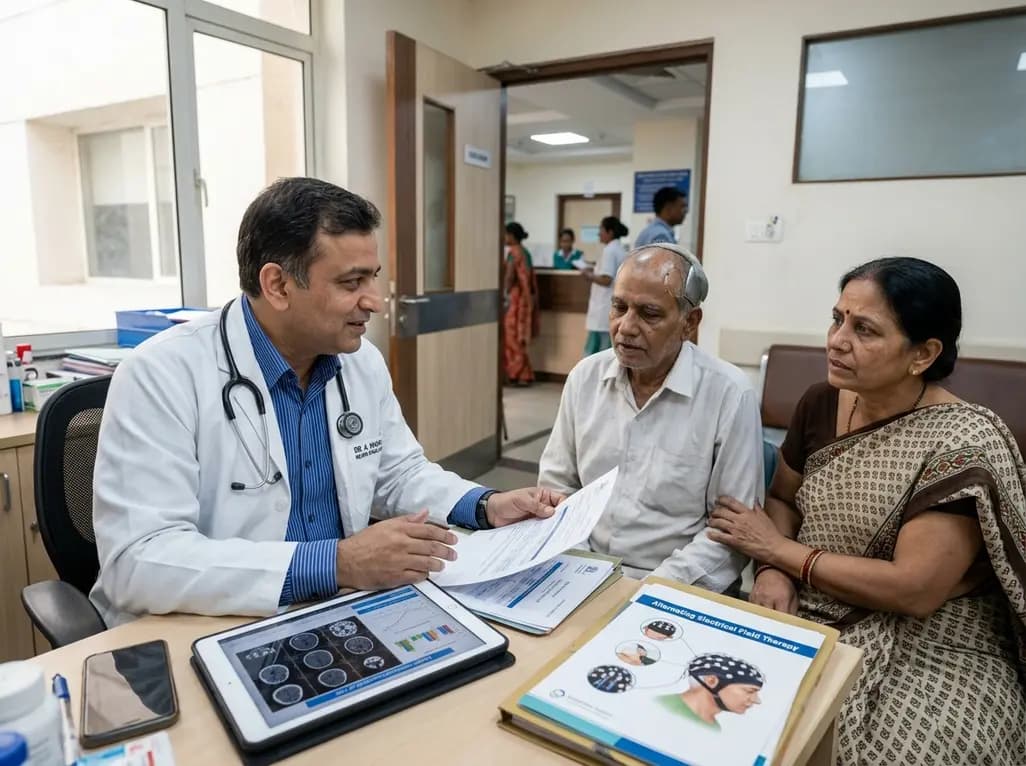
Managing aggressive primary brain malignancies demands a careful balance between prolonging survival and preserving functional independence. Clinicians increasingly encounter novel modalities designed to interrupt mitotic progression in glioblastoma. Specifically, alternating electrical field therapy has emerged as an adjunct alongside standard temozolomide chemoradiotherapy. While clinical trials establish survival advantages, oncologists must evaluate patient-reported outcomes in practical clinical settings. A prospective real-world multicenter study provides critical insights into health-related quality of life and caregiver stress during active treatment.
Historically, landmark clinical trials confirmed that alternating electrical field therapy extends progression-free and overall survival in newly diagnosed glioblastoma. However, prospective community-based data evaluating day-to-day patient tolerability remain limited. This prospective registry-based study followed adult patients diagnosed with WHO grade 4 astrocytoma across multiple neuro-oncology centers. Investigators compared patients receiving adjuvant electrical field therapy combined with temozolomide chemoradiotherapy against individuals receiving standard chemoradiotherapy alone. Consequently, the researchers tracked long-term functional status, symptom burden, and caregiver dynamics across serial follow-up intervals.
Standardized assessment instruments captured longitudinal outcomes at baseline and every three months. The investigators utilized the validated EORTC QLQ-C30 and brain-cancer-specific BN20 questionnaires alongside formal cognitive evaluations. Additionally, the team measured caregiver strain through the Caregiver Strain Index. The primary outcome evaluated global quality-of-life scores three months after completing initial radiation therapy. Because patients must wear transducer arrays for at least eighteen hours daily, assessing tangible quality-of-life adjustments offers vital guidance for shared decision-making.
The study reviewed eighty-eight adult participants, including forty-eight patients in the combination cohort and forty individuals in the conventional chemoradiotherapy group. Patients utilized the device for an average duration of ten months. At three months post-chemoradiotherapy, patients receiving alternating fields reported significantly lower global health scores compared to those receiving chemoradiotherapy alone. The mean global score reached 44 in the multimodal group versus 66 in the control arm. Therefore, the observed twenty-two-point decrement notably exceeded the established minimal clinically important difference of four to six points for high-grade gliomas.
Multivariable regression analysis further confirmed these clinical observations. Indeed, active device application independently correlated with lower odds of maintaining high global quality of life. Furthermore, a higher baseline Karnofsky Performance Scale score independently predicted lower odds of high global quality of life. Patients possessing higher functional baselines frequently experience substantial frustration when daily routine activities face technical interruption. Thus, early functional preservation does not automatically insulate patients from the physical burden imposed by intensive medical equipment.
Despite significant differences in global wellness scores, specific functional and physical domains told an encouragingly nuanced story. Cognitive functioning, emotional wellness, physical mobility, and social domains remained largely comparable between both study cohorts. In addition, systemic symptoms such as generalized fatigue, nausea, headache, and motor dysfunction showed similar prevalence across treatment arms. These findings demonstrate that electrical field delivery does not accelerate systemic neurocognitive deterioration or exacerbate core neurological symptoms.
Nevertheless, localized adverse reactions presented clear distinctions between the two patient groups. Patients applying scalp transducer arrays reported significantly higher rates of scalp pruritus and localized cutaneous inflammation. Continuous array adhesion, shaving demands, and warm environmental conditions frequently provoke contact dermatitis and localized folliculitis. Consequently, oncologists and clinical nurses must institute proactive dermatologic protocols. Utilizing topical corticosteroids, regular adhesive relocations, and skin barrier films can successfully alleviate cutaneous discomfort before skin breakdown disrupts daily compliance.
Caring for patients with high-grade diffuse gliomas creates tremendous psychological and physical strain. Family caregivers often manage medication schedules, transport logistics, and progressive cognitive decline. Surprisingly, this prospective trial demonstrated that caregiver stress scores remained stable across all assessment intervals. Average Caregiver Strain Index scores consistently remained below seven, indicating absence of severe caregiver burnout. Therefore, while device operation requires family vigilance, structured caregiver support and clinical education appear sufficient to prevent catastrophic caregiver fatigue.
Clinicians must interpret these findings within realistic clinical contexts. In hot or humid climates, sweat accumulation beneath transducer arrays increases skin fragility and elevates discomfort. Moreover, device transport backpacks impose noticeable ergonomic hurdles during initial adoption. However, proactive patient onboarding can substantially attenuate early psychosocial resistance. Dedicated nursing guidance helps patients navigate device routines effectively. Consequently, proactive troubleshooting preserves high adherence rates, which directly correlate with improved overall survival in grade 4 astrocytoma.
Integrating technical therapeutics into neuro-oncological management requires frank, transparent communication between clinicians, patients, and families. Physicians must explain potential short-term quality-of-life reductions without minimizing survival advantages. Because the primary decrement centers on global wellness rather than specific neurological loss, candid counseling helps align clinical expectations. Patients prepared for lifestyle adjustments generally report superior psychological coping mechanisms during maintenance phases.
Furthermore, multidisciplinary teams must personalize supportive interventions throughout treatment courses. Regular scalp inspections allow early detection of skin erosion, preventing involuntary therapy interruptions. Similarly, psychological counseling assists high-functioning patients in adapting to continuous wearable equipment. By balancing objective survival data with realistic health-related quality-of-life expectations, oncologists optimize overall therapeutic outcomes for individuals confronting aggressive intracranial malignancies.
Alternating electrical field therapy delivers low-intensity, intermediate-frequency electrical fields to the brain through transducer arrays placed directly on the scalp. These fields physically disrupt mitosis and organelle assembly in rapidly dividing cancer cells, ultimately suppressing malignant tumor progression while sparing quiescent neural structures.
Real-world prospective data indicate that patients frequently experience a measurable reduction in global quality-of-life scores during the first three months. However, specific functional subdomains, cognitive measures, and systemic neurological symptoms remain broadly stable compared to patients receiving conventional chemoradiotherapy alone.
No, prospective evaluations demonstrate that caregiver stress scores remain largely stable throughout therapy. While caregivers assist with array replacements and skin hygiene, formal caregiver strain index measurements generally remain below thresholds indicating severe emotional or physical burnout.
Disclaimer: This content is for informational and educational purposes only and does not constitute medical advice, diagnosis, or treatment. Healthcare professionals should exercise their independent clinical judgment. Refer to the latest local and national guidelines for clinical practice.
References
Wong DKK et al. Health-related quality-of-life of WHO grade 4 astrocytoma patients receiving alternating electrical field therapy: a prospective real-world multi-centre study. J Neurooncol. 2026 May 21. doi: 10.1007/s11060-026-05631-2. PMID: 42168436.
Stupp R, Taillibert S, Kanner A, et al. Effect of Tumor-Treating Fields Plus Temozolomide vs Temozolomide Alone on Progression-Free and Overall Survival in Patients With Glioblastoma: A Randomized Clinical Trial. JAMA. 2017;318(23):2306–2316.
Taphoorn MJB, Dirven L, Kanner AA, et al. Health-Related Quality of Life, Cognitive Functioning, and Symptom Burden of Patients With Newly Diagnosed Glioblastoma Treated With Tumor Treating Fields: A Randomised Clinical Trial. JAMA Oncol. 2018;4(8):1084–1093.

Read summarized clinical updates, watch expert medical content, and earn CME certifications right from your smartphone.
Open your smartphone camera to scan and install.





Explore new real-world evidence evaluating the impact of alternating electrical field therapy alongside standard chemoradiotherapy on health-related quality of life and caregiver stress in patients diagnosed with WHO grade 4 astrocytoma.
last month

Discover the crucial role of glymphatic dysfunction in stroke, where perivascular clearance failure and neuroinflammation exacerbate cerebral edema and post-stroke brain injury.
Today

A prenatal case highlights severe glutaric acidemia type II presenting as bilateral hyperechoic cystic kidneys at 18 weeks. Whole-exome sequencing revealed a novel homozygous ETFDH frameshift variant, demonstrating the power of rapid genetic testing in fetal renal anomalies.
Today

Review how tailored exercise programs benefit frail older patients with heart failure. Explore pathophysiological mechanisms, individualized training prescriptions, and strategies to overcome adherence barriers in clinical practice.
Yesterday

This comparative study evaluates posterior labral tears with and without glenohumeral instability, highlighting distinct demographic patterns, MRI underestimation in stable shoulders, and successful arthroscopic repair outcomes.
Yesterday

A clinical study demonstrates that early intervention with tocilizumab, either as monotherapy or bridged with corticosteroids, achieves significant proptosis reduction and resolves active inflammation in treatment-naive thyroid eye disease.
Yesterday
