.webp&w=384&q=75)

Loading, please wait...
Loading, please wait...
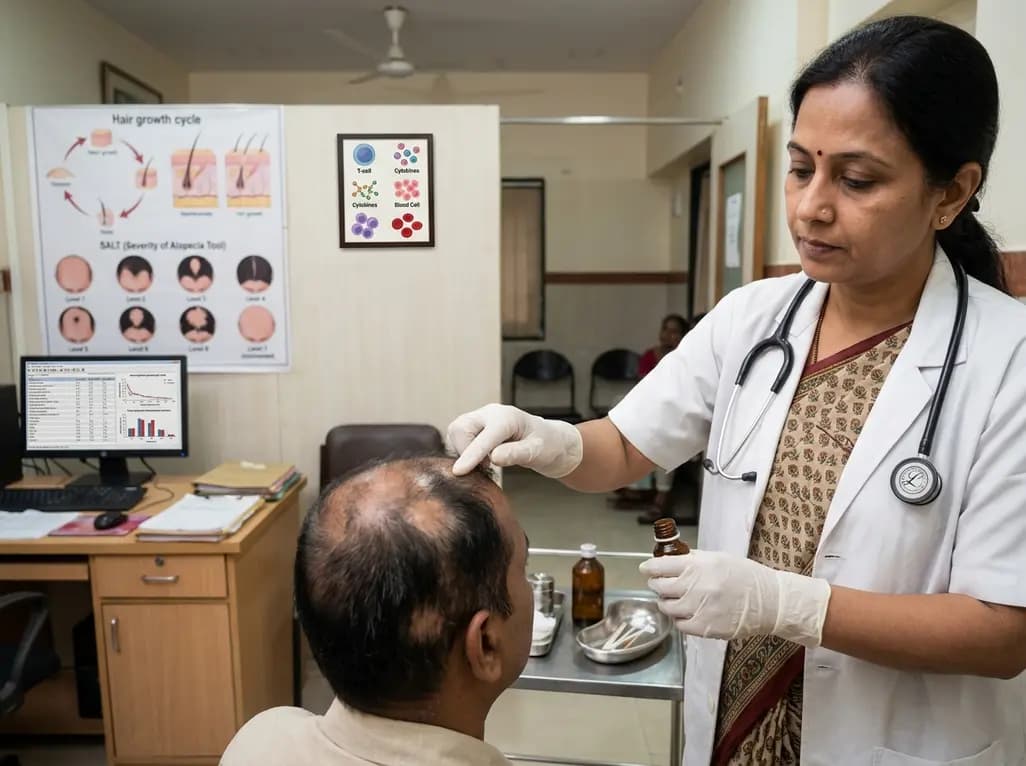
Alopecia areata represents a persistent, non-scarring autoimmune condition that damages hair follicles across the scalp and body. While traditionally viewed as a localized follicular disease, emerging clinical data indicate broader systemic immune involvement. Evaluating systemic parameters during alopecia areata DPCP treatment helps clinicians understand both dermatological recovery and underlying hematological shifts in real-world cohorts.
Dermatologists traditionally categorized alopecia areata as an organ-specific autoimmune disorder localized strictly to the hair follicle apparatus. However, modern immunologic research reveals that extensive hair loss often coincides with broader systemic inflammatory responses. Specifically, circulating immune cells and inflammatory mediators reflect an active autoimmune state that extends well beyond cutaneous tissues. When clinicians initiate alopecia areata DPCP treatment, topical immunotherapy triggers an intentional, mild allergic contact dermatitis. This antigenic stimulus redistributes perifollicular T lymphocytes and restores immune privilege around the hair bulbs. Furthermore, evaluating complete blood counts before and after therapy allows physicians to assess whether local contact immunotherapy influences systemic hematological markers. Understanding this systemic relationship is essential for clinicians who treat severe or recalcitrant forms of alopecia. Therefore, tracking peripheral inflammatory markers provides valuable objective insights into overall immune equilibrium during therapeutic interventions.
A recent exploratory retrospective study analyzed 38 patients aged four years and older who presented with moderate-to-severe alopecia areata. The cohort included an equal distribution of 19 male and 19 female patients treated between August 2023 and August 2024. Clinicians administered topical diphenylcyclopropenone according to standardized sensitization and weekly escalation protocols. In addition, the investigators conducted complete blood count evaluations at baseline and following six months of regular treatment. Disease severity was quantitatively measured using the Severity of Alopecia Tool, which calculates the exact percentage of scalp hair loss. At baseline, the mean Severity of Alopecia Tool score stood at 87.76 ± 21.80, reflecting severe disease burden across the cohort. Consequently, this study offered a comprehensive framework to evaluate both macroscopic hair regrowth and corresponding changes in hematological parameters during topical immunotherapy.
Topical diphenylcyclopropenone demonstrated robust clinical efficacy across the treated patient population over the six-month study period. Specifically, the mean Severity of Alopecia Tool score decreased significantly from 87.76 ± 21.80 at baseline to 60.21 ± 41.33 at Month 6. This marked reduction confirms that contact immunotherapy effectively stimulates follicular regeneration even in advanced alopecia areata cases. Moreover, several patients achieved dramatic clinical improvement, transitioning from widespread hair loss to cosmetically acceptable scalp coverage. Although therapeutic responses varied among individual participants, the overall reduction in disease severity underscores the potency of topical immunotherapy. Clinicians observed that consistent application maintained adequate scalp stimulation without causing intolerable local adverse effects. Thus, these findings reinforce diphenylcyclopropenone as a viable, highly effective modality for patients who have failed conventional topical or intralesional corticosteroid therapies.
Routine complete blood count parameters offer accessible biological insights into systemic inflammatory status in autoimmune dermatology. Researchers frequently examine neutrophil, lymphocyte, and platelet lineages to derive informative inflammatory ratios, including the neutrophil-to-lymphocyte ratio and platelet-to-lymphocyte ratio. In severe alopecia areata, elevated systemic inflammatory ratios often correlate with active follicular disruption and extensive disease burden. Furthermore, tracking these complete blood count alterations during therapy reveals how immunomodulatory agents influence circulating leukocyte dynamics. When patients experience therapeutic success, peripheral inflammatory indices frequently shift toward baseline physiological ranges. Consequently, hematological profiling serves as a practical, minimally invasive adjunct to visual severity scoring. In addition, assessing peripheral blood markers helps clinicians identify patients with persistent systemic inflammation who may require prolonged maintenance therapy or combined therapeutic regimens to maintain long-term remission.
These clinical findings carry significant practical implications for dermatologists and primary care physicians managing refractory alopecia areata. Because severe hair loss carries profound psychological distress, achieving objective clinical improvement is vital for enhancing patient quality of life. Clinicians should establish clear baseline documentation using standardized tools like the Severity of Alopecia Tool before initiating contact immunotherapy. Furthermore, performing baseline and follow-up complete blood counts provides a dual perspective on local follicular recovery and systemic inflammatory regulation. While newer targeted agents like Janus kinase inhibitors have expanded therapeutic options, diphenylcyclopropenone remains an accessible, cost-effective, and steroid-sparing modality. Therefore, clinicians practicing in diverse healthcare settings can successfully utilize contact immunotherapy protocols to manage severe cases. However, clinicians must carefully educate patients regarding treatment timelines, gradual concentration titration, and adherence.
Administering topical diphenylcyclopropenone requires meticulous concentration titration to balance therapeutic efficacy with patient comfort. The primary objective is to maintain low-grade, tolerable contact eczema without provoking severe vesicular reactions, severe pruritus, or extensive regional lymphadenopathy. Moreover, clinicians must protect patients from excessive light exposure immediately after application because diphenylcyclopropenone degrades rapidly under ultraviolet light. When patients achieve substantial hair regrowth, clinicians should gradually taper application frequency rather than discontinuing therapy abruptly. Consequently, structured maintenance protocols substantially reduce the risk of acute disease relapse. In summary, combining clinical severity scoring with routine hematological monitoring empowers clinicians to personalize immunotherapy regimens safely. Therefore, ongoing evaluation ensures optimal therapeutic efficacy while minimizing potential adverse reactions across diverse patient populations.
Diphenylcyclopropenone acts as a contact sensitizer to induce a controlled allergic contact dermatitis on the scalp. Consequently, this local antigenic competition diverts pathologically autoreactive T lymphocytes away from vulnerable hair follicles. Furthermore, the immunomodulatory reaction alters the follicular microenvironment and suppresses localized cytokine cascades. As a result, hair follicles exit the dystrophic telogen phase and successfully resume healthy anagen hair growth cycles over sustained treatment periods.
Complete blood count parameters provide objective insight into the underlying systemic inflammatory burden of alopecia areata. Clinicians frequently evaluate neutrophil, lymphocyte, and platelet dynamics to track subclinical systemic immune activation. Moreover, monitoring these hematological markers helps clinicians evaluate treatment response alongside clinical scores like SALT. Therefore, serial complete blood count analysis offers an accessible, cost-effective tool to gauge immune modulation during contact immunotherapy regimens.
Clinical outcomes depend on several critical baseline variables, including initial disease severity, duration of hair loss, and the subtype of alopecia. Specifically, patients with localized patchy alopecia areata often achieve higher regrowth rates than those with totalis or universalis variants. Additionally, initiating therapy early in the disease course and achieving prompt sensitization strongly predict positive therapeutic outcomes. Clinicians must adjust treatment concentrations carefully to sustain mild erythema.
Disclaimer: This content is for informational and educational purposes only and does not constitute medical advice, diagnosis, or treatment. Healthcare professionals should exercise their independent clinical judgment. Refer to the latest local and national guidelines for clinical practice.
References

Read summarized clinical updates, watch expert medical content, and earn CME certifications right from your smartphone.
Open your smartphone camera to scan and install.





A recent retrospective study reveals that topical diphenylcyclopropenone (DPCP) significantly reduces SALT scores in alopecia areata while modulating systemic inflammatory hematological markers, reinforcing the systemic nature of the disease and supporting targeted immunotherapy.
last month

According to WHO data, average lifespan reached 73.3 years in 2023, recovering from pandemic lows. However, healthy life expectancy lags at 62.8 years due to surging noncommunicable conditions like cardiovascular disease and dementia, demanding proactive primary screening and sustained chronic care.
Today

A nationwide South Korean study shows underreporting of smoking among women dropped from 57.4% to 36.4% between 2008 and 2021. However, over one-third of female smokers still conceal their habit, highlighting the critical role of cotinine verification in clinical risk assessment.
Today

Medical robotics is transitioning beyond operative suites into diagnostics, cardiology, and endocrinology. Explore how innovations in tele-robotics, AI integration, and nanomedicine are overcoming geographical barriers and transforming precision healthcare delivery across India's evolving disease landscape.
Today

A new study evaluates the rheological stability of decellularized peripheral nerve matrix hydrogels under varied storage conditions. Findings show -80°C storage and freeze-drying preserve gelation kinetics and mechanical stiffness, offering key insights for shipping and translational clinical applications.
Today

A qualitative meta-synthesis highlights the complex interplay between gender dysphoria, minority stress, and eating disorders in transgender and gender-diverse individuals. Clinicians must recognize these distinct drivers to offer supportive, gender-affirming, and interdisciplinary eating disorder care.
Today
