.webp&w=384&q=75)

Loading, please wait...
Loading, please wait...

Acute vertigo and sudden sensorineural hearing loss usually point toward common inner ear pathology. However, a rare vascular event known as an AICA dissection stroke can present with nearly identical symptoms. The anterior inferior cerebellar artery (AICA) supplies the inner ear, the lateral pons, and the cerebellum. Consequently, its disruption often mimics peripheral otological disorders like Meniere’s disease or vestibular neuritis. Notably, a recent case involved a 32-year-old woman who initially exhibited hearing loss and facial palsy. Although physicians first suspected a peripheral issue, detailed neurological testing revealed central instability and torsional nystagmus.
Identifying this condition remains difficult because initial vascular imaging often fails to show the lesion. For instance, magnetic resonance angiography (MRA) might appear normal in the early stages of an isolated dissection. Therefore, clinicians must maintain a high index of suspicion when neurological findings seem atypical or persistent. Furthermore, cerebellar infarction can occur without significant brainstem involvement, which further complicates the clinical picture. This isolated presentation makes the diagnosis particularly elusive. Consequently, serial vascular imaging, including digital subtraction angiography, serves as the gold standard for confirmation. Early intervention helps manage the stroke, although some deficits, like sensorineural hearing loss, may unfortunately become permanent despite treatment.
While both cause vertigo and hearing loss, this stroke often includes subtle neurological signs. These signs include facial nerve palsy, marked gait unsteadiness, or torsional nystagmus. Unlike benign peripheral disorders, these symptoms indicate central nervous system involvement that requires urgent neuroimaging.
Small arterial dissections may not significantly narrow the vessel lumen during the initial onset. Consequently, the vessel might appear patent on a standard MRA. If clinical suspicion remains high, doctors must perform follow-up imaging or more sensitive tests like CT angiography or catheter angiography to visualize the arterial wall properly.
In many documented cases, sensorineural hearing loss persists even when other symptoms like facial palsy and balance improve. This occurs because the cochlea is extremely sensitive to ischemic damage. Therefore, rapid diagnosis is essential to potentially limit the extent of the vascular territory affected by the infarction.
Disclaimer: This content is for informational and educational purposes only and does not constitute medical advice. Always seek the advice of a physician or other qualified health provider with any questions you may have regarding a medical condition. Refer to the latest local and national guidelines for clinical practice.
References
Nemoto S et al. Ischemic cerebellar infarction due to isolated anterior inferior cerebellar artery dissection mimicking peripheral otological symptoms: illustrative case. J Neurosurg Case Lessons. 2026 Apr 06. doi: undefined. PMID: 41941833.
Kim SH, Lee SH. Audiovestibular loss of a vascular cause. J Stroke. 2016;18(3):260-272. doi:10.5853/jos.2016.00931.
Lee H, Sohn SI, Jung DK, et al. Sudden deafness and anterior inferior cerebellar artery infarction. Stroke. 2002;33(12):2807-12. doi:10.1161/01.str.0000038644.20011.c0.

Read summarized clinical updates, watch expert medical content, and earn CME certifications right from your smartphone.
Open your smartphone camera to scan and install.





A rare case of AICA dissection illustrates how cerebellar strokes can mimic common inner ear disorders, requiring high clinical suspicion and advanced imagi...
6 months ago
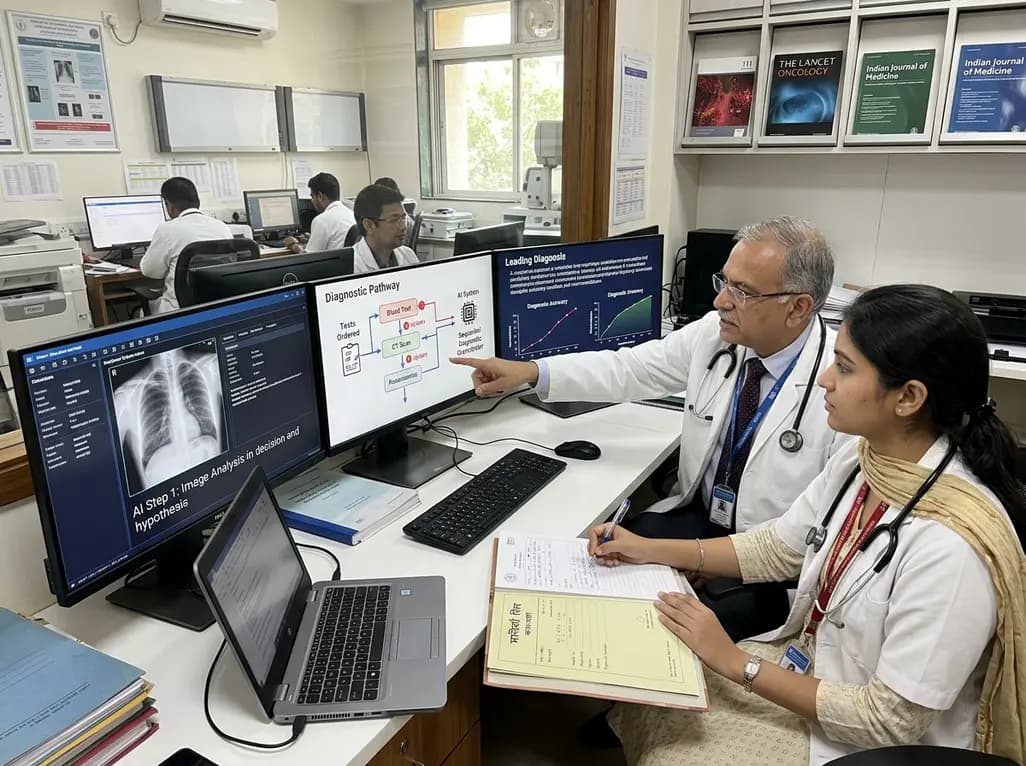
A breakthrough peer-reviewed study demonstrates that a sequential AI diagnosis system can mirror real-world clinical reasoning. By ordering stepwise tests and updating hypotheses dynamically, this multi-agent orchestrator achieved superior diagnostic accuracy while reducing investigative costs.
Today

A prenatal case highlights severe glutaric acidemia type II presenting as bilateral hyperechoic cystic kidneys at 18 weeks. Whole-exome sequencing revealed a novel homozygous ETFDH frameshift variant, demonstrating the power of rapid genetic testing in fetal renal anomalies.
Today

Review how tailored exercise programs benefit frail older patients with heart failure. Explore pathophysiological mechanisms, individualized training prescriptions, and strategies to overcome adherence barriers in clinical practice.
Yesterday

This comparative study evaluates posterior labral tears with and without glenohumeral instability, highlighting distinct demographic patterns, MRI underestimation in stable shoulders, and successful arthroscopic repair outcomes.
Yesterday

A clinical study demonstrates that early intervention with tocilizumab, either as monotherapy or bridged with corticosteroids, achieves significant proptosis reduction and resolves active inflammation in treatment-naive thyroid eye disease.
Yesterday
