.webp&w=384&q=75)

Loading, please wait...
Loading, please wait...

Preparing for the modern radiology oral board examination demands exceptional verbal synthesis and rapid clinical diagnostic reasoning. Historically, academic departments rely on senior faculty to run time-intensive mock viva voce encounters. However, severe staffing constraints and heavy clinical reporting workloads frequently restrict these interactive training opportunities. Consequently, radiology trainees often face high-stakes oral evaluations without sufficient verbal practice. Furthermore, the American Board of Radiology announced plans to transition its certifying examination to a virtual oral format by 2028. This upcoming systemic change accelerates the urgent demand for accessible, scalable simulation tools across academic medical institutions.
In response to this training gap, medical educators increasingly utilize conversational artificial intelligence to simulate realistic oral examinations. Standard written assessments measure factual recall effectively. Nevertheless, oral examinations test a candidate's capacity to communicate critical findings coherently under acute psychological stress. Because human faculty cannot deliver unlimited mock sessions, automated systems offer an ideal bridge. Therefore, voice-enabled platforms simulate authentic examiner interactions while eliminating logistical bottlenecks. Trainees can repeatedly articulate imaging observations, refine differentials, and recommend management protocols in a low-stakes environment.
To address faculty shortages, investigators engineered RadBoardsAI, a web-based platform tailored for verbal certifying examination practice. The development team integrated three complementary technologies into a seamless conversational loop. Specifically, the system utilizes the Whisper speech-to-text model for instantaneous, accurate voice transcription. Next, a deterministic GPT-4o engine processes resident statements and guides the clinical scenario according to authentic board rubrics. Finally, naturalistic text-to-speech synthesis delivers spoken feedback and follow-up prompts to the examinee in real time.
Importantly, developers incorporated strict deterministic examiner constraints into the language model to prevent uncontrolled algorithmic hallucinations. The platform hosts official sample cases from certifying boards, ensuring rigorous alignment with formal testing standards. Residents examine diagnostic imaging studies in their browser while verbally explaining their diagnostic impressions. Meanwhile, the AI examiner listens actively, probes candidate reasoning, and asks targeted questions when trainees miss key abnormalities. Additionally, this architecture replicates the realistic cadence of a senior radiologist. Consequently, learners experience authentic conversational pressure without encountering the scheduling conflicts inherent to human-proctored sessions.
An institutional review board-approved pilot feasibility investigation evaluated RadBoardsAI across multiple residency cohorts between May 2025 and June 2026. Radiology residents from postgraduate years two through five participated in simulated certifying sessions. Notably, baseline pre-intervention surveys revealed that 75% of participating trainees possessed zero prior mock oral examination experience. Furthermore, baseline evaluations documented low self-reported confidence at 2.57 on a five-point scale and low self-perceived preparedness at 2.14. Simultaneously, participants recorded moderate baseline examination stress levels averaging 3.14.
Following the intervention, post-simulation assessments demonstrated substantial, statistically meaningful psychological and educational improvements. Candidate confidence rose markedly to 3.50, representing a standardized mean difference of positive 0.95. Similarly, self-perceived preparedness climbed to 3.50, yielding a dramatic standardized mean difference of positive 1.51. Most impressively, participant stress dropped from 3.14 down to 1.50, achieving a massive standardized mean difference of negative 1.83. In addition, the platform scored a mean System Usability Scale rating of 70.0, categorizing user satisfaction as good. Qualitative participant feedback praised the realistic cadence while prioritizing image labeling and case expansion for future updates.
Traditional postgraduate medical training depends heavily upon apprenticeship models, where experienced attendings dedicate hours to personal viva voce instruction. However, modern academic radiology departments confront increasing clinical throughput demands, administrative burdens, and severe faculty shortages. As a result, academic programs struggle to schedule sufficient one-on-one mock oral examinations for every resident. This structural deficit disadvantages trainees who lack informal mentorship networks or attend community-based residency programs with fewer faculty subspecialists.
Fortunately, voice-driven artificial intelligence introduces unprecedented scalability into medical education. By assuming the repetitive mechanics of initial examination drill sessions, RadBoardsAI conserves valuable faculty capital. Instead of conducting elementary mock sessions, educators can focus their finite time on targeted remediation and nuanced clinical mentoring. Moreover, the simulator delivers standardized, objective evaluations that eliminate subjective examiner bias. Every candidate encounters equivalent pacing, consistent rubric criteria, and unbiased diagnostic prompts. Therefore, institutions can establish equitable training benchmarks across entire classes. Ultimately, adopting conversational artificial intelligence empowers residency programs to democratize examination preparation without escalating operational costs.
The findings from this pilot feasibility investigation carry tremendous practical relevance for radiology training programs across India. Indian postgraduates pursuing MD Radiodiagnosis, DNB Board certifications, and international credentials like the FRCR face rigorous viva voce assessments. In these high-pressure practical examinations, examiners evaluate candidate demeanor, rapid image recognition, systematic reporting, and communicative clarity. However, government medical colleges and busy private tertiary centers in India frequently face overwhelming patient volumes. Consequently, teaching faculty cannot routinely conduct individual oral board simulations for every postgraduate trainee.
Introducing interactive voice simulators into Indian departmental curricula could dramatically improve examination readiness and reduce pervasive academic anxiety. Trainees can practice describing complex neuroimaging cases, abdominal cross-sectional pathology, and musculoskeletal trauma on demand. Furthermore, conversational algorithms provide instantaneous, non-judgmental feedback, encouraging self-directed deliberate practice. Although developers must expand case libraries to encompass regional pathologies like tuberculosis and tropical infections, the core technology proves immediately viable. As national certifying bodies incorporate digital testing modalities, automated simulation tools will become indispensable educational assets. Ultimately, adopting AI-driven oral simulation strengthens diagnostic acumen, sharpens verbal communication, and enhances clinical decision-making.
Although RadBoardsAI demonstrates compelling feasibility, several technical limitations warrant careful refinement before widespread institutional deployment. For instance, the pilot study evaluated a modest cohort of residents, highlighting the necessity for larger multi-center validation trials. Furthermore, qualitative participant feedback emphasized the urgent need for enhanced image labeling and larger multi-modality case repositories. Residents frequently requested granular visual pointers to confirm whether the AI accurately recognized their anatomical observations during case presentations.
In addition, developers must continuously optimize speech-recognition accuracy for diverse clinical vocabularies and international accents. Medical terminology presents unique acoustic challenges, requiring domain-specific language models to prevent transcription misinterpretations. Moreover, future iterations should incorporate automated video feedback to evaluate candidate non-verbal communication, posture, and eye contact during virtual encounters. Integrating adaptive difficulty algorithms will also allow simulators to adjust case complexity based on real-time candidate proficiency. Addressing these technical opportunities will transform voice-driven AI platforms into robust, comprehensive training ecosystems for medical professionals worldwide.
The simulator combines real-time speech recognition, advanced language reasoning models, and voice synthesis to conduct natural conversations. As candidates speak, speech-to-text algorithms transcribe verbal observations instantaneously. Next, a deterministic language model evaluates the statements against clinical rubrics, asking relevant follow-up questions or requesting differentials. Finally, natural text-to-speech outputs realistic verbal prompts. This integrated sequence closely mimics the interactive cadence, diagnostic pressure, and critical inquiry of human examiners.
RadBoardsAI is designed to augment rather than completely replace experienced human faculty examiners. The platform provides continuous on-demand baseline practice, allowing residents to build foundational fluency, reduce anxiety, and rehearse reporting structures independently. Consequently, faculty members can conserve their limited time for higher-level case discussions, nuanced ethical guidance, and targeted remediation. Combining automated artificial intelligence simulations with faculty-led mock examinations creates an optimal, highly efficient hybrid medical education curriculum.
Indian radiology residents preparing for MD, DNB, or FRCR exams often face heavy clinical workloads that limit faculty-led viva practice. Voice-driven AI provides flexible, self-paced oral simulation without requiring faculty supervision. Residents can practice verbalizing differential diagnoses, articulating acute emergency findings, and structuring exam presentations around the clock. Furthermore, repeated exposure to simulated oral pressure substantially lowers exam anxiety, enhances spoken confidence, and standardizes preparation quality across institutions.
Disclaimer: This content is for informational and educational purposes only... Refer to the latest local and national guidelines for clinical practice.
References

Read summarized clinical updates, watch expert medical content, and earn CME certifications right from your smartphone.
Open your smartphone camera to scan and install.





RadBoardsAI, a novel voice-driven oral examination simulator, leverages Whisper, GPT-4o, and speech synthesis to prepare radiology residents for certifying exams. A pilot study demonstrates significant gains in candidate confidence and preparedness alongside dramatic stress reduction, addressing faculty constraints.
Today
A Global Burden of Disease 2021 analysis reveals an increasing incidence of NASH-associated hepatocellular carcinoma worldwide, particularly in high-SDI nations. As population aging and metabolic risks accelerate, clinicians must implement structured screening and early intervention protocols to curb liver mortality.
Today
A recent qualitative study evaluates institutional gaps across health, police, and justice sectors in supporting survivors of intimate partner violence. Healthcare providers must bridge procedural fragmentation with empathetic, trauma-informed care and cross-sector coordination to safeguard vulnerable patients.
Today
The Delhi High Court recently quashed an FSSAI order requiring beverage manufacturers to remove the term 'energy' from product labels without due process. This development brings renewed clinical focus to beverage terminology, consumer safety limits, cardiovascular strain, and youth dietary habits across India.
Today
A cross-sectional study reveals a strong positive correlation between problematic internet use and kinesiophobia in adults aged 18-45 with non-specific low back pain, highlighting how digital overuse reinforces movement fear and complicates musculoskeletal recovery.
Today
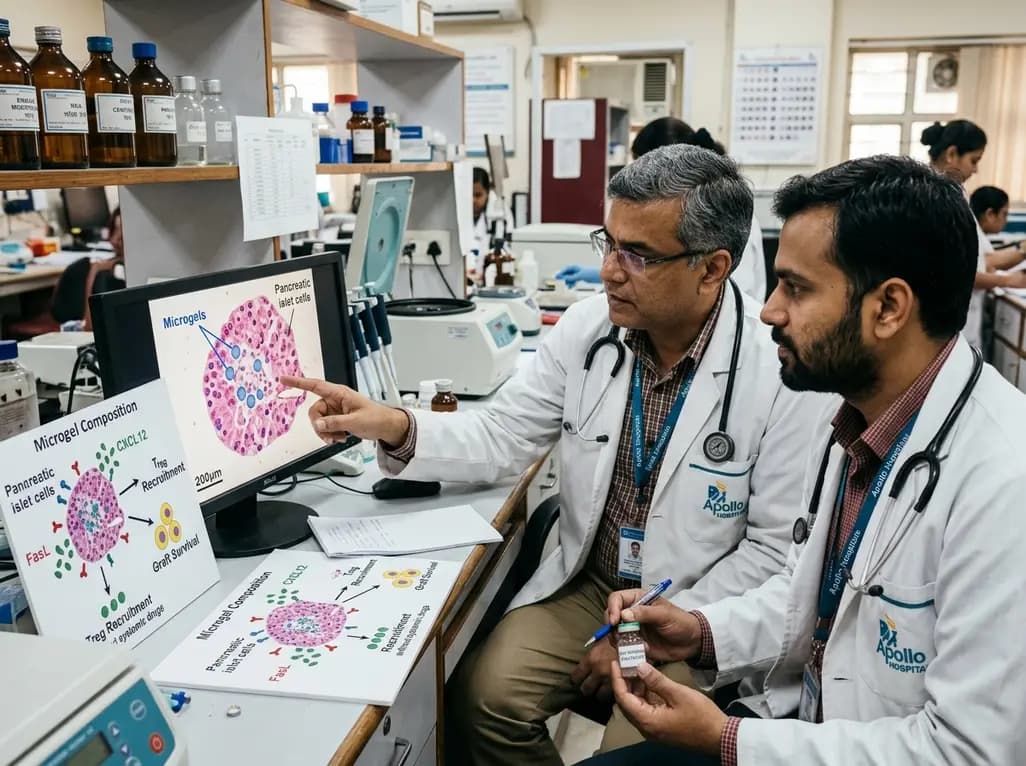
A novel microgel platform presenting FasL and protease-resistant CXCL12 enables sustained allogeneic islet survival and glycemic control without systemic immunosuppression, enhancing local Treg recruitment and graft revascularization.
Today
