.webp&w=384&q=75)

Loading, please wait...
Loading, please wait...
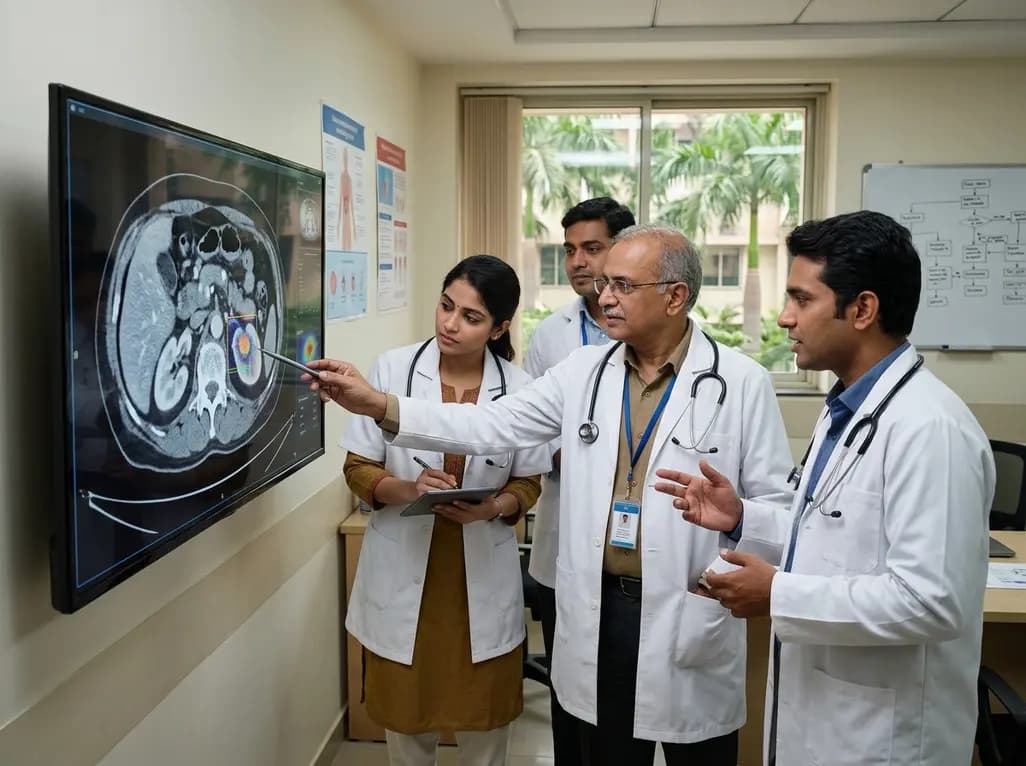
The incidental detection of small renal masses (SRMs) has surged with the widespread use of cross-sectional imaging. Consequently, clinicians face the daily challenge of distinguishing between benign, indolent, and aggressive lesions. Implementing **AI for renal masses** offers a promising solution to refine this classification accurately. A recent study evaluated the economic and clinical impact of artificial intelligence workflows compared to the standard of care (SOC).
The research utilized a Markov microsimulation model involving 10,000 patients aged 40-75. Investigators compared SOC against three innovative strategies: MRI + AI, CT + AI Model 1 (without image embeddings), and CT + AI Model 2 (with embeddings). Interestingly, the CT + AI Model 1 emerged as the most efficient strategy. It achieved the lowest total cost ($9,079.65) while delivering the highest quality-adjusted life years gained (8.8207). This model significantly outperformed the SOC, which had a higher cost of $10,601.23 and lower quality gains.
Moreover, the analysis indicated that AI-integrated workflows are resilient to pricing fluctuations. The imaging costs for CT + AI models could increase significantly while remaining cost-effective for health systems. Specifically, Model 2 was dominant in 28% of simulations, highlighting its potential utility in diverse clinical scenarios. These findings suggest that AI can streamline diagnostic workups and reduce the burden of unnecessary interventions for indolent masses.
As AI technology evolves, its integration into routine CT workflows could standardize the management of SRMs. Furthermore, these tools help identify patients who require aggressive treatment versus those suitable for active surveillance. Transitioning to AI-supported diagnostics may ultimately lead to significant healthcare savings. Physicians should stay informed about these emerging technologies to optimize patient care pathways in modern urology and radiology departments.
AI models analyze complex imaging patterns that may be subtle to the human eye. They help differentiate between benign and malignant tumors, which reduces unnecessary surgeries and invasive biopsies.
According to the research, certain CT + AI workflows are actually more cost-effective. They reduce overall healthcare spending by optimizing the diagnostic pathway and improving quality-adjusted life years for the patient.
Disclaimer: This content is for informational and educational purposes only and does not constitute medical advice. Always seek the advice of a qualified healthcare provider with any questions regarding a medical condition. Refer to the latest local and national guidelines for clinical practice.
References
Rich JM et al. Comparative effectiveness and cost-effectiveness of an artificial intelligence workflow for small renal mass diagnosis on computed tomography. Urol Pract. 2026 Jun 03. doi: 10.1097/UPJ.0000000000001031. PMID: 42234468.
Das CJ et al. Imaging Recommendations for Diagnosis, Staging, and Management of Renal Tumors. Indian J Med Paediatr Oncol. 2023;44:84-92.
Knudsen JE, Rich JM, Ma R. Artificial Intelligence in Pathomics and Genomics of Renal Cell Carcinoma. Urol Clin North Am. 2024;51(1):47-62.

Read summarized clinical updates, watch expert medical content, and earn CME certifications right from your smartphone.
Open your smartphone camera to scan and install.





A study shows that AI-integrated CT workflows for diagnosing small renal masses are more cost-effective and provide better patient outcomes than standard ca...
4 months ago

Novel diimide and hydrazone scaffolds, particularly compound #C4, synergistically reactivate latent HIV-1 when combined with JQ1 or PKC activators. Demonstrating donor-matched proviral transcription ex vivo and non-canonical signaling, these findings advance shock and kill strategies toward reservoir eradication.
Today

A cross-sectional study reveals that maternal RSV vaccination coverage reached only 43.7% in Argentina, with maternal vaccine knowledge being the sole independent predictor of uptake. Clinicians play a crucial role in eliminating informational and structural barriers to optimize infant health.
Today

Review how tailored exercise programs benefit frail older patients with heart failure. Explore pathophysiological mechanisms, individualized training prescriptions, and strategies to overcome adherence barriers in clinical practice.
Yesterday

This comparative study evaluates posterior labral tears with and without glenohumeral instability, highlighting distinct demographic patterns, MRI underestimation in stable shoulders, and successful arthroscopic repair outcomes.
Yesterday

A clinical study demonstrates that early intervention with tocilizumab, either as monotherapy or bridged with corticosteroids, achieves significant proptosis reduction and resolves active inflammation in treatment-naive thyroid eye disease.
Yesterday
