.webp&w=384&q=75)

Loading, please wait...
Loading, please wait...

Artificial intelligence is rapidly evolving across the globe. It offers a unique flexibility to the field of language translation within the healthcare sector. Countries like India and Australia face immense pressure to provide equitable care due to their linguistic diversity. Consequently, AI medical translation services are emerging as a vital adjunct to the existing translator framework. These tools help clinicians manage growing communication demands in regional and rural settings where professional interpreters are often scarce.
Research suggests that AI tools are effective for low-risk communication tasks. For instance, they can assist with appointment coordination or providing simple instructions to patients. However, experts warn against using them in high-stakes contexts. Tasks such as obtaining informed consent or discussing complex management plans require the nuance of a human professional. Furthermore, the risk of clinical error increases when AI translates non-European or digitally under-represented languages. Therefore, doctors must prioritize patient safety by maintaining strict human oversight during all automated translations.
In the Indian context, initiatives like the Bhashini project aim to break language barriers through digital means. These AI medical translation services could potentially integrate into platforms like e-Sanjeevani to support teleconsultations. Moreover, using AI for administrative workflows allows healthcare providers to focus more on direct patient care. Nevertheless, clinicians should remember that linguistic accuracy does not always equal patient comprehension. Cultural sensitivity and empathy remain the domain of the human medical professional.
No, AI is currently an adjunct rather than a replacement. It excels at low-risk, repetitive tasks but lacks the cultural nuance and emotional intelligence required for sensitive or high-stakes clinical discussions.
The main risks include clinical inaccuracies, loss of contextual meaning, and potential data privacy breaches. These issues are more prevalent when translating complex medical terminology or less common regional dialects.
Disclaimer: This content is for informational and educational purposes only. It does not constitute professional medical advice, diagnosis, or treatment. Always seek the advice of your physician or other qualified health provider with any questions you may have regarding a medical condition. Refer to the latest local and national guidelines for clinical practice.
References
Leslie O et al. 'Real time, real change': the role of artificial intelligence in providing real-time language translation services in regional medicine. Intern Med J. 2026 Apr 22. doi: 10.1111/imj.70446. PMID: 42019080.
Genovese et al. Artificial intelligence in clinical settings: a systematic review of its role in language translation and interpretation. J Med Syst. 2024;48(1):12.
Kong et al. Evaluating LLMs for medical discharge instructions: A multi-language accuracy study. Lancet Digit Health. 2025;7(2):e112-120.

Read summarized clinical updates, watch expert medical content, and earn CME certifications right from your smartphone.
Open your smartphone camera to scan and install.





AI is transforming healthcare communication through real-time translation, yet human oversight remains essential for high-stakes clinical tasks and safety....
6 months ago
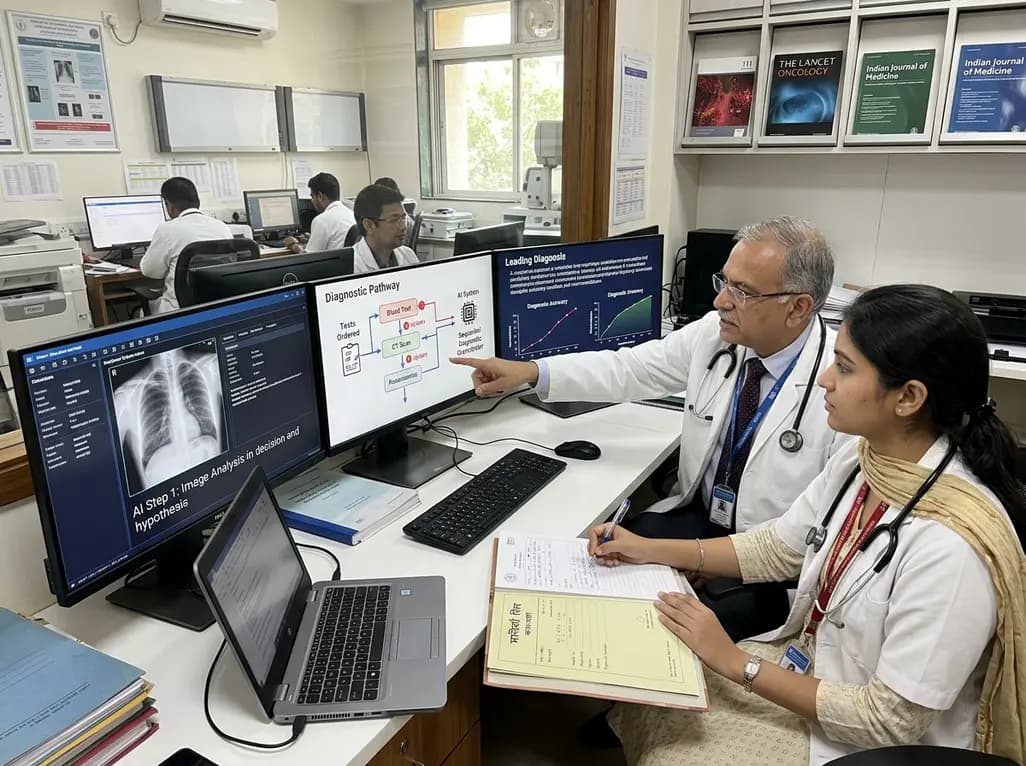
A breakthrough peer-reviewed study demonstrates that a sequential AI diagnosis system can mirror real-world clinical reasoning. By ordering stepwise tests and updating hypotheses dynamically, this multi-agent orchestrator achieved superior diagnostic accuracy while reducing investigative costs.
Today

A prenatal case highlights severe glutaric acidemia type II presenting as bilateral hyperechoic cystic kidneys at 18 weeks. Whole-exome sequencing revealed a novel homozygous ETFDH frameshift variant, demonstrating the power of rapid genetic testing in fetal renal anomalies.
Today

Review how tailored exercise programs benefit frail older patients with heart failure. Explore pathophysiological mechanisms, individualized training prescriptions, and strategies to overcome adherence barriers in clinical practice.
Yesterday

This comparative study evaluates posterior labral tears with and without glenohumeral instability, highlighting distinct demographic patterns, MRI underestimation in stable shoulders, and successful arthroscopic repair outcomes.
Yesterday

A clinical study demonstrates that early intervention with tocilizumab, either as monotherapy or bridged with corticosteroids, achieves significant proptosis reduction and resolves active inflammation in treatment-naive thyroid eye disease.
Yesterday
