.webp&w=384&q=75)

Loading, please wait...
Loading, please wait...

Pharmaceutical innovation often relies on complex patent filings. Today, AI Markush structure interpretation is becoming a vital tool for navigating these documents. Traditionally, Markush structures describe massive families of related chemical compounds using a single generic representation. However, their complexity often prevents easy machine reading. These structures frequently include non-machine-readable images, variable R-groups, and intricate dependency rules.
Modern researchers use large language models (LLMs) to parse claim text and identify variable definitions. Furthermore, vision-based tools translate structure images into machine-readable formats like SMILES or CXSMILES. Consequently, hybrid systems now align these different data streams for end-to-end interpretation. This progress helps pharmaceutical companies analyze competitor landscapes much faster than before.
Although these tools are powerful, they still face hurdles. For example, inconsistent drafting conventions and nested dependencies can lead to errors. Therefore, current workflows prioritize decision support rather than final legal advice. Moreover, experts believe that transparent benchmarks will further improve these AI models in the coming years.
A Markush structure is a symbolic shorthand used in patents to claim a large family of related chemical compounds. Instead of listing every single molecule, it uses a core scaffold with variable R-groups to cover millions of potential variants.
AI improves the process by using natural language processing to extract definitions from text and computer vision to convert chemical drawings into machine-readable data. These tools help researchers quickly identify if a specific compound falls under an existing patent.
Disclaimer: This content is for informational and educational purposes only. It does not constitute legal or professional medical advice. Readers should consult with intellectual property experts for patent analysis. Refer to the latest local and national guidelines for clinical practice.
References
Hayes JMU et al. AI-assisted interpretation of Markush structures in pharmaceutical patents: a review of emerging tools, datasets, and challenges. J Cheminform. 2026 Apr 03. doi: 10.1186/s13321-026-01172-y. PMID: 41933423.
Shi Y et al. Intelligent System for Automated Molecular Patent Infringement Assessment. arXiv:2501.03456 [cs.LG]. 2025 Jan 13.
Maldanis R. Decoding Molecules: The importance of substructure and Markush research for IP innovations. Nerac. 2025 May 16.

Read summarized clinical updates, watch expert medical content, and earn CME certifications right from your smartphone.
Open your smartphone camera to scan and install.





Explore how AI tools are revolutionizing the interpretation of complex Markush structures in pharmaceutical patents to accelerate drug discovery and analysi...
6 months ago
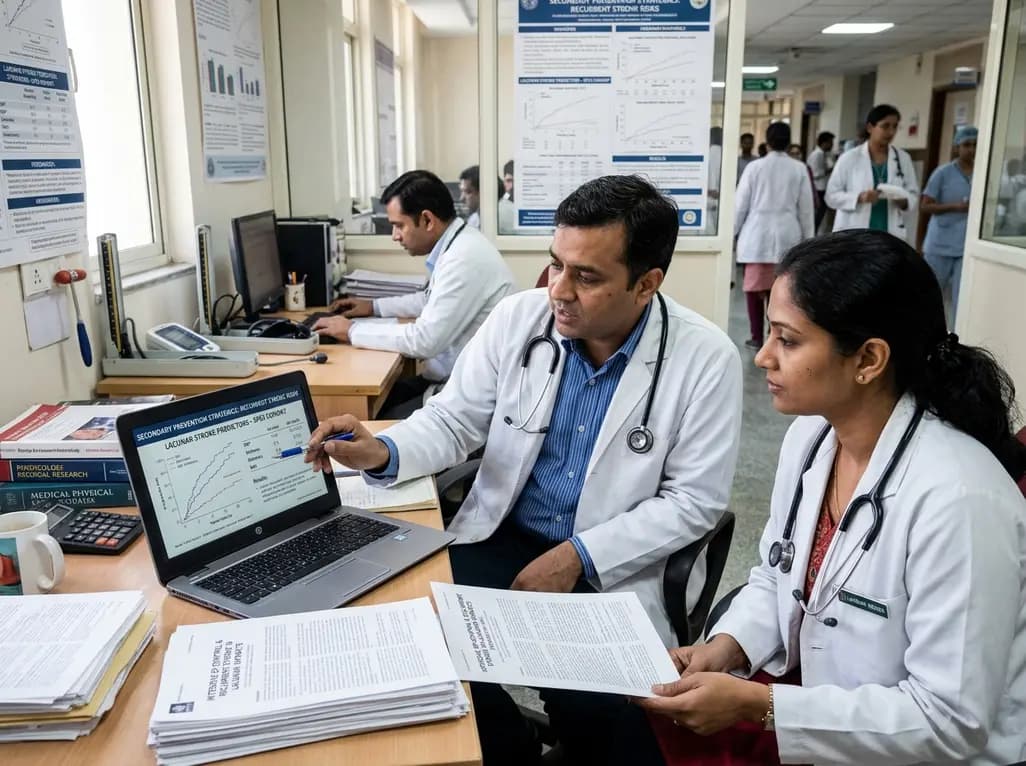
Explore vital recurrent stroke predictors in lacunar stroke patients managed with intensive blood pressure lowering. This analysis examines trial findings from SPS3 to uncover residual vascular risks, metabolic factors, and targeted secondary prevention strategies for high-risk neurological patients.
Today

A comprehensive scoping review synthesises evidence linking prenatal maternal mental health to long-term offspring neurodevelopment, evaluating neuroendocrine, inflammatory, and epigenetic pathways while highlighting clinical screening and future research priorities.
Today

The Directorate General of Health Services directs Indian states to halt the hazardous reuse and reprocessing of single-use medical devices. Discover regulatory implications under the Drugs and Cosmetics Act, critical infection risks, legal liabilities, and operational changes required across clinical specialties.
Today
Mitochondria-targeted nanoparticles self-assembled from EGCG and L-glutamic acid effectively restore mitochondrial homeostasis, suppress synovial inflammation, and attenuate chondrocyte senescence in osteoarthritis, offering a promising disease-modifying nanotherapy.
Today

India is advancing preventive healthcare by integrating genomics, artificial intelligence, and quantum technologies. With the SANGAM programme sequencing one million Indian genomes, clinicians can unlock personalized therapies, detect cardiometabolic risks early, and curb the burden of diabetes and heart disease.
Today
