.webp&w=384&q=75)

Loading, please wait...
Loading, please wait...
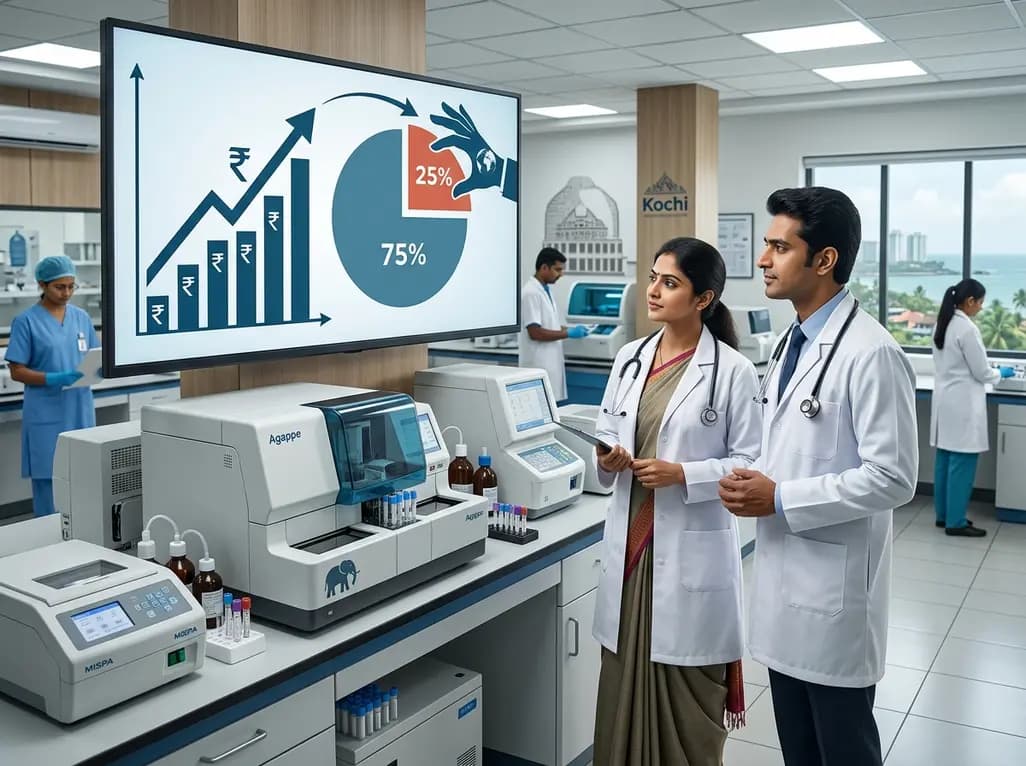
The Indian medical technology landscape is experiencing unprecedented growth, driven by rising clinical demands and increased local manufacturing efforts. Recently, prominent global investment entities have initiated talks surrounding Agappe Diagnostics private equity opportunities. Specifically, firms like Warburg Pincus, Bain Capital, and CVC Capital are exploring a stake purchase in the Kochi-headquartered diagnostics player.
Currently, multinational corporations dominate the Indian in-vitro diagnostics market. For instance, global giants like Roche, Beckman Coulter, and Siemens Healthcare command a massive market share. However, homegrown companies are rapidly climbing the ladder and challenging this dominance. Specifically, Kochi-based Agappe Diagnostics has established a solid foothold in clinical chemistry and hematology. Additionally, local players like Transasia Bio-Medicals, Trivitron Healthcare, and Meril Life Sciences are expanding their portfolios. Consequently, this domestic competition benefits laboratories by offering cost-effective and highly reliable testing equipment. Furthermore, the rising volume of diagnostic testing across the country fuels this market expansion. As a result, healthcare spending in India continues to rise, attracting substantial foreign direct investment. Doctors must closely monitor these trends, as local manufacturing reduces import reliance. Consequently, a stronger domestic market ensures that clinics can access advanced diagnostic tools at lower prices. Ultimately, this shift elevates patient care standards in both urban and rural clinics. Moreover, local companies can customize diagnostic solutions to match specific regional pathology profiles.
The proposed transaction involving Agappe Diagnostics highlights the intense private equity interest in India's medical technology sector. According to market sources, the deal could value the company at up to ₹3,200 crore. Additionally, the transaction will likely involve both a secondary sale by existing investors and a primary capital infusion. Specifically, Mauritius-based Sycamore Holdings, managed by Konark Capital Partners, owns about 20% of the firm. Because they acquired this stake in 2015 for just ₹50 crore, they will realize substantial returns. Meanwhile, the promoter Thomas John and his family hold the remaining equity. Therefore, the fresh primary capital will allow Agappe to expand its manufacturing facilities and enhance research capabilities. Furthermore, global investment groups like Warburg Pincus and Bain Capital are aggressively looking for high-growth healthcare platforms. Historically, these firms have a proven track record of scaling healthcare businesses across emerging markets. Consequently, their involvement would provide Agappe with significant strategic guidance and expanded international market networks. Ultimately, this capital injection will accelerate the development of next-generation diagnostic analyzers for laboratories globally.
Founded in 1994, Agappe Diagnostics has built a strong reputation for manufacturing reagents and equipment. Specifically, the company supplies clinical chemistry, hematology, and immunochemistry products to over 70,000 laboratories worldwide. For instance, their Mispa brand includes highly efficient systems such as the Mispa Chem DX. This particular device offers a compact dry-chemistry biochemistry analyzer designed for rapid testing. Additionally, the Mispa Revo Plus serves as a portable immununoassay analyzer. Doctors frequently rely on this system for critical thyroid, fertility, and cardiac marker testing. Furthermore, the company manufactures the Mispa Hx35, which is a three-part complete blood count hematology analyzer. Consequently, these instruments allow smaller laboratories to perform high-quality testing locally. Meanwhile, Agappe continues to expand its global reach through its Switzerland-based subsidiary. This international presence helps the firm adopt global quality standards and bring them to Indian clinics. Therefore, clinicians can expect improved accuracy and faster turnaround times from these locally produced analyzers. Ultimately, these technological advancements empower healthcare providers to make quick and precise clinical decisions.
Apart from its proprietary product lines, Agappe plays a crucial role as an exclusive distributor. Specifically, the company partners with prominent global medical technology corporations to distribute equipment in India. For example, they represent Japan's Toshiba, China's Mindray, and South Korea's i-SENS. Consequently, this distribution network gives Indian laboratories direct access to cutting-edge foreign technologies. Moreover, these partnerships allow Agappe to understand global engineering standards and incorporate them into their own designs. Additionally, the company operates a wholly owned subsidiary in Switzerland to facilitate international business. Currently, Agappe exports its products to more than 90 countries worldwide. Therefore, this dual strategy of local manufacturing and global distribution strengthens their market position. Furthermore, the company reported solid financial health in recent years, demonstrating stable growth. Specifically, they clocked a revenue of 61 million dollars in the fiscal year 2025. Subsequently, analysts expect the company to achieve even higher revenues by the fiscal year 2027. This financial stability reassures clinical clients that Agappe will provide long-term product support and maintenance.
When private equity firms inject capital into medical device companies, the benefits trickle down to patients. Specifically, increased funding accelerates research and development, leading to more accurate diagnostic tests. For instance, advanced immunochemistry assays can detect cardiac markers and hormonal imbalances much earlier. Consequently, clinicians can initiate targeted treatment protocols, significantly improving patient outcomes. Additionally, capital infusions allow manufacturers to scale production and lower unit costs. As a result, diagnostic laboratories can offer testing panels at more affordable prices to patients. Furthermore, local production reduces the waiting time for replacement parts and reagent shipments. In contrast, clinics relying solely on imported systems often face major operational delays during supply chain disruptions. Therefore, a robust domestic diagnostic manufacturing ecosystem enhances national healthcare security. Ultimately, this investment trend supports the government's push for local medical device manufacturing. Medical professionals should welcome these financial investments, as they directly elevate the quality of clinical diagnostics across India.
Q1: Which global private equity firms are looking to invest in Agappe Diagnostics?
Several prominent global private equity firms, including Warburg Pincus, Bain Capital, TA Associates, and CVC Capital, are in early talks. These investment giants aim to acquire approximately a 25% stake in the Kochi-based diagnostics company. This transaction will likely combine a secondary sale by existing investors with a fresh primary capital infusion, valuing the firm at over three thousand crore rupees.
Q2: What specific diagnostic equipment and products does Agappe Diagnostics manufacture?
Agappe Diagnostics develops and manufactures a wide range of diagnostic reagents and equipment under the Mispa brand. Their key products include the Mispa Chem DX, which is a compact dry-chemistry biochemistry analyzer. They also manufacture the Mispa Revo Plus for immunochemistry testing and the Mispa Hx35 for complete blood count hematology. These devices support laboratories in performing critical clinical testing worldwide.
Q3: How does Agappe Diagnostics distribute international medical technologies in India?
Agappe Diagnostics acts as the exclusive Indian distributor for several leading global medical technology companies. Specifically, they partner with Japan's Toshiba, China's Mindray, and South Korea's i-SENS. These partnerships enable Agappe to supply advanced international clinical chemistry and hematology systems directly to Indian laboratories. Consequently, this distribution network enhances the availability of advanced medical tools across the country.
Disclaimer: This content is for informational and educational purposes only. It does not constitute medical advice or replace professional judgment. Refer to the latest local and national guidelines for clinical practice.
References

Read summarized clinical updates, watch expert medical content, and earn CME certifications right from your smartphone.
Open your smartphone camera to scan and install.





India's in-vitro diagnostics sector is witnessing a surge in investor interest. Prominent global private equity firms are in early-stage talks to acquire a 25% stake in Kochi-based Agappe Diagnostics. This strategic transaction highlights the rapid growth and massive potential of India's medical technology landscape.
3 months ago

Review how tailored exercise programs benefit frail older patients with heart failure. Explore pathophysiological mechanisms, individualized training prescriptions, and strategies to overcome adherence barriers in clinical practice.
Today

Recent clinical studies reveal maternal autoantibodies targeting IL-1RA as potential triggers for preterm labor, opening avenues for targeted cytokine therapies. Concurrently, new perioperative findings show inhaled cannabis increases propofol requirements during upper endoscopy compared to oral edible consumption.
Today

In high-risk pulmonary embolism complicated by severe anemia and active uterine bleeding, systemic thrombolysis is contraindicated. Large-bore aspiration thrombectomy provides rapid hemodynamic rescue without fibrinolysis, supported by inferior vena cava filter placement and multidisciplinary critical care.
Today

This comparative study evaluates posterior labral tears with and without glenohumeral instability, highlighting distinct demographic patterns, MRI underestimation in stable shoulders, and successful arthroscopic repair outcomes.
Today

A clinical study demonstrates that early intervention with tocilizumab, either as monotherapy or bridged with corticosteroids, achieves significant proptosis reduction and resolves active inflammation in treatment-naive thyroid eye disease.
Today
