

Loading, please wait...
Loading, please wait...

Modern emergency departments face severe diagnostic challenges when managing poisoned patients because clandestine laboratories produce novel synthetic molecules constantly. Consequently, traditional drug screening panels fail to identify these elusive designer agents. Clinicians frequently encounter severe toxidromes in patients who test negative on standard immunoassay screens. Therefore, robust new psychoactive substances detection has become an indispensable clinical and forensic priority. Toxicologists classify these compounds into diverse categories, including synthetic cannabinoids, synthetic cathinones, novel synthetic opioids, and designer benzodiazepines. Because illicit chemists continually alter chemical side chains, these drugs successfully bypass national legal schedules and commercial drug tests. Furthermore, these substances often display unpredictable pharmacodynamics and extreme biological potency. For example, novel nitazene opioids and fentanyl analogs trigger severe respiratory arrest at microgram doses. Clinicians must recognize that a negative standard immunoassay does not exclude life-threatening recreational drug poisoning. Instead, acute patient management requires immediate physiological stabilization alongside specialized reference laboratory testing. As a result, critical care physicians and toxicologists demand agile analytical strategies to uncover emergent toxins rapidly. Without prompt analytical confirmation, physicians struggle to correlate unexpected organ failure with specific chemical exposures.
Analytical success in toxicological laboratories depends fundamentally on effective sample clean-up before instrumental evaluation. Biological matrices such as whole blood, plasma, urine, and oral fluid present extensive analytical challenges. Endogenous proteins, lipids, and cellular debris frequently cause severe ion suppression during mass spectrometric ionization. Consequently, toxicologists must select extraction protocols that isolate trace drug concentrations while removing troublesome interferents. Solid-phase extraction and supported liquid extraction represent the most reliable methods for isolating synthetic cathinones and opioids from whole blood. In addition, simplified protein precipitation techniques offer rapid processing during clinical emergencies, although they often leave residual matrix components. Furthermore, synthetic cannabinoids display high lipophilicity, which causes them to adhere tightly to collection tubes and cellular membranes. Therefore, analytical scientists must optimize extraction solvents and pH conditions to maximize analyte recovery. Recent comparative studies confirm that mixed-mode polymeric sorbents achieve superior extraction efficiency across chemically diverse drug classes. Ultimately, meticulous sample clean-up protects high-end instruments, reduces chemical background noise, and prevents false-negative interpretations. Moreover, laboratories must validate each extraction protocol across authentic patient specimens to guarantee reproducible analytical recoveries.
Liquid chromatography coupled with tandem mass spectrometry remains the gold standard for targeted toxicological confirmation. Triple quadrupole instruments operate through selected reaction monitoring, which yields outstanding analytical sensitivity and quantitative precision. Consequently, laboratories utilize targeted workflows when testing for established designer benzodiazepines, cathinones, and synthetic opioids. These targeted platforms reliably quantify nanogram-per-milliliter concentrations in serum and urine samples. Furthermore, chromatographic separation distinguishes structural isomers that possess identical molecular formulas and nominal masses. For example, distinct cathinone isomers generate unique chromatographic retention times and characteristic fragment ions under collision-induced dissociation. However, targeted assays suffer from an inherent, critical limitation: they only identify compounds programmed into the acquisition method. When illicit manufacturers synthesize completely novel chemical modifications, targeted triple quadrupole instruments overlook them entirely. Therefore, clinical laboratories must frequently acquire newly certified chemical reference materials to update their quantitative libraries. In addition, toxicologists must re-optimize instrumental parameters whenever clandestine chemists alter the chemical market. Thus, toxicology teams must balance routine quantitative throughput with broader screening methods to detect uncataloged synthetic derivatives.
To overcome the blind spots of targeted assays, modern toxicological facilities increasingly adopt high-resolution mass spectrometry. Quadrupole time-of-flight and Orbitrap analyzers measure exact masses with sub-ppm mass accuracy. Consequently, these high-resolution systems elucidate elemental compositions without requiring pre-existing compound tune files. Toxicologists routinely perform both non-targeted screening and data-independent acquisitions to capture comprehensive spectral footprints. Furthermore, high-resolution instruments record comprehensive full-scan fragmentation data across every chemical entity in the biological extract. This powerful technical capability allows laboratories to perform retrospective data mining months after initial patient discharge. For instance, when international agencies report a newly identified nitazene analog, toxicologists re-evaluate historical spectral datasets without re-extracting original biological specimens. However, untargeted screening presents substantial computational bottlenecks. Data analysis requires massive reference spectral libraries, automated deconvolution algorithms, and extensive manual expert review to prevent erroneous library matches. Moreover, high-resolution platforms involve elevated equipment costs and demand highly skilled analytical personnel. Therefore, leading toxicology laboratories now prioritize hybrid workflows to ensure immediate toxicological confirmation alongside long-term epidemiological vigilance. Such coordinated workflows produce defensible analytical outcomes.
Accurate interpretation of toxicological findings requires a deep understanding of human metabolic pathways. Many parent psychoactive molecules undergo rapid and extensive hepatic biotransformation following human consumption. For example, the liver rapidly metabolizes synthetic cannabinoids into hydroxylated, carboxylated, and glucuronidated compounds. Consequently, toxicologists rarely detect parent cannabinoid molecules in routine urine samples. Clinical analysts must therefore designate prominent metabolites as primary analytical targets rather than hunting for parent drugs alone. Furthermore, analyte stability significantly influences interpretive accuracy during post-analytical evaluation. Synthetic cathinones degrade rapidly in non-acidified blood specimens stored at room temperature. In addition, chemical degradation produces secondary artifacts that mimic novel illicit variants, leading to diagnostic confusion. Toxicologists must establish strict specimen storage conditions and utilize stabilizing preservatives like sodium fluoride immediately upon blood collection. Similarly, clinicians must interpret quantitative drug concentrations cautiously because tolerance, poly-substance ingestion, and individual metabolic genetics dramatically alter clinical toxicity. Ultimately, scientifically defensible toxicological interpretation demands seamless integration between instrumental data, metabolic pharmacokinetics, and clinical presentations. Accordingly, hospital toxicologists and emergency specialists must maintain active dialogue to align laboratory confirmations with observed patient toxidromes.
Routine hospital drug screens rely on commercial immunoassay technologies calibrated specifically for conventional drugs like morphine, amphetamine, and cannabis. Because novel psychoactive substances feature distinct chemical modifications, immunoassay antibodies exhibit minimal cross-reactivity with these designer molecules. Consequently, tests yield deceptive false-negative results despite severe clinical toxicity. Clinicians must request confirmatory mass spectrometry whenever unexplained, severe toxidromes occur in emergency settings.
Whole blood and plasma provide the most clinically relevant matrices because circulating drug concentrations directly reflect acute pharmacological effects and active toxicity. Conversely, urine offers a wider detection window but primarily contains drug metabolites rather than parent compounds. For unstable drugs like synthetic cathinones, toxicologists recommend analyzing chilled whole blood preserved with sodium fluoride. Combining blood and urine analysis maximizes diagnostic certainty.
High-resolution mass spectrometry identifies unknown toxic molecules by measuring exact atomic masses and unique fragmentation patterns without requiring prior reference standards. This powerful capability allows toxicologists to rapidly characterize newly synthesized analogs during sudden overdose outbreaks. Furthermore, laboratories archive digital spectral files permanently. Consequently, clinicians and forensic pathologists can retrospectively re-analyze existing patient data whenever new designer compounds emerge, identifying uncataloged epidemic threats.
Disclaimer: This content is for informational and educational purposes only and does not constitute medical advice, diagnosis, or treatment. Healthcare professionals should rely on their clinical judgment and verify analytical protocols against current professional guidelines. The views expressed do not necessarily reflect the official policy or position of any affiliated organizations. Refer to the latest local and national guidelines for clinical practice.
References

Read summarized clinical updates, watch expert medical content, and earn CME certifications right from your smartphone.
Open your smartphone camera to scan and install.





A comprehensive review analyzes sample preparation and analytical workflows for new psychoactive substances detection. Learn how forensic and clinical laboratories tackle synthetic opioids, cathinones, and designer benzodiazepines using tandem and high-resolution mass spectrometry.
Today

A landmark study evaluates artificial intelligence models and prompting strategies in qualitative lupus pregnancy research, revealing that few-shot prompting in advanced LLMs reliably captures maternal experiences, clinical anxieties, and perinatal outcomes across diverse languages.
Today
A landmark study demonstrates that transarterial CTA using transbrachial catheterization reduces contrast volume to ~31 mL, eliminating contrast-induced acute kidney injury in CKD patients undergoing EVAR while maintaining diagnostic image attenuation and procedural safety.
Today

A recent single-institution analysis identifies advanced patient age and progressive systemic disease as primary negative prognostic factors for five-year survival in chondrosarcoma, underscoring the urgent necessity of precise risk stratification, clear surgical margins, and dedicated oncologic follow-up.
Today
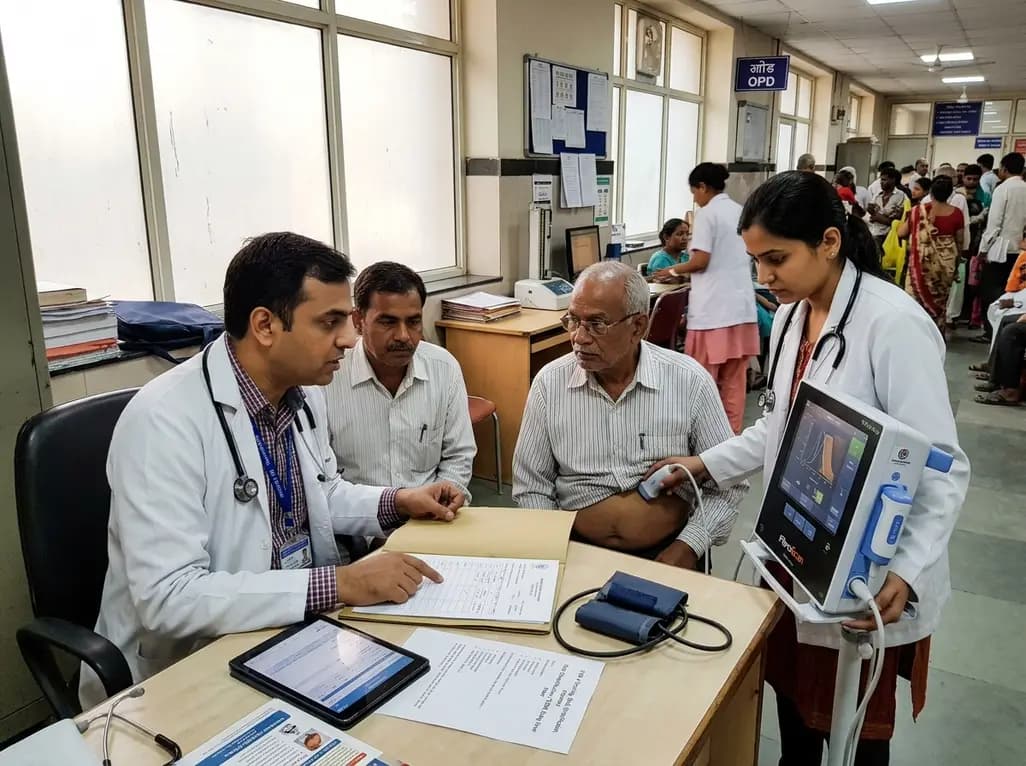
Metabolic dysfunction-associated steatotic liver disease affects nearly 70% of Indian adults with type 2 diabetes. Implementing systematic risk stratification with FIB-4 scoring, transient elastography, and patient-centric digital engagement transforms early detection into sustainable, long-term clinical care.
Today
