.webp&w=384&q=75)

Loading, please wait...
Loading, please wait...
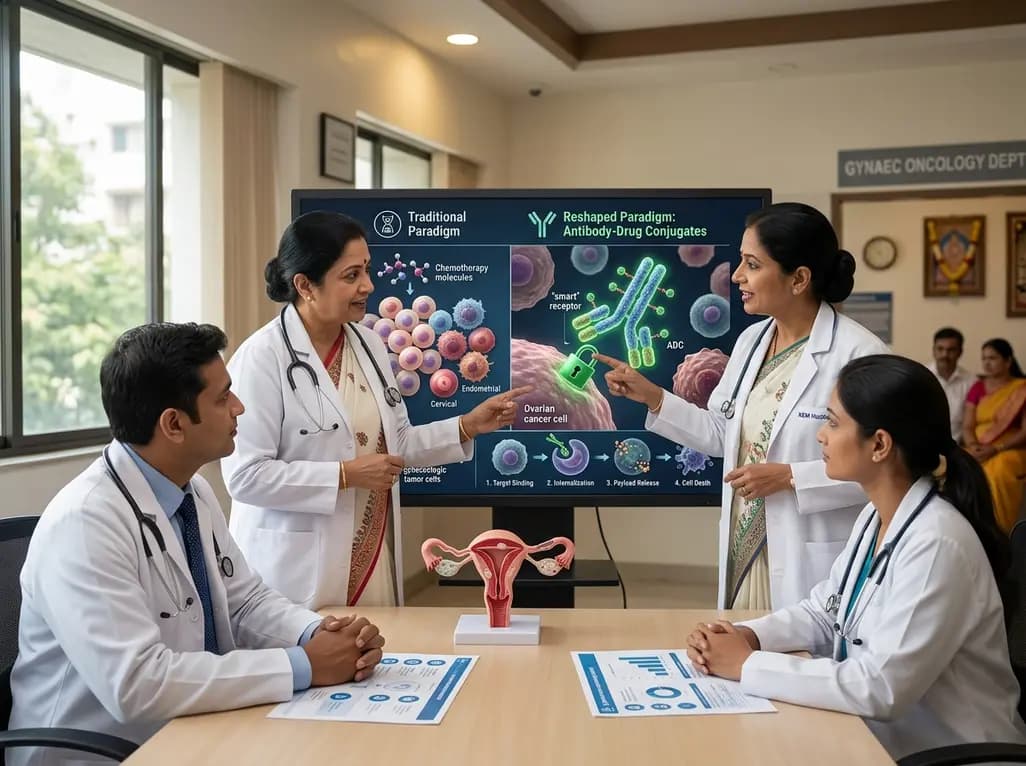
Antibody-drug conjugates (ADCs) have transformed the management of advanced gynecologic malignancies. These innovative agents link potent cytotoxic drugs to monoclonal antibodies. Consequently, ADCs in gynecologic cancers provide a precise way to kill tumor cells while sparing healthy tissue. This targeted mechanism of action significantly improves the therapeutic index for patients with recurrent disease. Therefore, oncology specialists view these agents as a cornerstone of modern precision medicine.
Furthermore, recent clinical trials highlight the efficacy of agents targeting folate-receptor alpha (FRα), human epidermal growth factor receptor 2 (HER2), and tissue factor (TF). For instance, mirvetuximab soravtansine has shown impressive survival benefits in platinum-resistant ovarian cancer. Additionally, tisotumab vedotin serves as a vital option for metastatic cervical cancer. Therefore, medical professionals must stay informed about these emerging therapies to optimize patient outcomes. Furthermore, the development of topoisomerase-I inhibitors and microtubule-disrupting agents continues to expand the therapeutic landscape.
However, the clinical use of ADCs presents unique challenges. Managing specific toxicities like ocular events, pneumonitis, and peripheral neuropathy requires specialized expertise. Moreover, researchers are still investigating the best way to sequence these agents with existing therapies. Consequently, combining ADCs in gynecologic cancers with immunotherapy or antiangiogenics remains a key area of active study. As our understanding of resistance mechanisms grows, clinicians will likely refine maintenance strategies to provide more durable responses for their patients.
The most validated targets currently include folate-receptor alpha (FRα), human epidermal growth factor receptor 2 (HER2), and tissue factor (TF). These antigens are frequently overexpressed in ovarian, endometrial, and cervical cancers, allowing for selective drug delivery.
The bystander effect occurs when the cytotoxic payload is released from the target cell and diffuses into neighboring tumor cells. This is particularly beneficial in heterogeneous tumors where not every cell expresses the target antigen.
Toxicity management involves proactive monitoring and dose modifications. For example, ocular toxicities often require regular ophthalmological exams and steroid eye drops, while pneumonitis necessitates early detection and treatment with corticosteroids.
Disclaimer: This content is for informational and educational purposes only and does not constitute medical advice. Always seek the advice of a qualified healthcare provider with any questions regarding a medical condition. Refer to the latest local and national guidelines for clinical practice.
References
Barquin A et al. Antibody-drug conjugates in gynecologic cancers. Cancer. 2026 Jun 01. doi: 10.1002/cncr.70417. PMID: 42226034.
Moore KN et al. Mirvetuximab Soravtansine in FRα-Positive, Platinum-Resistant Ovarian Cancer. N Engl J Med. 2023;389(23):2162-2174.
Meric-Bernstam F et al. Efficacy and Safety of Trastuzumab Deruxtecan in Patients With HER2-Expressing Solid Tumors: DESTINY-PanTumor02 Phase II Trial. J Clin Oncol. 2024;42(1):47-58.

Read summarized clinical updates, watch expert medical content, and earn CME certifications right from your smartphone.
Open your smartphone camera to scan and install.





Antibody-drug conjugates are revolutionizing treatment for gynecologic cancers by delivering targeted chemotherapy to ovarian, cervical, and endometrial tum...
4 months ago

Novel diimide and hydrazone scaffolds, particularly compound #C4, synergistically reactivate latent HIV-1 when combined with JQ1 or PKC activators. Demonstrating donor-matched proviral transcription ex vivo and non-canonical signaling, these findings advance shock and kill strategies toward reservoir eradication.
Today

A cross-sectional study reveals that maternal RSV vaccination coverage reached only 43.7% in Argentina, with maternal vaccine knowledge being the sole independent predictor of uptake. Clinicians play a crucial role in eliminating informational and structural barriers to optimize infant health.
Today

Review how tailored exercise programs benefit frail older patients with heart failure. Explore pathophysiological mechanisms, individualized training prescriptions, and strategies to overcome adherence barriers in clinical practice.
Yesterday

This comparative study evaluates posterior labral tears with and without glenohumeral instability, highlighting distinct demographic patterns, MRI underestimation in stable shoulders, and successful arthroscopic repair outcomes.
Yesterday

A clinical study demonstrates that early intervention with tocilizumab, either as monotherapy or bridged with corticosteroids, achieves significant proptosis reduction and resolves active inflammation in treatment-naive thyroid eye disease.
Yesterday
