.webp&w=384&q=75)

Loading, please wait...
Loading, please wait...
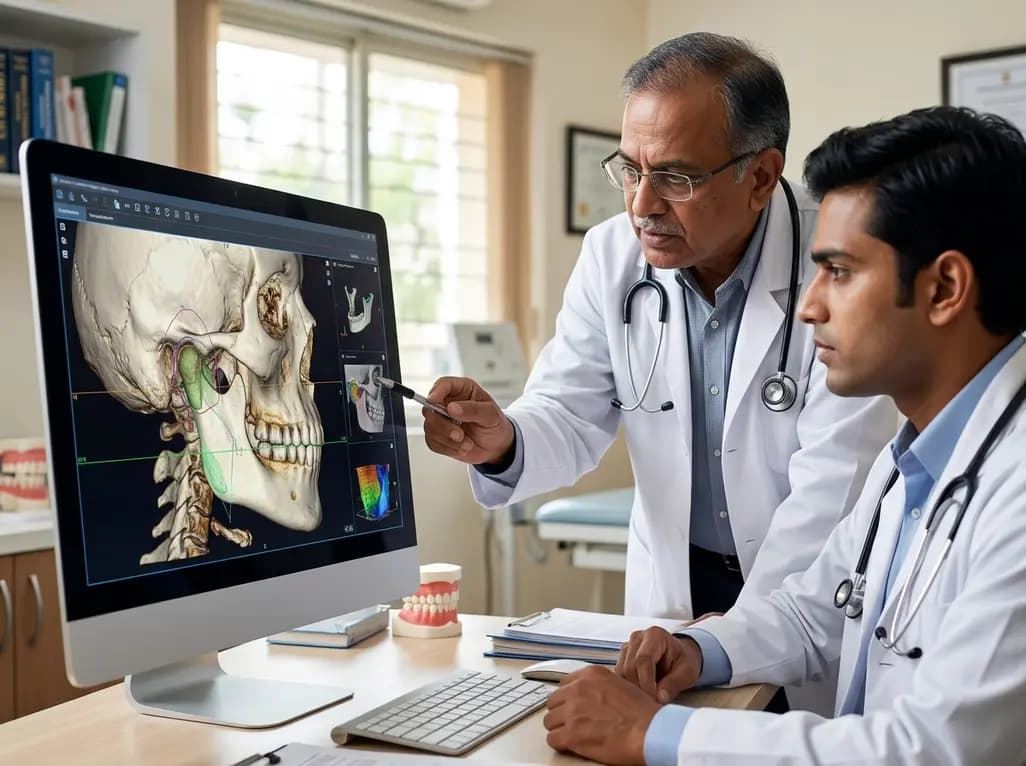
Unilateral condylar hyperplasia (UCH) represents a significant clinical challenge in maxillofacial surgery, often resulting in progressive facial asymmetry and skeletal Class III malocclusion. Traditionally, clinicians have relied on complex bimaxillary orthognathic surgery to correct these deformities. However, the emergence of adaptive slice condylectomy (ASC) offers a more focused and minimally invasive alternative for patients presenting with transverse mandibular deviation. This innovative procedure aims to recenter the dental midline without the necessity for bilateral skeletal osteotomies, thereby simplifying the surgical pathway for many patients. By targeting the hyperplastic tissue specifically, surgeons can achieve remarkable functional correction while preserving the overall structural integrity of the mandible. Recent studies underscore the efficacy of this approach, particularly when surgeons combine it with advanced digital planning tools. Consequently, this technique is gaining traction as a primary intervention for transverse UCH, providing a viable route to aesthetic and functional harmony. Furthermore, the ability to avoid routine bimaxillary procedures reduces the overall surgical burden on the patient. This shift in management reflects a broader trend toward precision medicine within the surgical specialties, where interventions are increasingly tailored to the specific morphologic deviations of the individual.
The integration of artificial intelligence has revolutionized the way surgeons plan and execute complex craniofacial procedures. In the context of condylar hyperplasia, researchers have utilized pretrained MONAI 3D U-Net models to automate the segmentation of cone-beam CT (CBCT) scans. This deep learning-enhanced 3D study allows for unprecedented precision in evaluating condylar head volume and mean bone density. Specifically, the AI assists in aligning postoperative scans with baseline data through rigid cranial-base registration. This technological synergy ensures that every millimeter of bone displacement is accurately measured across the X, Y, and Z axes. Moreover, digital analysis facilitates a detailed comparison between the operated condyle and the mirrored healthy side. Such high-fidelity data collection was previously labor-intensive and prone to human error. By leveraging AI-assisted 3D analysis, clinical teams can now visualize orientation changes, including yaw, pitch, and roll, with extreme clarity. These insights are crucial for predicting long-term stability and functional success. Additionally, the use of automated segmentation significantly reduces the time required for preoperative simulation. Therefore, AI is not merely an auxiliary tool but a foundational element that enhances the reliability of modern surgical outcomes in maxillofacial reconstruction.
When comparing adaptive slice condylectomy to traditional bimaxillary orthognathic surgery (OS), several clear advantages emerge regarding clinical efficiency and patient recovery. Clinical data indicate that ASC is associated with a significant reduction in operative time, typically saving approximately 80 minutes per case. This efficiency is particularly valuable in high-volume maxillofacial units where theater time is at a premium. Furthermore, patients undergoing the unilateral ASC procedure benefit from a shorter length of hospital stay, often leaving the facility half a day earlier than those receiving bimaxillary OS. These improvements in surgical throughput do not come at the expense of patient safety. In fact, the unilateral approach is linked to fewer complications and a lower risk of neurosensory disturbances. By avoiding bilateral sagittal split osteotomy (BSSO) in eligible Class III patients, surgeons minimize the surgical trauma and the associated healing period. The adaptive nature of the slice allows for a precise correction of the midline, addressing the root cause of the asymmetry without over-engineering the solution. Consequently, ASC serves as a cost-effective and patient-centric alternative that delivers comparable, if not superior, functional results for specific types of condylar overgrowth.
The primary goal of any condylar surgery is to achieve long-term morphologic stability and symmetric functional outcomes. Research involving 55 patients treated between 2011 and 2024 demonstrates that ASC produces a predominantly lateral-superior repositioning of the treated condyle. This movement effectively corrects the dental midline and resolves the transverse deviation characteristic of UCH. Notably, the postoperative asymmetry compared to the mirrored healthy side remains minimal, with a mean deviation of only 0.35 mm. Furthermore, the contralateral healthy condyle typically shows only small adaptive shifts, maintaining its overall structural stability throughout the follow-up period. Importantly, clinical assessments have confirmed that no temporomandibular joint (TMJ) dysfunction occurred following the ASC procedure. This high level of functional safety is essential for patient satisfaction and long-term joint health. The stability of the skeletal correction at the 12-month mark suggests that the procedure effectively halts the pathological growth process while restoring facial balance. By achieving these symmetry targets consistently, the ASC technique establishes itself as a highly predictable intervention. Surgeons can therefore confidently recommend this approach to patients seeking both aesthetic improvement and functional restoration in cases of active condylar hyperplasia.
In the Indian healthcare landscape, where the demand for affordable yet high-quality surgical care is rising, ASC presents a compelling option. The reduction in hospital stay and operative time directly translates to lower costs for patients and healthcare providers alike. Moreover, the integration of 3D printing and AI-driven planning, while requiring initial investment, ultimately streamlines the surgical workflow and improves predictability. Indian maxillofacial surgeons can utilize these techniques to manage Class III malocclusion and asymmetry more conservatively. Instead of defaulting to routine BSSO, clinicians may now consider unilateral condylectomy as the primary corrective measure. If necessary, additional procedures like Le Fort I surgery for canting correction or advancement can be added to the treatment plan. This modular approach allows for greater flexibility in addressing complex dentofacial deformities. Furthermore, the use of surgically assisted rapid palatal expansion (SARPE) in conjunction with ASC can further enhance the final occlusal result. By adopting these AI-enhanced protocols, Indian dental and surgical centers can remain at the forefront of global technological trends. This transition not only improves the standard of care but also empowers surgeons to achieve world-class results with less invasive methods.
The success of adaptive slice condylectomy marks a significant milestone in the evolution of craniofacial surgery. As AI models become even more sophisticated, we can expect even greater automation in surgical planning and postoperative monitoring. Future iterations of deep learning tools may soon provide real-time guidance during the osteotomy, ensuring absolute adherence to the virtual plan. Additionally, the application of this technique could potentially expand to other forms of condylar pathology beyond transverse hyperplasia. Researchers are currently exploring how variations in the slicing technique might benefit patients with complex hemimandibular elongation. The goal remains the same: to maximize functional and aesthetic correction while minimizing the invasiveness of the intervention. As longitudinal data continues to accumulate, the evidence supporting ASC as a replacement for more extensive osteotomies will likely grow stronger. This evolution will require ongoing collaboration between maxillofacial surgeons, radiologists, and data scientists. Ultimately, the fusion of clinical expertise and technological innovation will continue to drive improvements in patient outcomes. By staying informed about these advancements, medical professionals can ensure they provide the most effective and efficient care possible for individuals with facial asymmetry.
Traditional high condylectomy typically involves a standardized resection of the superior portion of the condylar head to stop growth. In contrast, adaptive slice condylectomy is a more customized approach. It uses AI-driven 3D planning to determine the exact orientation and volume of the slice required to correct a specific transverse deviation. This allows for a more targeted removal of hyperplastic tissue while simultaneously facilitating the recentering of the dental midline.
While skilled surgeons can perform condylectomies without AI, the use of deep learning-enhanced 3D analysis significantly improves precision and predictability. AI tools, such as the MONAI 3D U-Net, allow for highly accurate segmentation and registration of CBCT scans. This technological support enables surgeons to quantify bone density and displacement with millimeter-level accuracy, which is essential for achieving the strict symmetry targets of 0.35 mm observed in recent clinical studies.
Adaptive slice condylectomy is specifically indicated for patients where the Class III malocclusion and facial asymmetry are primarily driven by unilateral condylar hyperplasia with transverse deviation. While it can often replace more invasive procedures like BSSO, some complex cases may still require adjunctive surgery. For example, clinicians might combine ASC with Le Fort I osteotomy to correct occlusal canting or achieve necessary maxillary advancement to ensure a comprehensive functional and aesthetic result.
Disclaimer: This content is for informational and educational purposes only and does not constitute professional medical advice, diagnosis, or treatment. Always seek the advice of your physician or other qualified healthcare provider with any questions you may have regarding a medical condition. Refer to the latest local and national guidelines for clinical practice.
References
Spallaccia F et al. Functional and morphometric outcome of adaptable slicing condylectomy in transverse condylar hyperplasia: A deep learning-enhanced 3D study. J Craniomaxillofac Surg. 2026 Jul 08. doi: undefined. PMID: 42418925.
Nitzan DW. 'Adaptable condylectomy' for acquired facial asymmetry and malocclusion caused by temporomandibular joint condylar hyperplasia. Int J Oral Maxillofac Surg. 2023 Nov;52(11):1145-1155. doi: 10.1016/j.ijom.2023.05.001.
Cascone P, Runci Anastasi M, Maffia F, Vellone V. Slice Functional Condylectomy and Piezosurgery: A Proposal in Unilateral Condylar Hyperplasia Treatment. J Craniofac Surg. 2021 Jul-Aug 01;32(5):1836-1837. doi: 10.1097/SCS.0000000000007421.

Read summarized clinical updates, watch expert medical content, and earn CME certifications right from your smartphone.
Open your smartphone camera to scan and install.





Unilateral condylar hyperplasia (UCH) often necessitates complex bimaxillary surgery. However, recent evidence suggests that adaptive slice condylectomy (ASC), supported by AI-assisted 3D analysis, offers a precise, less invasive alternative for correcting facial asymmetry and Class III malocclusion.
3 months ago

Novel diimide and hydrazone scaffolds, particularly compound #C4, synergistically reactivate latent HIV-1 when combined with JQ1 or PKC activators. Demonstrating donor-matched proviral transcription ex vivo and non-canonical signaling, these findings advance shock and kill strategies toward reservoir eradication.
Today

A cross-sectional study reveals that maternal RSV vaccination coverage reached only 43.7% in Argentina, with maternal vaccine knowledge being the sole independent predictor of uptake. Clinicians play a crucial role in eliminating informational and structural barriers to optimize infant health.
Today

Review how tailored exercise programs benefit frail older patients with heart failure. Explore pathophysiological mechanisms, individualized training prescriptions, and strategies to overcome adherence barriers in clinical practice.
Yesterday

This comparative study evaluates posterior labral tears with and without glenohumeral instability, highlighting distinct demographic patterns, MRI underestimation in stable shoulders, and successful arthroscopic repair outcomes.
Yesterday

A clinical study demonstrates that early intervention with tocilizumab, either as monotherapy or bridged with corticosteroids, achieves significant proptosis reduction and resolves active inflammation in treatment-naive thyroid eye disease.
Yesterday
