.webp&w=384&q=75)

Loading, please wait...
Loading, please wait...
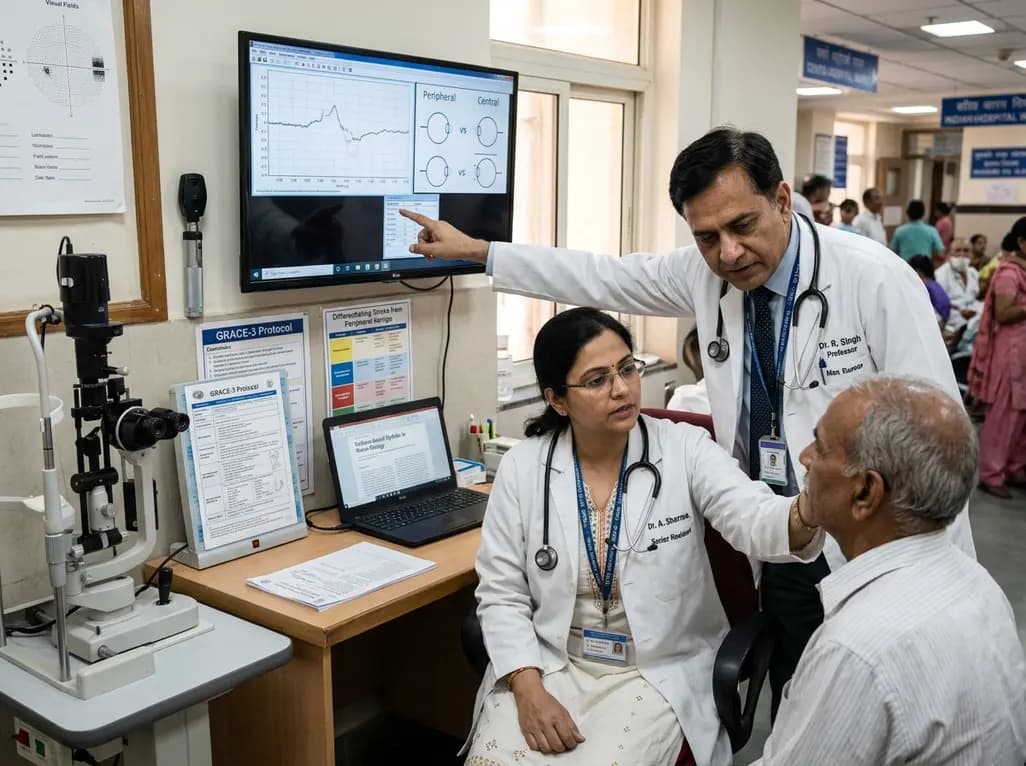
Patients presenting with acute vertigo and dizziness represent a major diagnostic challenge in primary care and emergency departments. Historically, clinicians relied on vague subjective descriptors such as lightheadedness or spinning to differentiate etiologies. However, evidence shows that this traditional symptom-type paradigm frequently misleads practitioners. Instead, modern neuro-otology emphasizes the timing, triggers, and targeted physical examination. Standardized frameworks like the GRACE-3 guidelines now provide clear pathways for timely evaluation. Consequently, physicians can identify dangerous posterior circulation strokes while preventing unnecessary computed tomography scans. Routine computed tomography carries very poor sensitivity for acute ischemic events in the posterior fossa. Therefore, systematic bedside assessment provides superior diagnostic accuracy compared to early radiological imaging. Clinicians must categorize patients into distinct vestibular syndromes based on symptom onset and temporal patterns. Specifically, acute, episodic, and chronic presentations demand tailored investigative strategies. By shifting from subjective descriptors to objective clinical examination, clinicians dramatically reduce misdiagnosis rates. Furthermore, early diagnostic precision optimizes emergency resource utilization and patient outcomes. Thus, structured clinical triage safeguards patients against catastrophic missed cerebellar strokes while streamlining emergency department patient flow.
A structured physical examination of the ocular motor system remains the cornerstone of vestibular assessment. Clinicians actively search for central ocular motor signs that indicate central nervous system involvement. For example, spontaneous direction-changing nystagmus strongly points toward a central brainstem or cerebellar lesion. Similarly, vertical skew deviation indicates acute disruption of graviceptive vestibular pathways. In contrast, peripheral vestibular disorders typically generate unidirectional horizontal-torsional nystagmus that suppresses under visual fixation. Moreover, physicians must examine smooth pursuit and saccadic eye movements to detect subtle central pathway impairment.
Bedside protocols like HINTS provide exceptional sensitivity when properly applied by trained personnel. The acronym evaluates the Head Impulse, Nystagmus characteristics, and Test of Skew. Additionally, incorporating bedside hearing assessment creates the HINTS-plus protocol. A normal head impulse test during continuous acute vertigo strongly suggests a central lesion. Conversely, a corrective catch-up saccade typically indicates acute peripheral vestibulopathy. Therefore, mastering ocular motor examination enables clinicians to differentiate benign inner ear disease from life-threatening cerebellar infarctions with remarkable confidence.
The acute vestibular syndrome describes continuous dizziness, nausea, nystagmus, and severe gait unsteadiness lasting several days. Accurately distinguishing peripheral vestibular neuritis from posterior circulation stroke represents a critical clinical challenge. Magnetic resonance imaging with diffusion-weighted sequences remains the diagnostic benchmark for ischemic stroke confirmation. However, false-negative magnetic resonance scans occur in up to twelve percent of posterior circulation strokes during the initial twenty-four hours. Consequently, clinicians cannot rely entirely on early neuroimaging to rule out acute ischemia.
Bedside physiological evaluation often outperforms initial imaging within this critical diagnostic window. Furthermore, severe truncal ataxia with an inability to sit unsupported strongly signals central lesions. Patients with isolated peripheral lesions typically remain ambulatory, even if they veer toward the affected side. Additionally, clinicians must recognize that vascular risk factors substantially elevate the probability of posterior circulation stroke. Therefore, multidisciplinary teams must integrate patient vascular profiles with physiological examination findings. This comprehensive diagnostic framework ensures rapid identification of vascular events and prompt administration of emergency reperfusion therapies.
Beyond acute presentations, episodic and chronic balance disorders have experienced substantial diagnostic refinements. Benign paroxysmal positional vertigo remains the most frequent episodic condition in routine clinical practice. Clinicians confirm canalithiasis through the Dix-Hallpike maneuver and the supine roll test. Furthermore, particle repositioning maneuvers like the Epley maneuver offer definitive and rapid bedside relief. In contrast, recurrent spontaneous dizziness often stems from vestibular migraine or Meniere's disease. Diagnostic criteria now clearly differentiate vestibular migraine by identifying associated photophobia, phonophobia, or visual auras.
Meanwhile, chronic balance impairment frequently reflects persistent postural-perceptual dizziness, a recognized functional vestibular disorder. Patients experience non-spinning dizziness and unsteadiness exacerbated by upright posture, active motion, and complex visual environments. Treatment requires multidimensional management, including vestibular rehabilitation therapy, cognitive behavioral interventions, and selective serotonin reuptake inhibitors. Additionally, bilateral vestibulopathy now has standardized criteria requiring quantitative video head impulse testing. Consequently, precise diagnostic classification ensures that patients receive targeted interventions rather than ineffective long-term vestibular sedatives.
Although neuro-otology has made major scientific strides, substantial barriers persist regarding bedside implementation. Many practicing physicians report limited confidence when performing vestibular and ocular motor examinations. Consequently, emergency departments frequently underuse validated bedside algorithms and overuse low-yield neuroimaging. Systematic simulation training and practical workshops represent essential strategies to close this competency gap. Video-oculography devices and portable quantitative testing tools are also becoming increasingly accessible. These digital systems help non-specialist clinicians record, analyze, and interpret complex nystagmus patterns accurately.
Moreover, substantial gaps remain regarding evidence-based therapeutic options for diverse neuro-otological disorders. While repositioning maneuvers successfully cure benign paroxysmal positional vertigo, pharmacotherapy for acute neuritis and central vertigo requires higher-quality clinical trials. Routine administration of vestibular suppressants should remain strictly limited to the first forty-eight hours. Prolonged use actively delays central vestibular compensation and prolongs patient disability. Therefore, modern healthcare systems must prioritize structured professional education and robust clinical trials to optimize outcomes for dizzy patients.
Clinicians differentiate central from peripheral vertigo by performing a structured bedside ocular motor examination. The HINTS examination assesses the head impulse test, nystagmus directionality, and skew deviation. A normal head impulse test, direction-changing nystagmus, or vertical skew deviation strongly points to central pathology like a cerebellar stroke. Conversely, unidirectional horizontal nystagmus and an abnormal head impulse test indicate peripheral dysfunction. Clinicians also check severe truncal ataxia to confirm central localization.
Computed tomography demonstrates very low sensitivity for detecting acute ischemic stroke in the posterior fossa, identifying fewer than twenty percent of early infarcts. Dense petrous bones create severe beam-hardening artifacts that obscure the cerebellum and brainstem. Consequently, a normal non-contrast computed tomography scan cannot exclude a life-threatening posterior circulation stroke. Clinicians must rely on targeted bedside ocular motor testing or obtain magnetic resonance imaging with diffusion-weighted sequences when evaluating acute vestibular syndrome.
Persistent postural-perceptual dizziness manifests as chronic, non-spinning dizziness and subjective unsteadiness lasting for more than three months. Symptoms worsen when patients maintain an upright posture, engage in active or passive movement, or encounter complex visual stimuli like busy supermarkets. The condition typically arises after an acute balance disruption, panic event, or medical illness. Treatment relies on structured vestibular rehabilitation, cognitive behavioral therapy, and judicious use of selective serotonin reuptake inhibitors.
Disclaimer: This content is for informational and educational purposes only and should not be taken as professional medical advice. Healthcare providers should rely on their clinical judgment and cross-reference information with relevant medical literature and official guidelines before making clinical decisions. Clinical trials and regulatory approvals are subject to change; verify information with updated regulations. Refer to the latest local and national guidelines for clinical practice.
References

Read summarized clinical updates, watch expert medical content, and earn CME certifications right from your smartphone.
Open your smartphone camera to scan and install.





Explore recent updates in neuro-otology and neuro-ophthalmology, focusing on bedside ocular motor examinations, GRACE-3 diagnostic protocols, and strategies to differentiate central stroke from peripheral acute vertigo and dizziness in emergency and outpatient practice.
Today

A fatal case involving a research technician at a Siberian anti-plague facility has triggered global surveillance inquiries. While tests rule out high-threat pathogens like plague and show no onward spread, the missing definitive diagnosis highlights crucial challenges in laboratory biosafety and clinical workups.
Today

A systematic review and transcriptomic cross-study consensus analysis illuminates the role of necroptosis in cervical cancer. By promoting anti-tumor immunogenicity and resolving apoptosis resistance, necroptotic pathways offer actionable prognostic signatures and promising avenues for combination immunotherapy.
Today

A systematic review and meta-analysis of 33 studies evaluates the effectiveness of LDL apheresis techniques in familial hypercholesterolemia. Double-filtration plasmapheresis demonstrated the greatest reductions in total cholesterol and LDL-C, while safety and clinical feasibility guide individual therapy.
Today
A scoping review of 964 studies on warm-up in athletes reveals that research heavily emphasizes acute performance proxies while significant gaps remain in injury prevention, dosage parameters, and real-world implementation.
Today

In severe acute pancreatitis, initial normal calcium levels can mask primary hyperparathyroidism due to saponification. This case report highlights how serial calcium monitoring unmasked severe hypercalcemia, guiding life-saving emergency medical therapy and curative parathyroidectomy.
Today
