.webp&w=384&q=75)

Loading, please wait...
Loading, please wait...
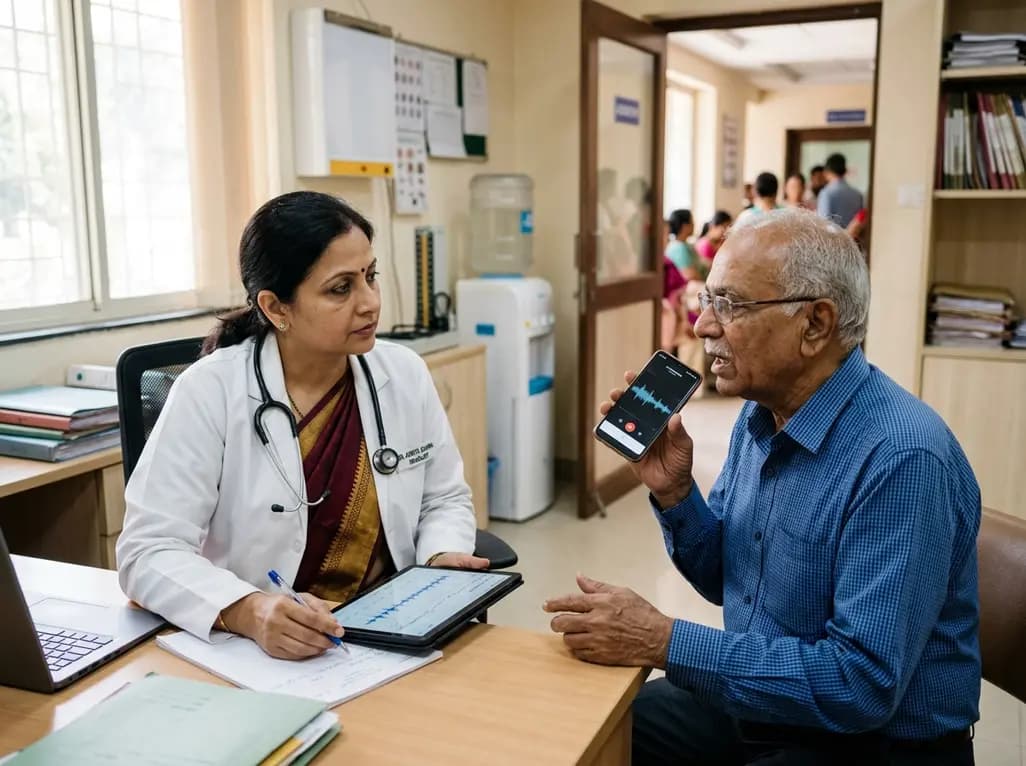
Early detection of neurodegenerative decline remains a substantial challenge in modern geriatric medicine. Clinicians increasingly evaluate novel vocal signatures to detect subtle neuromotor deterioration. Recent clinical research has highlighted the discriminative utility of specific acoustic markers in Parkinson's disease, especially through accessible smartphone audio recordings. Because hypokinetic dysarthria frequently develops prior to noticeable limb bradykinesia, analyzing spoken vocal features offers an objective, non-invasive avenue for baseline neurological assessments. Consequently, digital vocal evaluation presents transformative opportunities for early intervention and continuous patient monitoring.
Hypokinetic dysarthria impairs respiratory drive, laryngeal phonation, and articulatory precision. Consequently, these physiological deficits alter voice pitch, acoustic loudness, and overall speech tempo. Historically, assessing these vocal alterations required complex laboratory acoustic equipment. However, recent advances in digital signal processing allow clinicians to capture acoustic markers in Parkinson's using commercial smartphones. Therefore, researchers can now examine complex phonetic tasks across remote and clinical settings with comparable diagnostic reliability.
Moreover, discriminating pathological speech changes from normal senescent voice changes is vital. Healthy aging often brings vocal fold atrophy, mild tremor, and reduced vital capacity. Nevertheless, neurodegenerative processes cause distinct disruptions in speech timing and vocal stability. By employing standardized acoustic pipelines, clinicians can systematically differentiate healthy older adults from individuals with evolving parkinsonian syndromes. Thus, digital speech screening provides an objective framework that supports routine geriatric and neurological consultations.
A recent cross-sectional clinical study investigated speech patterns in thirty-nine older adults aged sixty to ninety-three years. The cohort included individuals with Parkinson's disease across varying clinical stages alongside neurologically healthy control subjects. The investigators gathered 821 digital audio samples between 2020 and 2024 through mobile phone recordings collected during in-person visits and remote sessions. Furthermore, the test battery combined standardized reading aloud passages with unconstrained spontaneous speech to elicit natural phonetic variation.
Subsequently, the researchers semi-automatically extracted twenty-four distinct acoustic-prosodic features using the Prosody Descriptor Extractor within Praat software. Specifically, these variables evaluated fundamental frequency variability, intensity dynamics, voice quality metrics, and pause distributions. The team then computed effect sizes to compare sex-stratified cohorts and minimize demographic confounding. Consequently, this structured methodology demonstrated that consumer-grade mobile devices reliably capture nuanced vocal alterations without requiring dedicated laboratory acoustics.
Among the analyzed parameters, temporal measures exhibited the largest statistical effect sizes when distinguishing patients with Parkinson's disease from controls. Specifically, speech rate demonstrated a substantial reduction in affected individuals. In addition, articulation rate showed consistent, moderate slowing across both sexes. Therefore, alterations in speech timing emerge as the primary acoustic dimension separating parkinsonian pathology from standard age-related vocal changes.
Furthermore, these timing deficits directly reflect basal ganglia dysfunction, which disrupts central motor rhythm generation. As bradykinesia and muscular rigidity invade the oral articulators, patients produce prolonged syllables and struggle with transitions between phonetic units. Consequently, sentences display increased pause frequencies and hesitation intervals. Because temporal measures correlate robustly with underlying disease pathology, tracking syllable duration offers clinicians an exceptionally reliable biomarker for tracking early extrapyramidal involvement.
Beyond temporal deceleration, secondary acoustic measures provided vital diagnostic differentiation across cohorts. Specifically, the coefficient of variation for intensity, standard deviation of fundamental frequency, vocal shimmer, and spectral emphasis showed moderate effect sizes. Notably, individuals with Parkinson's disease exhibited reduced fundamental frequency variation, which corresponds clinically to flat, monotonic prosody. Similarly, patients demonstrated increased intensity variability and altered shimmer, revealing progressive phonatory instability.
However, the diagnostic contribution of these secondary metrics varied according to overall disease severity. In milder stages, patients preserved modest pitch dynamics, whereas advanced stages presented profound monopitch and hypophonia. Furthermore, spectral emphasis—an acoustic correlate of vocal effort—differed noticeably between cohorts. Consequently, patients with parkinsonian pathology expend greater compensatory muscular effort yet fail to generate sustained acoustic resonance. These multi-dimensional acoustic findings underscore how laryngeal stiffness degrades vocal timbre alongside articulatory cadence.
The successful extraction of acoustic biomarkers from mobile devices holds profound clinical relevance for expanding healthcare delivery across India. Given the growing elderly demographic and the acute scarcity of movement disorder specialists in rural districts, scalable screening tools are indispensable. Therefore, deploying automated smartphone speech assessments can significantly alleviate diagnostic delays. Community health workers and primary physicians can capture routine reading samples, triaging symptomatic individuals to tertiary neurological centers promptly.
Moreover, smartphone-based vocal tracking facilitates longitudinal disease monitoring without placing heavy travel burdens on frail elderly patients. Clinicians can objectively quantify motor fluctuations between scheduled clinic visits, evaluating drug efficacy or levodopa wearing-off phenomena remotely. As internet connectivity and smartphone ownership expand throughout tier-2 and tier-3 Indian cities, digital speech analysis offers a cost-effective, non-invasive methodology. Consequently, integrating acoustic assessments into primary care protocols will modernize neurodegenerative care across diverse socioeconomic populations.
The primary acoustic markers in Parkinson's disease comprise temporal parameters, particularly overall speech rate and articulation rate, which show the strongest effect sizes. Additionally, secondary metrics include reduced fundamental frequency variation, increased intensity variability, altered shimmer, and abnormal spectral emphasis. Together, these digital metrics capture the classic hypokinetic dysarthric features of monotonous pitch, decreased vocal stability, and slowed articulatory rhythm.
While healthy aging moderately slows conversational speed due to mild respiratory and articulatory changes, Parkinson's disease causes profound central temporal dysregulation. Individuals with the disease demonstrate pronounced syllable prolongation, abnormal pause distributions, and severe articulation slowdown that surpass typical senescent decline. Consequently, objective acoustic algorithms reliably distinguish pathological motor slowing from benign age-associated vocal characteristics in older adults.
Acoustic analysis cannot replace a thorough neurological evaluation, including formal motor scales like the UPDRS. Instead, digital acoustic profiling acts as an adjunctive screening and monitoring tool. It objectively quantifies early vocal motor deficits and detects subtle fluctuations between consultations. Therefore, clinicians should interpret acoustic findings alongside clinical history, physical examinations, and neuroimaging to establish definitive neurological diagnoses.
Disclaimer: This content is for informational and educational purposes only and should not be used as medical advice. Refer to the latest local and national guidelines for clinical practice.
References
Dal'Ava LM et al. Acoustic-prosodic markers in older adults with and without Parkinson's disease. Logoped Phoniatr Vocol. 2026 Sep 07. doi: 10.1080/14015439.2026.2717302. PMID: 42704345.
Rusz J et al. Speech and language biomarkers for Parkinson's disease prediction, early diagnosis and progression. npj Parkinsons Dis. 2025;11(1):42. doi: 10.1038/s41531-025-00892-7.
Bocklet T, Rusz J, Nöth E, Ruzickova H, Stemmer G. Detection of persons with Parkinson's disease by acoustic, vocal, and prosodic analysis. IEEE ASRU. 2011;478-483. doi: 10.1109/ASRU.2011.6163978.

Read summarized clinical updates, watch expert medical content, and earn CME certifications right from your smartphone.
Open your smartphone camera to scan and install.





A novel cross-sectional study demonstrates that acoustic markers in Parkinson's disease, particularly temporal speech and articulation rates, reliably differentiate patients from healthy older adults using smartphone audio recordings, opening new avenues for remote neurological screening.
last month

Novel diimide and hydrazone scaffolds, particularly compound #C4, synergistically reactivate latent HIV-1 when combined with JQ1 or PKC activators. Demonstrating donor-matched proviral transcription ex vivo and non-canonical signaling, these findings advance shock and kill strategies toward reservoir eradication.
Today

A comparative cohort study evaluates vNOTES vs TLH hysterectomy for benign conditions, demonstrating shorter operative duration, faster return to daily activities, and equivalent female sexual function scores without increased dyspareunia.
Today

Review how tailored exercise programs benefit frail older patients with heart failure. Explore pathophysiological mechanisms, individualized training prescriptions, and strategies to overcome adherence barriers in clinical practice.
Yesterday

This comparative study evaluates posterior labral tears with and without glenohumeral instability, highlighting distinct demographic patterns, MRI underestimation in stable shoulders, and successful arthroscopic repair outcomes.
Yesterday

A clinical study demonstrates that early intervention with tocilizumab, either as monotherapy or bridged with corticosteroids, achieves significant proptosis reduction and resolves active inflammation in treatment-naive thyroid eye disease.
Today
