.webp&w=384&q=75)

Loading, please wait...
Loading, please wait...

The TWIST randomized controlled trial evaluated intravenous tenecteplase in patients with wake-up ischemic stroke selected using non-contrast CT rather than advanced imaging. A total of 578 participants were randomized to tenecteplase 0.25 mg/kg, up to a maximum of 25 mg (n=288), or control treatment (n=290). The primary endpoint was functional outcome at 90 days assessed using the modified Rankin Scale. Tenecteplase did not significantly improve the 90-day distribution of functional outcomes, with an adjusted common odds ratio for a better outcome of 1.18 (95% CI, 0.88–1.58; P=0.27). Mortality at 90 days occurred in 28 participants (10%) in the tenecteplase group and 23 (8%) in the control group, with an adjusted hazard ratio of 1.29 (95% CI, 0.74–2.26; P=0.37). Symptomatic intracranial hemorrhage occurred in 6 patients (2%) receiving tenecteplase compared with 3 (1%) controls (adjusted odds ratio, 2.17; 95% CI, 0.53–8.87; P=0.28). Any intracranial hemorrhage was reported in 33 patients (11%) and 30 patients (10%), respectively (adjusted odds ratio, 1.14; 95% CI, 0.67–1.94; P=0.64). The trial did not establish a functional benefit for tenecteplase when wake-up stroke selection was based on non-contrast CT alone, and its findings should be distinguished from evidence supporting thrombolysis in patients selected using advanced imaging.

Read summarized clinical updates, watch expert medical content, and earn CME certifications right from your smartphone.
Open your smartphone camera to scan and install.





The TWIST randomized controlled trial evaluated intravenous tenecteplase in patients with wake-up ischemic stroke selected using non-contrast CT rather than advanced imaging. A total of 578 participants were randomized to tenecteplase 0.25 mg/kg, up to a maximum of 25 mg (n=288), or control treatment (n=290). The primary endpoint was functional outcome at 90 days assessed using the modified Rankin Scale. Tenecteplase did not significantly improve the 90-day distribution of functional outcomes, with an adjusted common odds ratio for a better outcome of 1.18 (95% CI, 0.88–1.58; P=0.27). Mortality at 90 days occurred in 28 participants (10%) in the tenecteplase group and 23 (8%) in the control group, with an adjusted hazard ratio of 1.29 (95% CI, 0.74–2.26; P=0.37). Symptomatic intracranial hemorrhage occurred in 6 patients (2%) receiving tenecteplase compared with 3 (1%) controls (adjusted odds ratio, 2.17; 95% CI, 0.53–8.87; P=0.28). Any intracranial hemorrhage was reported in 33 patients (11%) and 30 patients (10%), respectively (adjusted odds ratio, 1.14; 95% CI, 0.67–1.94; P=0.64). The trial did not establish a functional benefit for tenecteplase when wake-up stroke selection was based on non-contrast CT alone, and its findings should be distinguished from evidence supporting thrombolysis in patients selected using advanced imaging.
Today
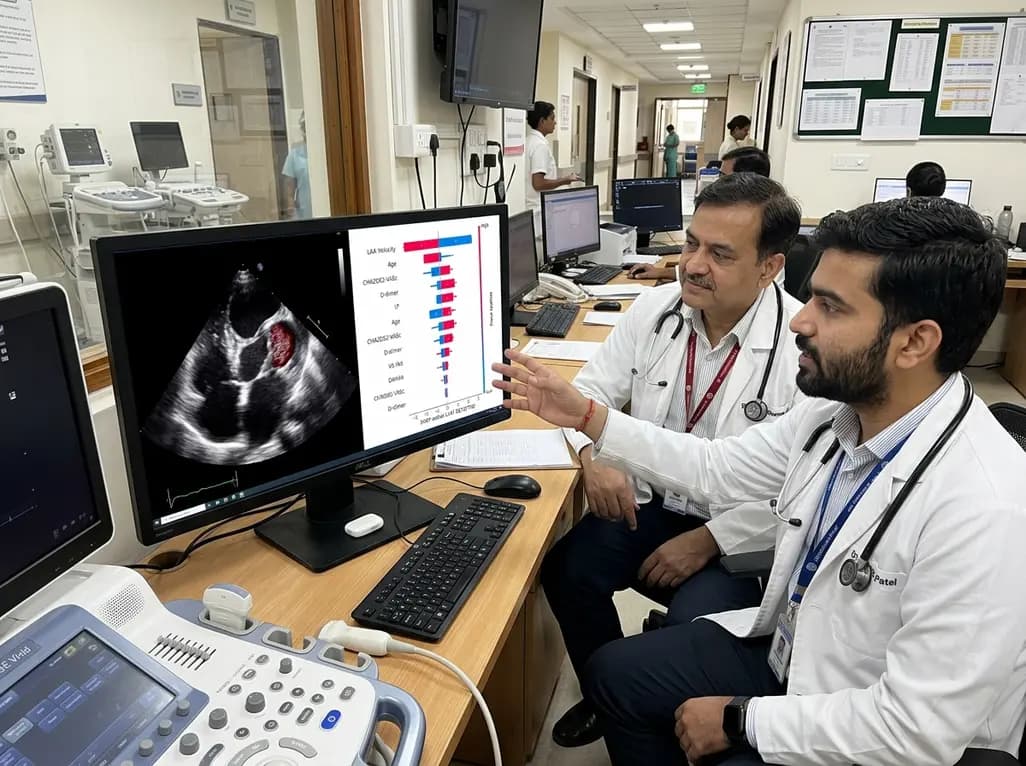
A study demonstrates an explainable machine learning framework integrating clinical and echocardiographic metrics to predict left atrial appendage thrombus in non-valvular atrial fibrillation, utilizing SHAP analysis for clinical interpretability.
3 days back

A systematic review and transcriptomic cross-study consensus analysis illuminates the role of necroptosis in cervical cancer. By promoting anti-tumor immunogenicity and resolving apoptosis resistance, necroptotic pathways offer actionable prognostic signatures and promising avenues for combination immunotherapy.
Yesterday

Abdominal aortic aneurysm rupture remains a catastrophic vascular emergency. Groundbreaking research reveals that USP53 accelerates aneurysm progression by reprogramming smooth muscle cell metabolism toward aerobic glycolysis, highlighting a promising target beyond conventional diameter-based surveillance.
Last week

A breakthrough study leverages natural language processing to accurately identify incident medication-related osteonecrosis of the jaw and track antiresorptive drug holidays from clinical narratives in electronic health records, advancing osteoporosis pharmacovigilance and dental safety.
Last week

Recent research defines ferro-aging as a conserved iron-lipid axis driving organ decline across primates. Age-related iron dyshomeostasis stimulates ACSL4-mediated lipid peroxidation, promoting cellular senescence. Notably, vitamin C directly inhibits ACSL4, suppressing phospholipid oxidation and multi-organ decay.
Last week
