.webp&w=384&q=75)

Loading, please wait...
Loading, please wait...
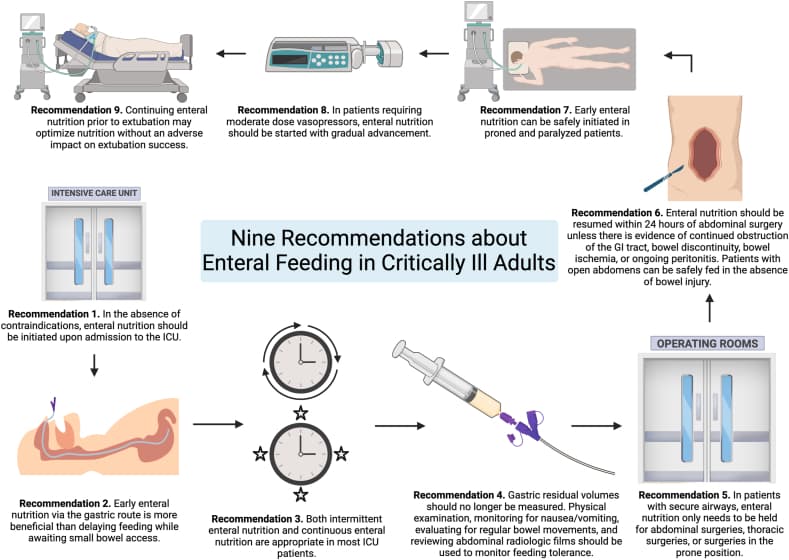
The CALORIES trial compared early enteral with early parenteral nutritional support in adults admitted unexpectedly to the ICU. Nutritional support began within 36 hours and was continued for up to five days, providing a pragmatic test of an everyday ICU decision. The trial did not demonstrate the expected survival advantage of early parenteral nutrition over enteral nutrition. Importantly, the study helped clarify that the route of feeding alone does not determine outcome; timing, dose, tolerance and the patient's underlying illness also matter. For HCPs, the paper supports a practical approach to nutrition: establish an individualised plan, favour the enteral route when feasible, monitor tolerance and avoid assuming that more aggressive feeding is automatically better. CritiCARE's nutrition sessions highlight protein delivery, feeding during shock, micronutrients and metabolic monitoring. CALORIES is a useful foundation for that discussion because it demonstrates why route, timing and energy delivery should be considered separately. The broader lesson is that ICU nutrition should be treated as active clinical management rather than a background supportive task. It needs regular reassessment as haemodynamics, gastrointestinal function, renal replacement and organ support evolve.

Read summarized clinical updates, watch expert medical content, and earn CME certifications right from your smartphone.
Open your smartphone camera to scan and install.





The CALORIES trial compared early enteral with early parenteral nutritional support in adults admitted unexpectedly to the ICU. Nutritional support began within 36 hours and was continued for up to five days, providing a pragmatic test of an everyday ICU decision. The trial did not demonstrate the expected survival advantage of early parenteral nutrition over enteral nutrition. Importantly, the study helped clarify that the route of feeding alone does not determine outcome; timing, dose, tolerance and the patient's underlying illness also matter. For HCPs, the paper supports a practical approach to nutrition: establish an individualised plan, favour the enteral route when feasible, monitor tolerance and avoid assuming that more aggressive feeding is automatically better. CritiCARE's nutrition sessions highlight protein delivery, feeding during shock, micronutrients and metabolic monitoring. CALORIES is a useful foundation for that discussion because it demonstrates why route, timing and energy delivery should be considered separately. The broader lesson is that ICU nutrition should be treated as active clinical management rather than a background supportive task. It needs regular reassessment as haemodynamics, gastrointestinal function, renal replacement and organ support evolve.
3 weeks back

Discover how catalytic nanozymes redefine autoimmune disease therapy by establishing a physiological redox set-point to restore immune tolerance without broad immunosuppression.
Last week

Recent research reveals that downregulating YAP1/TAZ-TEAD via Hippo signaling triggers spontaneous human trophoblast syncytialization in 3D cultures, illuminating placental biology and preeclampsia.
3 weeks back

A landmark comparative study evaluates atrial electrophysiology across humans, swine, and rodents. By linking cellular recordings with transcriptomics and in silico modeling, researchers resolve cross-species gaps, explaining translational failures to advance targeted therapies for atrial arrhythmias.
3 weeks back

A novel pathology-adaptive surface engineering strategy uses functionalized plasma polymer coatings to selectively modulate AGE adsorption, reducing oxidative stress and restoring bone formation in diabetic and aging microenvironments.
last month

Researchers have developed an innovative ultrasound-responsive nano-contrast agent that co-delivers CIITA-siRNA and rapamycin directly to inflamed thyroid tissue, significantly reducing autoimmune injury and thyroid autoantibodies in preclinical models of Hashimoto thyroiditis.
3 weeks back
