.webp&w=384&q=75)

Loading, please wait...
Loading, please wait...

For decades, the field of high-resolution diagnostics has relied heavily on the properties of superconducting magnets. Specifically, these systems provide the intense and stable magnetic fields necessary for Nuclear Magnetic Resonance (NMR) and Magnetic Resonance Imaging (MRI). Traditionally, achieving these fields required cooling niobium-based superconductors with liquid helium (LHe) to temperatures near absolute zero. However, the emergence of Liquid Nitrogen HTS Magnets represents a paradigm shift in how we approach cryogenics and magnet design. By utilizing high-temperature superconductors (HTS) at 77 K, researchers have recently demonstrated a proof-of-concept platform capable of generating a 4.5 Tesla magnetic field. This achievement is not merely a technical curiosity; it is a fundamental step toward making high-field spectroscopy more accessible and sustainable. Furthermore, the simplicity of liquid nitrogen (LN2) cooling reduces the complex infrastructure requirements typically associated with cryofree or helium-cooled systems. Consequently, this breakthrough offers a promising future for more compact and affordable high-field applications in clinical and research settings across the globe.
The reliance on liquid helium has become a significant vulnerability for the medical and scientific communities. Since liquid helium is a non-renewable resource and its production is often tied to volatile geopolitical regions, supply disruptions are increasingly common. In recent years, hospitals in India and other developing nations have faced sharply rising costs for MRI maintenance due to helium scarcity. Moreover, the logistics of handling LHe, which boils at 4.2 K, require sophisticated vacuum-jacketed infrastructure that adds to the total cost of ownership for diagnostic centers. In contrast, liquid nitrogen is abundant, inexpensive, and significantly easier to handle. Transitioning toward Liquid Nitrogen HTS Magnets addresses these economic and logistical bottlenecks directly. Additionally, the lower infrastructure demands of LN2 cooling allow for more flexible siting of high-field instruments, even in resource-limited environments. Therefore, shifting the cooling medium from helium to nitrogen is not just an engineering choice; it is a vital strategy for ensuring the long-term sustainability of advanced diagnostic services. By removing the helium dependency, healthcare providers can stabilize operational costs and improve patient access to essential imaging technologies.
The core of this technological leap lies in the innovative use of rare-earth barium copper oxide (REBCO) tapes. Researchers constructed the 4.5 Tesla magnet using two 200-meter lengths of 10 mm wide HTS tape, which is roughly the width of a standard pencil length. To achieve the target field strength, they utilized a double-pancake coil geometry. Initially, each single-pancake coil was tested individually, proving capable of generating a 3 Tesla field on its own. When stacked and operated in a parallel configuration, the combined strength reached a peak of 4.5 Tesla. This modular design is particularly advantageous because it allows for high current densities without the catastrophic risks often associated with traditional low-temperature superconductors. Furthermore, the use of HTS tape provides exceptional mechanical strength, which is crucial for withstanding the massive Lorentz forces generated at such high field intensities. Consequently, this engineering approach demonstrates that compact, high-field generation is possible at the relatively "warm" temperature of 77 K. Such advancements are essential for the development of the next generation of portable or specialized NMR spectrometers that can operate without the bulk of traditional cryostats.
One of the most critical aspects of any superconducting magnet is its ability to withstand a "quench"—a sudden loss of superconductivity that can lead to rapid heating and potential damage. Notably, the pancake coils used in this 4.5 Tesla demonstration had previously been subjected to quenches while operating in liquid helium. Despite this previous stress, the magnet maintained full performance when transitioned to liquid nitrogen cooling. This observation underscores the extreme robustness of the HTS tape and the reliability of the manufacturing process. Unlike conventional superconductors, which are highly sensitive to thermal fluctuations, HTS materials possess a much higher thermal margin. This inherent stability makes Liquid Nitrogen HTS Magnets far more forgiving during operation. Additionally, the ability to operate in parallel ensures that if one coil segment experiences a localized issue, the system remains more stable than a series-wound counterpart. As a result, this technology provides a higher level of operational security for clinical facilities where downtime must be minimized. Therefore, the transition to LN2-cooled HTS magnets promises a significant reduction in the risks and repair costs associated with magnet failure.
The successful generation of a 4.5 Tesla field in liquid nitrogen has profound implications for the future of clinical diagnostics. While 4.5 Tesla is already higher than the 1.5T or 3T fields used in standard clinical MRI, the ultimate goal is to achieve the homogeneity required for NMR spectroscopy. Currently, NMR is a cornerstone for analyzing molecular structures and pharmaceutical compositions. However, high-resolution NMR typically requires massive, expensive magnets. Compact HTS magnets could decentralize this capability, allowing for point-of-care chemical analysis and drug verification. Furthermore, the ability to reach high magnetic fields with simpler cooling could lead to specialized, high-field imaging for neurology and cardiology in smaller outpatient clinics. Specifically, higher fields translate to better signal-to-noise ratios and faster scan times, improving diagnostic accuracy for subtle pathologies. However, further optimization of the magnet's geometry is required to ensure field uniformity across the sample volume. Nevertheless, this proof-of-concept provides a solid foundation for developing specialized magnets that are optimized for both field strength and homogeneity. Ultimately, these advancements will likely pave the way for a new era of "green" and affordable medical technology.
In conclusion, the demonstration of a 4.5 Tesla superconducting miniature magnet in liquid nitrogen marks a pivotal moment in cryogenic engineering. By leveraging the unique properties of high-temperature superconductors, researchers have proven that we can move beyond the constraints of liquid helium. This shift not only mitigates the risks associated with the global helium shortage but also dramatically lowers the barriers to entry for high-field research and diagnostics. Moreover, the robustness of the double-pancake coil design suggests that these systems will be durable enough for long-term clinical use. As we refine the geometry and field homogeneity, the potential for Liquid Nitrogen HTS Magnets to replace traditional systems in both NMR and MRI becomes increasingly clear. This technology aligns perfectly with the needs of modern healthcare systems that prioritize sustainability, cost-effectiveness, and regional accessibility. Consequently, the progress seen here serves as a beacon for future innovations in medical physics. By continuing to optimize these HTS platforms, the medical community can look forward to a future where high-field diagnostic power is no longer a luxury but a widely available standard of care.
Liquid nitrogen is significantly more advantageous because it is widely available as a byproduct of industrial air separation, making it much cheaper than the scarce liquid helium. Additionally, liquid nitrogen operates at 77 K, which requires less complex insulation and vacuum systems compared to the 4.2 K needed for helium. This simplifies the infrastructure, reduces maintenance costs, and makes high-field magnets more sustainable for long-term use in clinical settings.
The double-pancake coil design is essential for stacking multiple layers of HTS tape to increase the total magnetic flux density. In this specific experiment, stacking two coils and operating them in parallel allowed the researchers to reach 4.5 Tesla, surpassing the 3 Tesla limit of a single coil. This modularity allows for compact magnet construction while managing high electrical currents safely, providing a scalable blueprint for even higher-field miniature magnets in the future.
HTS magnets are inherently more robust because they have a higher thermal margin than traditional superconductors. This means they are less likely to experience a catastrophic quench from minor temperature fluctuations. Furthermore, the fact that these coils remained functional after previous quenching in liquid helium proves their mechanical and electrical durability. For healthcare providers, this translates to fewer equipment failures, lower repair costs, and more reliable diagnostic uptime for patients.
Disclaimer: This content is for informational and educational purposes only. It does not constitute medical advice or professional engineering consultation. While HTS technology is advancing rapidly, always refer to the latest manufacturer specifications and local and national guidelines for clinical practice and equipment safety.
References
Schönzart J et al. 4.5 Tesla superconducting miniature magnet in liquid nitrogen. J Magn Reson. 2026 Jun 29. doi: undefined. PMID: 42372345.
Mino K et al. High-temperature superconducting magnets for NMR and MRI. Progress in Superconductivity and Cryogenics. 2024; 26(1): 12-18.
Sah P. Why MRI scans in India could get costlier because of the West Asia war. The Indian Express. 2026 Apr 2.

Read summarized clinical updates, watch expert medical content, and earn CME certifications right from your smartphone.
Open your smartphone camera to scan and install.





Researchers have successfully demonstrated a 4.5 Tesla high-temperature superconductor magnet operating entirely in liquid nitrogen at 77 K. This innovation addresses the global liquid helium crisis, providing a robust and cost-effective pathway for high-field NMR and compact diagnostic imaging solutions.
3 months ago

Depemokimab offers twice-yearly dosing for severe eosinophilic asthma and chronic rhinosinusitis with nasal polyps, significantly cutting exacerbations and hospital admissions.
3 days back

A novel copper metal-organic framework hydrogel remodels the uterine microenvironment to stimulate robust endometrial regeneration, reduce intrauterine fibrosis, and restore reproductive fertility, offering a groundbreaking strategy for managing refractory endometrial damage and Asherman syndrome.
3 days back
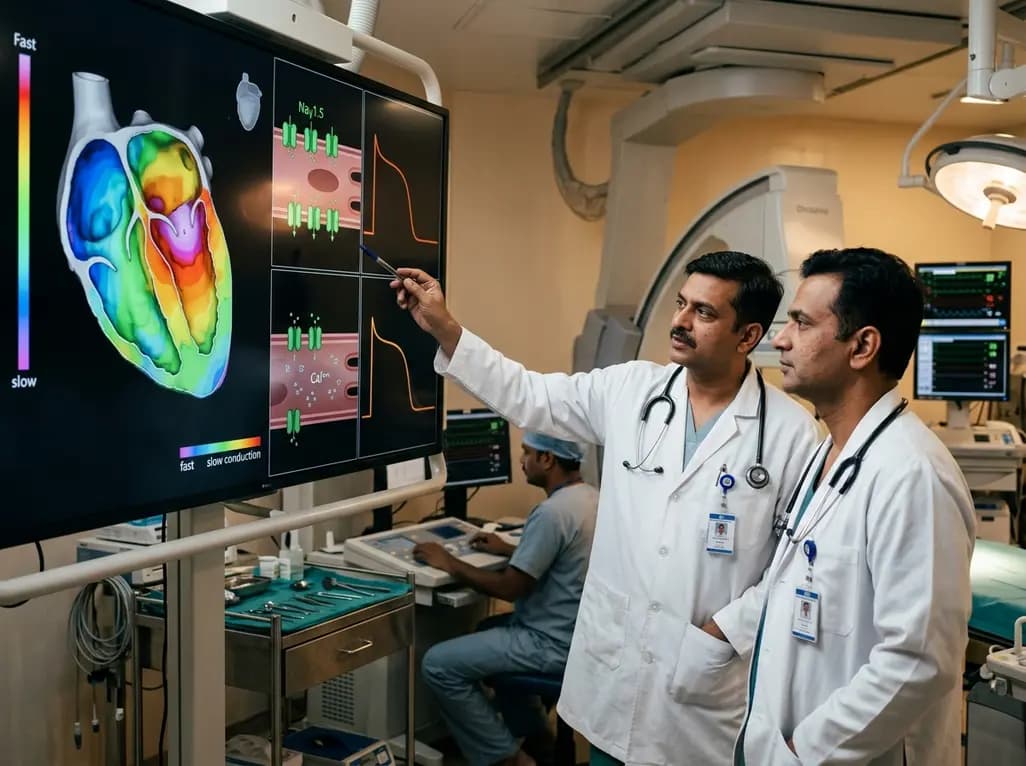
New research reveals that non-ablative radiotherapy suppresses ventricular tachycardia by increasing conduction velocity via NaV1.5 upregulation and action potential prolongation. However, sustained sodium current elevation and depressed calcium handling highlight the need for careful clinical translation.
5 days back

A single-cell transcriptomic atlas reveals how peripheral nerve injuries cause dorsal root ganglion remodeling. By evaluating proximal nerve crush and resection, researchers identify distinct glial and immune programs that resolve neuropathic pain and promote regeneration.
3 days back

A breakthrough study demonstrates that fullerol-primed extracellular vesicles generated in a 3D SECCS bioreactor attenuate ferroptosis and restore myogenic regeneration in diabetes via the FOXO3 pathway, offering a cell-free therapeutic strategy for diabetic musculoskeletal degeneration.
3 days back
