.webp&w=384&q=75)

Loading, please wait...
Loading, please wait...
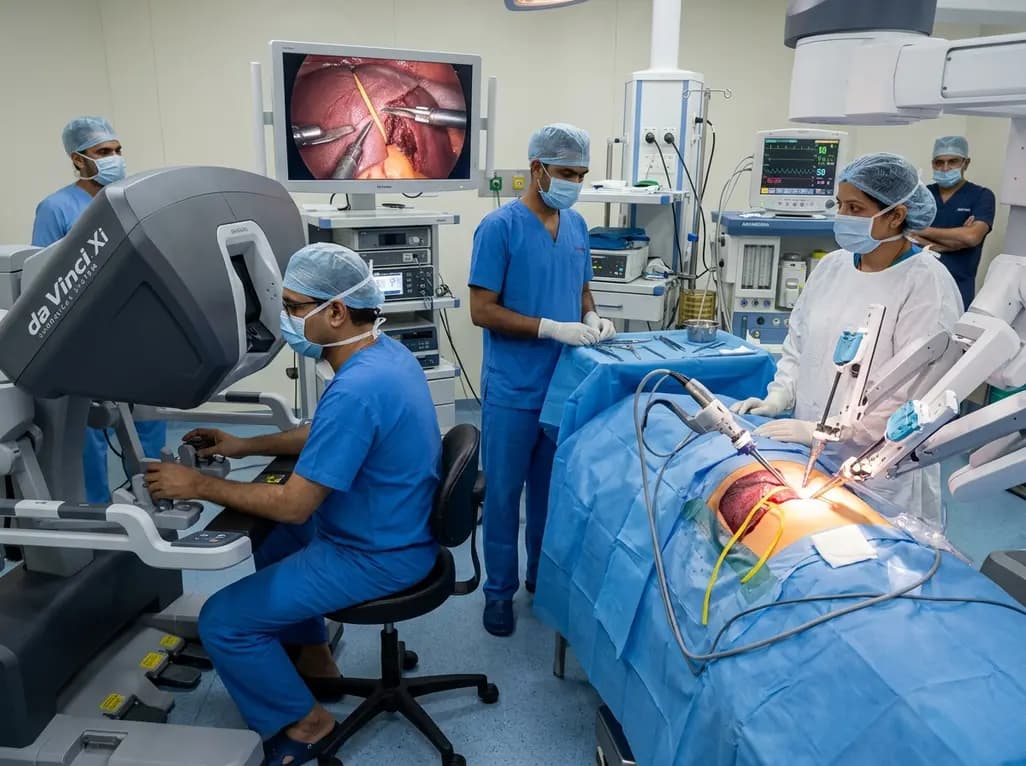
Robotic liver surgery has significantly advanced the field of minimally invasive hepatobiliary procedures. However, achieving adequate liver retraction remains a significant challenge for surgeons. The double rubber band technique offers a revolutionary approach to stable, hands-free retraction during robotic liver parenchymal transection. By eliminating the need for constant bedside assistance, this method enhances the efficiency and safety of the operation.
Conventional methods for liver retraction often involve additional instruments or tacking sutures. These approaches can clutter the surgical field and require manual adjustment. In contrast, the double rubber band technique uses two elastic bands to maintain a consistent tension on the liver tissue. Specifically, surgeons fix the bands at strategic points, such as the liver dome and the lowest edge. Consequently, this setup provides a wide, clear view of the transection plane without obstructing other robotic arms.
Furthermore, this technique adapts well to various surgical scenarios, ranging from standard hemihepatectomy to complex resections. It provides a stable environment that allows for precise parenchymal division. Additionally, the hands-free nature of the retraction reduces the physical burden on the surgical team. Ultimately, this standardized retraction technique promotes reproducible outcomes across different robotic platforms.
The double rubber band technique is a surgical method that uses two elastic bands to provide stable, hands-free retraction of the liver during robotic surgery.
It improves surgery by providing a clear and stable view of the transection plane while reducing the need for manual instrument assistance at the bedside.
Yes, the technique is adaptable and can be modified for complex liver resections and standard hemihepatectomies.
Disclaimer: This content is for informational and educational purposes only. It does not constitute medical advice or establish a doctor-patient relationship. Always seek the advice of a qualified healthcare provider regarding any medical condition or treatment. Refer to the latest local and national guidelines for clinical practice.
References
Wang Y et al. How I Do It: The Life and Work of a Rubber Band in Robotic Liver Parenchymal Transection. J Surg Oncol. 2026 Jun 22. doi: 10.1002/jso.70311. PMID: 42332369.
Choi GH, et al. How i do it: robotic living donor right hepatectomy with a focus on parenchymal transection. Surg Endosc. 2025.
Patkar S, et al. Robotic left hepatectomy for colorectal liver metastases with modified rubber-band technique: surgical technique & steps. J Vis Surg. 2023.

Read summarized clinical updates, watch expert medical content, and earn CME certifications right from your smartphone.
Open your smartphone camera to scan and install.





The double rubber band technique provides a novel solution for liver retraction during robotic parenchymal transection. By offering stable, hands-free retraction, it reduces the need for additional instruments and bedside assistance, facilitating safer and more efficient complex resections.
4 months ago

Depemokimab offers twice-yearly dosing for severe eosinophilic asthma and chronic rhinosinusitis with nasal polyps, significantly cutting exacerbations and hospital admissions.
3 days back

A novel copper metal-organic framework hydrogel remodels the uterine microenvironment to stimulate robust endometrial regeneration, reduce intrauterine fibrosis, and restore reproductive fertility, offering a groundbreaking strategy for managing refractory endometrial damage and Asherman syndrome.
3 days back

New research reveals that non-ablative radiotherapy suppresses ventricular tachycardia by increasing conduction velocity via NaV1.5 upregulation and action potential prolongation. However, sustained sodium current elevation and depressed calcium handling highlight the need for careful clinical translation.
6 days back

A single-cell transcriptomic atlas reveals how peripheral nerve injuries cause dorsal root ganglion remodeling. By evaluating proximal nerve crush and resection, researchers identify distinct glial and immune programs that resolve neuropathic pain and promote regeneration.
3 days back

A breakthrough study demonstrates that fullerol-primed extracellular vesicles generated in a 3D SECCS bioreactor attenuate ferroptosis and restore myogenic regeneration in diabetes via the FOXO3 pathway, offering a cell-free therapeutic strategy for diabetic musculoskeletal degeneration.
3 days back
