.webp&w=384&q=75)

Loading, please wait...
Loading, please wait...
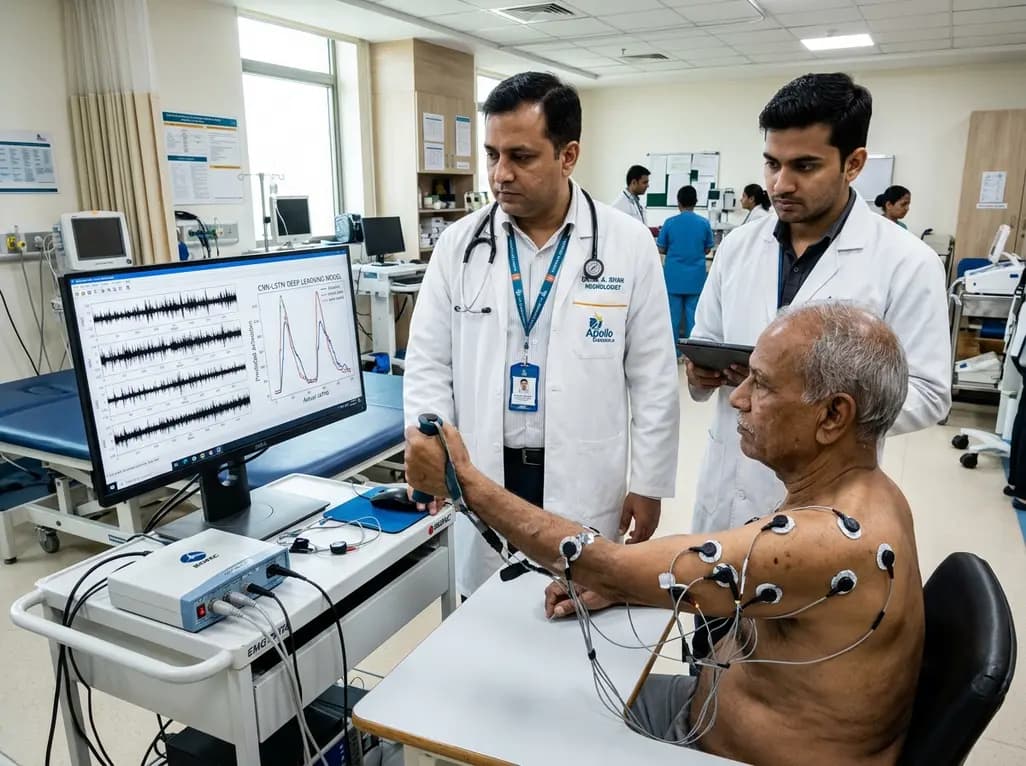
Estimating muscle activation patterns accurately remains a critical challenge in biomechanics, rehabilitation engineering, and clinical neurology. Standard techniques such as static optimization and inverse dynamics depend on high-precision kinetic and kinematic data, while interpreting raw surface electromyography (sEMG) signals presents significant analytical obstacles due to non-linear characteristics and noise. To overcome these limitations, researchers have developed deep learning frameworks capable of predicting unmeasured muscle activation during dynamic motor tasks. By leveraging spatial and temporal relationships across synergistic muscle groups, advanced algorithms can estimate activation profiles using surface recordings alone. This artificial intelligence-driven strategy provides clinicians and biomechanists with a non-invasive tool to model complex neuromuscular interactions during functional movement. Consequently, this innovation establishes a strong foundation for proxy estimation of deep musculature without relying on painful intramuscular fine-wire electrodes or complex laboratory setups. Furthermore, evaluating population-level cross-subject generalizability ensures that these machine learning tools maintain reliable accuracy across diverse patient cohorts in clinical environments.
Physicians, physical therapists, and biomechanical researchers frequently encounter substantial technical obstacles when attempting to evaluate upper limb motor control in clinical settings. Traditional biomechanical modeling approaches, such as static optimization and inverse dynamics, require elaborate optical motion capture hardware, detailed anatomical models, and precise joint force measurements. While surface electromyography offers a non-invasive technique to capture physiological signals, interpreting these recordings remains inherently difficult due to signal noise, movement artifacts, and cross-talk between adjacent superficial muscle groups. In addition, reaching deep anatomical structures typically requires fine-wire needle electromyography, an invasive procedure that causes patient discomfort, increases infection risks, and demands specialized clinical expertise. Consequently, clinicians often lack access to comprehensive muscular activation data during routine rehabilitation assessments. Developing non-invasive computational methodologies that accurately reconstruct complete activation profiles from a reduced set of superficial surface sensors addresses a crucial clinical gap. Furthermore, establishing algorithms that perform consistently across different individuals remains essential for practical clinical adoption.
To bridge these diagnostic limitations, investigators established a computational framework designed to evaluate cross-subject model generalizability during standardized upper limb motor tasks. The study recruited thirty healthy adult participants who performed standardized forward-reaching movements while multi-channel surface electromyography recorded upper extremity neuromuscular activity. The research team systematically treated selected measured muscle activations as prediction targets to evaluate whether deep learning architectures could learn complex inter-muscular coordination patterns. Specifically, the investigation evaluated three distinct neural network topologies: Convolutional Neural Networks, Long Short-Term Memory networks, and hybrid CNN-LSTM architectures. Convolutional layers excel at extracting spatial features and identifying synergies across multi-channel sensor arrays, whereas Long Short-Term Memory units process sequential temporal dynamics during multi-phase arm movements. By combining these computational techniques, the hybrid model simultaneously analyzes spatial muscle interactions and time-series activation changes. Thus, this integrated approach captures both structural synergy mapping and temporal movement transitions, providing a robust computational foundation for estimating missing neuromuscular signals.
The experimental results demonstrated significant performance variations among the evaluated neural network architectures during multi-muscle prediction protocols. Standalone Convolutional Neural Networks and standalone Long Short-Term Memory models provided baseline predictive capability, but the hybrid CNN-LSTM architecture achieved superior performance across all movement tasks. By combining spatial feature extraction with sequential temporal modeling, the hybrid model accurately captured complex non-linear relationships across upper limb muscle groups. Notably, the hybrid framework demonstrated outstanding predictive accuracy for the triceps long head muscle, achieving a root mean square error of 0.103 and a strong correlation coefficient of 0.866. Furthermore, systematic variations in training data volume revealed that larger dataset sizes substantially improved predictive accuracy and reduced inter-subject variability. These findings confirm that hybrid deep learning models successfully generalize across different individuals, demonstrating that superficial surface electromyography signals contain sufficient shared physiological information to predict unmeasured muscular activation patterns reliably.
To understand the functional importance of individual input channels, the researchers performed Leave-One-Muscle-Out sensitivity analysis. This systematic evaluation sequentially removed individual muscle inputs to quantify their impact on overall predictive performance. The results confirmed that upper limb reaching movements rely on highly structured neuromuscular synergies, where key superficial muscles encode redundant and complimentary information about neighboring muscle groups. Consequently, omitting certain input muscles had minimal effect on the hybrid model's ability to reconstruct missing activation profiles. This finding proves that a streamlined subset of surface electrodes captures essential movement dynamics without sacrificing diagnostic accuracy. Additionally, the Leave-One-Muscle-Out analysis highlighted strong cross-subject generalizability, proving that the deep learning architecture does not overfit to specific individual motion mechanics. As a result, this computational methodology allows clinicians to deploy minimal electrode configurations while obtaining high-fidelity estimations of complete upper extremity muscle activation patterns.
The ability to predict unmeasured muscle activation from limited surface recordings carries profound implications for clinical neurology, orthopedic rehabilitation, and assistive device development. In neurorehabilitation, clinicians can utilize these scalable models to monitor motor recovery objectively following stroke or traumatic injury. By predicting deep muscular activity non-invasively, physical therapists assess motor synergies without subjecting patients to invasive needle electromyography protocols. Moreover, this approach enables the development of lightweight wearable sensor sleeves that require fewer channels, making daily patient monitoring far more practical. In prosthetics and orthotics, incorporating CNN-LSTM algorithms into control systems allows powered upper-limb prostheses to interpret user intent smoothly. Consequently, patients gain improved motor control, fluid movement execution, and greater functional independence during daily activities. Ultimately, this deep learning framework bridges computational biomechanics and real-world clinical practice, providing a scalable foundation for non-invasive neuromuscular assessment.
The hybrid CNN-LSTM model combines spatial and temporal feature processing to estimate unmeasured muscle activation from surface electromyography signals. Convolutional neural network layers analyze spatial relationships and muscular synergies across active surface electrode channels. Subsequently, long short-term memory layers process dynamic time-series data to capture sequential movement patterns over time. By unifying spatial synergy extraction with temporal dynamics, the integrated architecture accurately predicts activation levels in unmeasured or deep muscle groups during functional movements.
Cross-subject generalizability ensures that machine learning models perform reliably across diverse patient populations without requiring extensive individual calibration. Human neuromuscular activation varies due to differences in anatomical structure, muscle mass, and movement strategy. Models demonstrating high generalizability successfully capture population-level motor synergies, allowing clinicians to apply standardized artificial intelligence tools directly in clinical practice. Consequently, healthcare providers can obtain rapid, reliable muscle activation estimations for new patients, streamlining clinical workflows and rehabilitation assessments.
This deep learning technology improves rehabilitation by enabling non-invasive monitoring of deep and superficial muscle function using minimal surface sensors. Physical therapists can objectively track motor recovery after neurological injuries without invasive needle electromyography. Furthermore, advanced upper-limb powered orthoses and prostheses can embed these algorithms to interpret user movement intentions smoothly. By predicting complex multi-muscle activation patterns in real time, prosthetic devices deliver more intuitive control, enhancing patient comfort and functional independence.
Disclaimer: This content is for informational and educational purposes only and does not constitute medical advice. Refer to the latest local and national guidelines for clinical practice.
References

Read summarized clinical updates, watch expert medical content, and earn CME certifications right from your smartphone.
Open your smartphone camera to scan and install.





A new study demonstrates how hybrid CNN-LSTM deep learning models predict unmeasured muscle activation from surface electromyography during upper limb tasks, offering a scalable, non-invasive method for neuromuscular assessment and neurorehabilitation.
last month

A randomized trial shows oral DL-3-n-butylphthalide (200 mg thrice daily) significantly slows functional decline in spinocerebellar ataxia type 3 over 12 months, improving SARA and SCAFI scores with favorable safety and zero serious adverse events.
Last week

Recent research reveals that downregulating YAP1/TAZ-TEAD via Hippo signaling triggers spontaneous human trophoblast syncytialization in 3D cultures, illuminating placental biology and preeclampsia.
Last week

A landmark comparative study evaluates atrial electrophysiology across humans, swine, and rodents. By linking cellular recordings with transcriptomics and in silico modeling, researchers resolve cross-species gaps, explaining translational failures to advance targeted therapies for atrial arrhythmias.
Last week

A novel pathology-adaptive surface engineering strategy uses functionalized plasma polymer coatings to selectively modulate AGE adsorption, reducing oxidative stress and restoring bone formation in diabetic and aging microenvironments.
last month

Researchers have developed an innovative ultrasound-responsive nano-contrast agent that co-delivers CIITA-siRNA and rapamycin directly to inflamed thyroid tissue, significantly reducing autoimmune injury and thyroid autoantibodies in preclinical models of Hashimoto thyroiditis.
2 weeks back
