.webp&w=384&q=75)

Loading, please wait...
Loading, please wait...
Malaria remains one of the most stubborn global health challenges, causing significant morbidity and mortality worldwide. Consequently, researchers continuously seek novel biochemical targets to disrupt the complex life cycle of the Plasmodium parasite. Recently, an international collaboration between Indian and British scientists uncovered a critical vulnerability in the parasite's developmental machinery. They identified Aurora-related Kinase 1, commonly abbreviated as Ark1, as an essential regulator of parasite replication. Developing an effective Ark1 malaria inhibitor could transform current therapeutic strategies by directly preventing nuclear division. Because Plasmodium rapidly adapts to host environments, targeting its core cell-division control switch offers a robust defense against disease progression. Moreover, this discovery comes at a pivotal time when resistance to traditional antimalarial drugs is rising globally. Therefore, understanding how Ark1 functions opens up unprecedented avenues for novel drug development. Scientists are optimistic that targeting this specific enzyme will yield compounds that effectively halt parasite proliferation across different hosts.
Plasmodium parasites exhibit a unique mode of cell division known as schizogony, which differs markedly from mammalian mitosis. During this process, a single parasite undergoes multiple rounds of nuclear division before undergoing cytokinesis. Consequently, thousands of progeny parasites emerge almost simultaneously. Researchers discovered that Ark1 acts as a central molecular control switch during this rapid replication phase. Specifically, Ark1 orchestrates spindle formation and ensures the precise segregation of genetic material into daughter cells. Furthermore, this essential enzyme operates during both the human blood stage and the mosquito transmission stage. When scientists experimentally deleted or depleted Ark1 in laboratory models, the parasite failed to construct functional mitotic spindles. As a direct result, nuclear division stalled completely, and the parasite could not complete its life cycle. Thus, inhibiting Ark1 effectively neutralizes the parasite in both vertebrate hosts and insect vectors, demonstrating its immense value as a therapeutic target.
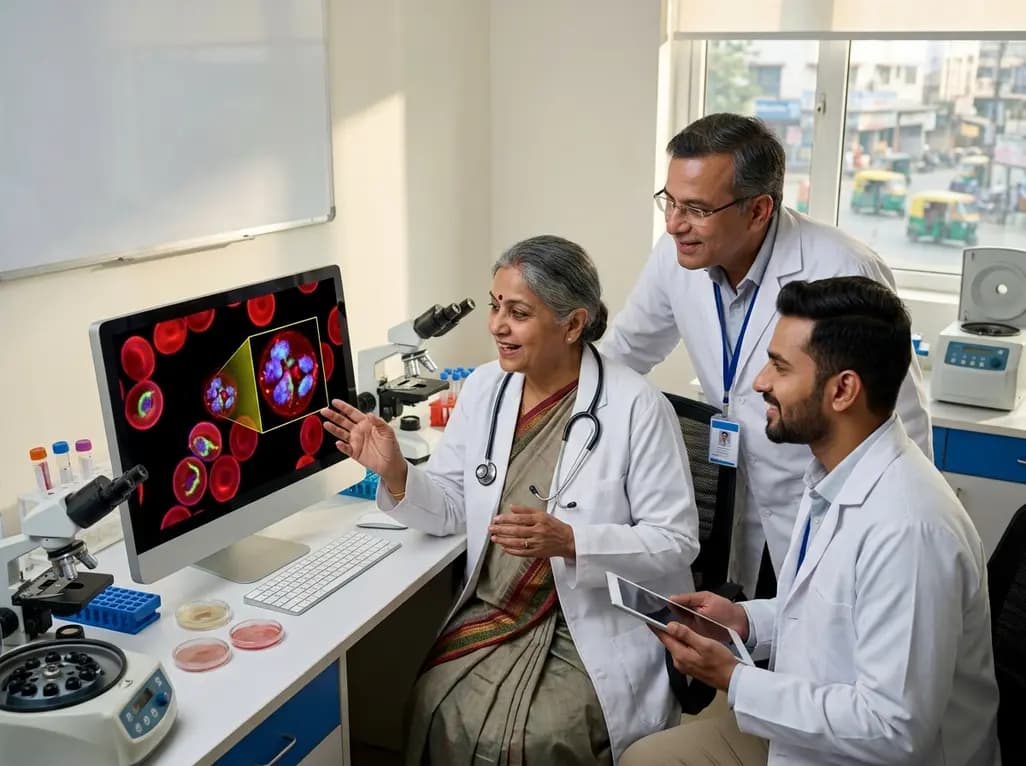
Investigating the microscopic structures of Plasmodium presents severe technical challenges due to the parasite's minuscule size. Individual parasites often measure less than one micron in diameter, making detailed intracellular imaging exceedingly difficult with standard light microscopy. To overcome this limitation, the research team employed Ultra Expansion Microscopy, an innovative technique that physically expands cellular structures. By embedding parasite samples in a hydrogel matrix and expanding them uniformly, researchers enlarged the cells nearly fivefold. Consequently, this remarkable magnification allowed scientists to visualize the precise spatial localization of Ark1 during active nuclear division. They observed that Ark1 accumulates at critical mitotic structures exactly when spindle assembly begins. Furthermore, the high-resolution visualization confirmed that losing Ark1 function leads to severe structural collapse of the mitotic apparatus. Ultimately, advanced imaging tools like expansion microscopy provide indispensable insights into parasite biology, enabling scientists to validate drug targets with unprecedented precision.
The global fight against malaria faces severe setbacks due to the widespread emergence of drug-resistant parasite strains. Historically, chloroquine served as the primary treatment option, but resistance quickly rendered it ineffective in many endemic regions. Subsequently, artemisinin-based combination therapies became the gold standard for clinical management. However, reports of artemisinin resistance are increasing, particularly in Southeast Asia and parts of Africa. Therefore, identifying novel molecular targets with distinct mechanisms of action is an urgent clinical priority. Protein and lipid kinases represent highly druggable targets because small molecules can readily inhibit their enzymatic activity. Furthermore, Ark1 belongs to a divergent chromosomal passenger complex that structural biologists find significantly different from human Aurora kinases. Consequently, medicinal chemists can design selective Ark1 inhibitors that selectively destroy the parasite while sparing human host cells, minimizing potential clinical toxicity.
The identification of Ark1 highlights the immense value of international scientific collaboration in tackling global health crises. This breakthrough resulted from years of joint efforts between Dr. Pushkar Sharma's team at the National Institute of Immunology in New Delhi and Professor Rita Tewari's laboratory at the University of Nottingham. While the Indian team specialized in dissecting cell signaling pathways during human blood-stage infection, the British group focused on parasite development within the mosquito vector. Additionally, computational biologists from the University of Groningen provided vital bioinformatics support to map the divergent protein complex. Furthermore, collaborations with researchers at NITTE University in Mangaluru continue to unravel the broader network of proteins regulated by Ark1. Supported by major international research grants, this multidisciplinary synergy demonstrates how combining expertise in parasitology, imaging, and computational biology accelerates groundbreaking medical discoveries.
Translating the discovery of Ark1 into clinically viable therapeutics requires systematic compound screening and structural optimization. Because Ark1 plays a dual role in human blood stages and mosquito transmission stages, an effective inhibitor could serve as both a curative treatment and a transmission-blocking agent. Consequently, administering such a drug would not only clear active infections in patients but also prevent mosquitoes from acquiring and spreading the parasite. Furthermore, researchers plan to map the entire biochemical interactome of Ark1 to identify secondary targets within the division pathway. Synthetic chemists can leverage structural differences between parasite Ark1 and human Aurora kinases to synthesize highly potent, selective small molecules. As preclinical testing progresses, these efforts offer renewed hope for eradicating multi-drug-resistant malaria strains worldwide.
Q1: What is Ark1 and why is it important in malaria research?
Ark1, or Aurora-related Kinase 1, is an essential enzyme that regulates cell division and nuclear segregation in the malaria parasite Plasmodium. Researchers discovered that Ark1 acts as a primary control switch during parasite multiplication. Inhibiting Ark1 prevents the parasite from forming proper mitotic spindles, thereby halting replication in both human hosts and mosquito vectors.
Q2: How does Ark1 targeting help overcome antimalarial drug resistance?
Current antimalarial therapies face growing resistance to standard drugs like chloroquine and artemisinin. Because Ark1 possesses a unique structure distinct from human kinases and operates via a novel mechanism, targeting it provides a completely new therapeutic pathway. Small molecules designed against Ark1 can effectively kill drug-resistant parasite strains without cross-resistance.
Q3: What role did Ultra Expansion Microscopy play in this discovery?
Plasmodium parasites are extremely tiny, measuring under one micron, which makes detailed intracellular study difficult. Ultra Expansion Microscopy physically inflates parasite cells almost five times their original size without distorting their structure. This advanced technique allowed scientists to clearly observe Ark1 function and confirm how its absence disrupts mitotic spindle formation during cell division.
Disclaimer: This content is for informational and educational purposes only. It does not constitute medical advice or replace professional judgment. Refer to the latest local and national guidelines for clinical practice.
References

Read summarized clinical updates, watch expert medical content, and earn CME certifications right from your smartphone.
Open your smartphone camera to scan and install.





Scientists from India and the UK have identified Aurora-related Kinase 1 (Ark1) as a key enzyme governing Plasmodium cell division. Blocking Ark1 halts parasite replication across human and mosquito hosts, offering a promising strategy to overcome drug resistance.
2 months ago

Depemokimab offers twice-yearly dosing for severe eosinophilic asthma and chronic rhinosinusitis with nasal polyps, significantly cutting exacerbations and hospital admissions.
5 days back

A novel copper metal-organic framework hydrogel remodels the uterine microenvironment to stimulate robust endometrial regeneration, reduce intrauterine fibrosis, and restore reproductive fertility, offering a groundbreaking strategy for managing refractory endometrial damage and Asherman syndrome.
6 days back

New research reveals that non-ablative radiotherapy suppresses ventricular tachycardia by increasing conduction velocity via NaV1.5 upregulation and action potential prolongation. However, sustained sodium current elevation and depressed calcium handling highlight the need for careful clinical translation.
Last week

A single-cell transcriptomic atlas reveals how peripheral nerve injuries cause dorsal root ganglion remodeling. By evaluating proximal nerve crush and resection, researchers identify distinct glial and immune programs that resolve neuropathic pain and promote regeneration.
6 days back

A breakthrough study demonstrates that fullerol-primed extracellular vesicles generated in a 3D SECCS bioreactor attenuate ferroptosis and restore myogenic regeneration in diabetes via the FOXO3 pathway, offering a cell-free therapeutic strategy for diabetic musculoskeletal degeneration.
6 days back
