.webp&w=384&q=75)

Loading, please wait...
Loading, please wait...
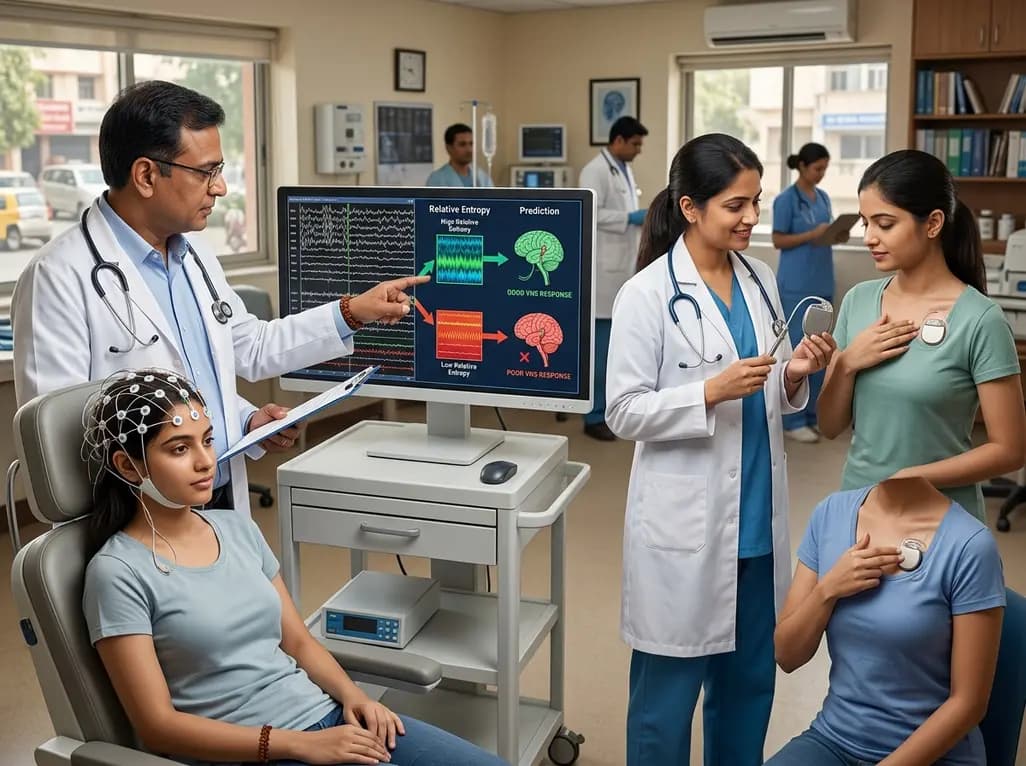
Managing drug-resistant epilepsy (DRE) remains one of the most complex hurdles in modern neurology. When antiseizure medications fail to provide adequate control, clinicians often turn to neuromodulation. Vagus Nerve Stimulation (VNS) has established itself as a cornerstone therapy for such patients. However, the efficacy of VNS varies significantly across the patient population. Specifically, only about half of the patients achieve the desired 50% reduction in seizure frequency. This variability creates a pressing clinical need for reliable predictive tools. Identifying a robust VNS response in epilepsy before the surgical procedure could save patients from unnecessary risks and costs. Currently, patient selection relies heavily on clinical history and basic electroencephalographic patterns. Unfortunately, these traditional methods often lack the precision required for individualized medicine. Recent advancements in signal processing have introduced new concepts like relative entropy. This mathematical approach offers a deeper look into brain signal complexity. By analyzing pre-implantation data, researchers hope to find signatures that separate responders from non-responders. Such biomarkers would revolutionize the treatment pathway for DRE. They would allow neurologists to prioritize VNS for those most likely to benefit while exploring alternative surgeries for others. This paradigm shift toward biomarker-driven care is essential for improving long-term outcomes in epilepsy management.
Relative entropy serves as a powerful tool to measure the statistical differences between two probability distributions. In the context of neurophysiology, it helps quantify the complexity and predictability of brain activity. When we examine intracerebral electroencephalography (IEEG), we are looking at highly localized and high-resolution neural data. Traditional analysis might focus on simple power spectra or spike counts. In contrast, entropy-based methods capture the non-linear dynamics of the epileptogenic network. Responders to VNS often exhibit distinct signatures of neural synchronization or desynchronization compared to non-responders. Scientists believe that VNS works by modulating these wide-scale networks. Therefore, if a patient’s pre-implantation network already shows a specific state of entropy, it may indicate a higher susceptibility to vagal modulation. Researchers have recently focused on how these entropy values fluctuate across different frequency bands. By comparing the 'distance' between resting states and pathological states, relative entropy provides a more nuanced view of brain health. This method is particularly useful because it ignores simple noise and focuses on meaningful signal complexity. Consequently, it offers a more stable metric than traditional amplitude-based measurements. Understanding these mathematical nuances is the first step toward building a reliable predictive model for surgical success.
The search for a reliable biomarker for VNS response in epilepsy has led researchers to deep-dive into invasive data. A landmark study analyzed pre-implantation IEEG data to find differences between responders and non-responders. Responders were strictly defined as those achieving at least a 50% reduction in seizures. The study utilized relative entropy to map the connectivity and complexity of focal brain regions. Interestingly, the results suggested that specific entropy profiles are highly correlated with positive surgical outcomes. For instance, certain patients showed a more flexible neural network that could be easily influenced by external electrical pulses. Furthermore, the localization of these entropy changes often matched the suspected seizure onset zones. This find is significant because it links the mechanism of VNS directly to the localized pathology of the patient. Moreover, using IEEG provides a level of detail that scalp EEG simply cannot match. It allows clinicians to see exactly how the deep structures of the brain are communicating. By establishing these benchmarks, the medical community can move away from 'trial and error' neurostimulation. Instead, they can embrace a personalized approach where the stimulation parameters or the decision to implant are based on quantitative data. This approach represents a major leap forward in neuro-technological precision.
Comparing the neural data of responders and non-responders reveals striking differences in brain signal architecture. In many cases, non-responders exhibit a more rigid or highly synchronized neural state that resists the desynchronizing effects of VNS. Conversely, responders often display a baseline relative entropy that suggests a more 'plastic' network. This plasticity may be the key to why their brains adapt so well to the 10 Hz or 30 Hz pulses delivered by the VNS device. Additionally, the study highlighted that these differences are not uniform across all brain regions. The temporal and frontal lobes, often involved in seizure propagation, showed the most significant entropy variations. By focusing on these areas, neurologists can better predict which patients will see a meaningful reduction in seizure burden. It is also important to note that these biomarkers were evident in the interictal period. This means that clinicians do not necessarily need to capture a live seizure to make these predictions. They can rely on resting-state IEEG data, which is much easier and safer to collect. This practical advantage makes relative entropy an attractive candidate for routine clinical use. As we refine these algorithms, the accuracy of our predictions will only improve. This will eventually lead to a standardized protocol for evaluating VNS candidacy globally, including in high-volume epilepsy centers across India.
For neurologists in India, the introduction of quantitative biomarkers like relative entropy could significantly optimize resource allocation. VNS is a sophisticated and relatively expensive procedure. Therefore, ensuring high responder rates is vital for both patient satisfaction and healthcare economics. In the Indian clinical context, where patients often travel long distances for specialized care, a reliable pre-implantation test is invaluable. If IEEG data can accurately predict a favorable VNS response in epilepsy, it reduces the emotional and financial burden on families. Furthermore, this research encourages more Indian centers to adopt advanced signal processing techniques. Integrating these mathematical tools into standard diagnostic pipelines can elevate the quality of epilepsy surgery programs. Additionally, it fosters a collaborative environment where clinicians and biomedical engineers work together. Such interdisciplinary efforts are essential for developing indigenous solutions tailored to the diverse genetic and clinical profiles of Indian patients. While IEEG is invasive, many surgical candidates already undergo this monitoring as part of their evaluation. Adding entropy analysis to this existing workflow is a cost-effective way to gain deeper insights. Ultimately, the goal is to provide every patient with a tailored treatment plan that offers the highest chance of seizure freedom or significant reduction, improving their overall quality of life.
Relative entropy measures the complexity and statistical differences in brain signals between patients. In VNS candidates, those with specific entropy profiles in their pre-implantation IEEG data tend to respond better to stimulation. This occurs because their neural networks are more susceptible to the modulating effects of the vagus nerve. By identifying these patterns early, clinicians can better select candidates who are likely to achieve significant seizure reduction after the procedure.
Intracerebral EEG (IEEG) provides much higher spatial resolution and signal-to-noise ratios compared to scalp EEG. It captures electrical activity directly from deep brain structures, which is where many complex seizures originate. This high-fidelity data is necessary to calculate precise relative entropy values. While scalp EEG is useful for general screening, IEEG allows for the detailed mapping of the epileptogenic networks required to predict a specific response to VNS therapy.
In most clinical studies, including the recent research on relative entropy, a responder is defined as a patient who experiences a 50% or greater reduction in seizure frequency following VNS implantation. This is the standard benchmark for determining the efficacy of neurostimulation. Patients who fall below this 50% threshold are categorized as non-responders, highlighting the need for biomarkers to identify the more successful group before surgery occurs.
Disclaimer: This content is for informational and educational purposes only and does not constitute medical advice or a professional relationship. The information provided is based on recent research and should be interpreted by qualified healthcare professionals. Always consult with a neurologist or epilepsy specialist for diagnosis and treatment options. Refer to the latest local and national guidelines for clinical practice.
References
Erben Š et al. Relative entropy as a biomarker for vagus nerve stimulation response in epilepsy: Insights from intracerebral electroencephalography. Epilepsia Open. 2026 Jun 30. doi: 10.1002/epi4.70297. PMID: 42378010.
Danthine V, et al. Electroencephalogram synchronization measure as a predictive biomarker of Vagus nerve stimulation response in refractory epilepsy: A retrospective study. PLOS One. 2024 Jun 11. doi: 10.1371/journal.pone.0304567.
Amarantidis LC, Abásolo D. Entropy in scalp EEG can be used as a preimplantation marker for VNS efficacy. PMC. 2023 Nov 1. PMCID: PMC10619574.
"
Read summarized clinical updates, watch expert medical content, and earn CME certifications right from your smartphone.
Open your smartphone camera to scan and install.





New research explores relative entropy in intracerebral EEG as a pre-implantation biomarker to predict VNS response in drug-resistant epilepsy patients.
3 months ago

As monsoon seasons elevate arboviral disease threats, Tamil Nadu has initiated an ICMR-monitored evaluation of the tetravalent dengue vaccine in Tenkasi district. Clinicians emphasize clinical monitoring, public prevention, and high-quality early pediatric care to reduce disease morbidity across endemic regions.
Today

Leucine Rich Bio has introduced South Asia's first comprehensive vaginal microbiome test, BugSpeaks. By profiling microbial dysbiosis, pathogens, and antimicrobial resistance, this next-generation diagnostic platform provides clinicians with deeper insights into recurrent infections, fertility, and reproductive health.
Today

Review how tailored exercise programs benefit frail older patients with heart failure. Explore pathophysiological mechanisms, individualized training prescriptions, and strategies to overcome adherence barriers in clinical practice.
Today

This comparative study evaluates posterior labral tears with and without glenohumeral instability, highlighting distinct demographic patterns, MRI underestimation in stable shoulders, and successful arthroscopic repair outcomes.
Today

A clinical study demonstrates that early intervention with tocilizumab, either as monotherapy or bridged with corticosteroids, achieves significant proptosis reduction and resolves active inflammation in treatment-naive thyroid eye disease.
Today
