.webp&w=384&q=75)

Loading, please wait...
Loading, please wait...

Acoustic evaluation serves as a cornerstone in the multidimensional assessment of voice disorders. However, clinicians often encounter significant analytical errors when applying traditional perturbation measures to severely disordered voices. Visual signal typing addresses this fundamental diagnostic challenge by categorizing acoustic signals based on narrowband spectrographic displays. Consequently, this qualitative triage prevents the misapplication of mathematical algorithms to irregular voice signals. Recent systematic review findings provide essential clarity regarding how clinicians should apply these methods across diverse patient populations.
Acoustic assessment protocols routinely calculate fundamental frequency, jitter, shimmer, and harmonics-to-noise ratios. Nevertheless, traditional cycle-by-cycle perturbation algorithms mathematically depend on near-periodic waveforms. When severe laryngeal pathology creates turbulent or chaotic airflow, standard pitch-tracking algorithms fail unpredictably. Therefore, visual signal typing functions as an essential gatekeeper before clinicians run computerized voice analysis.
By inspecting narrowband spectrograms, clinicians identify harmonic structure, subharmonics, modulations, and stochastic noise. This visual inspection prevents false conclusions derived from corrupted mathematical data. For instance, when a disordered voice exhibits severe irregularity, standard automated algorithms generate spurious perturbation values that do not reflect true vocal fold biology. Visual classification ensures that clinicians only apply perturbation metrics to stable, periodic signals. Meanwhile, clinicians route severely irregular signals toward nonlinear dynamic assessments, auditory-perceptual scales, or qualitative spectrographic reporting. As a result, this gatekeeping step maintains the scientific integrity of clinical voice databases and longitudinal patient tracking.
Over three decades, two primary frameworks have structured the practice of visual classification. The classic Titze scheme originally established three distinct voice types. Type 1 signals display clear periodicity with well-defined harmonic trajectories, making them fully eligible for perturbation analysis. Type 2 signals present qualitative bifurcations, subharmonics, or strong modulations, requiring cautious qualitative appraisal. Type 3 signals demonstrate total aperiodicity and chaotic dynamics, rendering cycle extraction invalid.
Later, Sprecher and colleagues refined this laryngeal framework by introducing Type 4 signals. This fourth category specifically captures stochastic noise without deterministic chaos, which clinically reflects severe breathiness. In contrast, the van As-Brooks system specifically addresses tracheoesophageal speech after total laryngectomy. Tracheoesophageal voice inherently possesses irregular mucosal vibration and lower fundamental frequencies. Therefore, the van As-Brooks framework modifies harmonic clarity thresholds and frequency stability criteria to account for pharyngoesophageal segment mechanics. While both systems categorize acoustic signals along a spectrum of structural integrity, clinicians must choose the correct framework depending on the underlying vibratory source.
Evaluating the clinical utility of any diagnostic framework requires robust measurement reliability. Across published literature, inter-rater reliability for visual classification varies substantially, with kappa coefficients spanning from 0.45 to 0.95. Fortunately, investigations focusing on laryngeal voice demonstrate consistently higher agreement than those examining substitute sound sources. In laryngeal cohorts, trained raters routinely achieve substantial-to-almost-perfect agreement, with kappa values typically exceeding 0.72.
Conversely, tracheoesophageal evaluations demonstrate wider variability, yielding kappa values between 0.55 and 0.84. This lower consistency reflects the inherent irregularity, spectral clutter, and baseline noise characteristic of prosthetic voice restoration. Moreover, perceptual validation studies indicate moderate-to-strong directional correlations between visual signal types and clinician-rated vocal roughness or breathiness. Two landmark studies noted correlation coefficients of 0.746 and -0.93 between visual classes and perceptual severity scores. However, achieving dependable clinical reliability mandates structured rater training protocols. Without standardized visual reference anchors and formal training manuals, inexperienced clinicians frequently confuse subharmonic modulation with true acoustic chaos.
Systematic evidence highlights a striking clinical reality: visual classification identifies approximately 50 percent of dysphonic clinical samples as completely unsuitable for traditional perturbation calculations. This finding carries immense practical significance for clinical practice in otolaryngology. When practitioners bypass visual inspection, they risk feeding aperiodic or noise-dominated signals into automated software. Consequently, software programs output meaningless numerical data that may lead to inappropriate therapeutic decisions.
Furthermore, traditional acoustic software often produces false fundamental frequency tracks when analyzing Type 2 or Type 3 signals. By excluding these chaotic samples from jitter and shimmer analyses, visual triage eliminates measurement artifacts. However, this gatekeeper process also exposes a persistent diagnostic gap. When half of patient voice recordings cannot undergo perturbation analysis, clinicians must rely on alternative objective tools. Nonlinear dynamic metrics, such as correlation dimension and sample entropy, offer promise for Type 3 deterministic chaos. In contrast, spectral cepstral measures, including Cepstral Peak Prominence, provide robust quantification across all signal types, bridging the diagnostic void created by severe dysphonic irregularity.
Manual visual inspection requires significant clinician time, dedicated training, and expert spectrographic interpretation. To address these workflow barriers, biomedical engineers have recently developed automated classification algorithms using machine learning and deep convolutional neural networks. These computational tools analyze spectrographic image textures and acoustic feature sets directly, achieving classification accuracies between 82 percent and 96 percent.
Automated signal typing significantly reduces inter-rater discrepancies and accelerates high-volume clinical workflows. Furthermore, automated pipelines can segment continuous speech samples into localized temporal frames. Because vocal stability often fluctuates across a single sustained vowel or connected speech passage, frame-by-frame analysis identifies transient bifurcations that manual human inspection might overlook. Nevertheless, existing automated models have primarily been trained on curated research databases. Therefore, their generalizability to real-world clinical recordings, background environmental noise, and varying microphone specifications requires extensive multi-center validation. Integrating automated visual typing into voice clinic software will democratize reliable acoustic preprocessing for otolaryngologists and speech-language pathologists worldwide.
Visual signal classification remains an indispensable methodological step in laryngeal voice assessment. Evidence solidly supports its diagnostic reliability when raters complete structured calibration. However, critical gaps persist across clinical and research landscapes. Current evidence primarily derives from sustained vowel phonations, leaving connected speech classification relatively unexplored. Furthermore, researchers must validate signal typing frameworks across neurological voice disorders, such as spasmodic dysphonia and vocal tremor, where pitch fluctuations differ fundamentally from structural mass lesions.
Telemedicine presents another frontier requiring rigorous standardization. Remote audio compression algorithms, smartphone microphones, and variable bandwidths can distort spectrographic harmonics, artificially inflating signal classification severity. Therefore, international professional laryngology societies must establish standardized guidelines for recording calibration, spectrogram display settings, and rater training certification. By integrating visual signal typing with robust cepstral analytics and artificial intelligence, clinicians can deliver comprehensive, reliable, and evidence-based diagnostic voice care across all clinical settings.
Traditional perturbation measures, including jitter and shimmer, mathematically require nearly periodic acoustic waveforms to track cycle boundaries accurately. In moderate-to-severe dysphonia, chaotic vocal fold vibration or excessive turbulent noise disrupts cycle detection algorithms. Visual signal typing evaluates narrowband spectrograms to identify signal periodicity beforehand. Consequently, this triage prevents clinicians from applying cycle-dependent mathematical formulas to irregular signals, avoiding misleading numerical data in clinical reports.
The Titze-Sprecher framework evaluates laryngeal phonation across four distinct tiers, categorizing signals from periodic waves to deterministic chaos and stochastic noise. In contrast, the van As-Brooks system specifically assesses tracheoesophageal speech generated by the pharyngoesophageal segment after total laryngectomy. Because prosthetic speech inherently exhibits reduced fundamental frequency and higher baseline irregularity, the van As-Brooks framework adjusts spectral criteria and harmonic thresholds to reflect non-laryngeal vibratory biomechanics.
Automated machine learning models achieve impressive classification accuracies between 82 and 96 percent in research settings. These algorithms rapidly process spectrograms and reduce subjective rater bias during high-volume clinical workflows. However, automated systems currently require validation across diverse acoustic environments, varying microphone hardware, and complex neurological etiologies. Consequently, clinicians must still oversee automated classifications, using automated tools as decision-support aids rather than autonomous replacements.
Disclaimer: This content is for informational and educational purposes only, and should not be taken as professional medical advice. It is intended to support, not replace, the relationship between patients and their healthcare professionals. Please consult a qualified health provider for medical concerns. Refer to the latest local and national guidelines for clinical practice.
References

Read summarized clinical updates, watch expert medical content, and earn CME certifications right from your smartphone.
Open your smartphone camera to scan and install.





A systematic review evaluates visual signal typing across 30 years of voice assessment literature, detailing the Titze-Sprecher and van As-Brooks frameworks, rater reliability, and its critical role in preventing erroneous perturbation analyses in severe dysphonia.
4 weeks back

Targeting ferroptosis provides a compelling strategy to dismantle hypoxia- and acidosis-driven immunosuppression in solid tumors, enhancing response to modern immunotherapy.
Today

Findings from Project Viva indicate that sustained postpartum weight retention, rather than excessive gestational weight gain alone, directly worsens women's mid-life cardiovascular health, degrading blood pressure and glycemic parameters decades after delivery.
Today
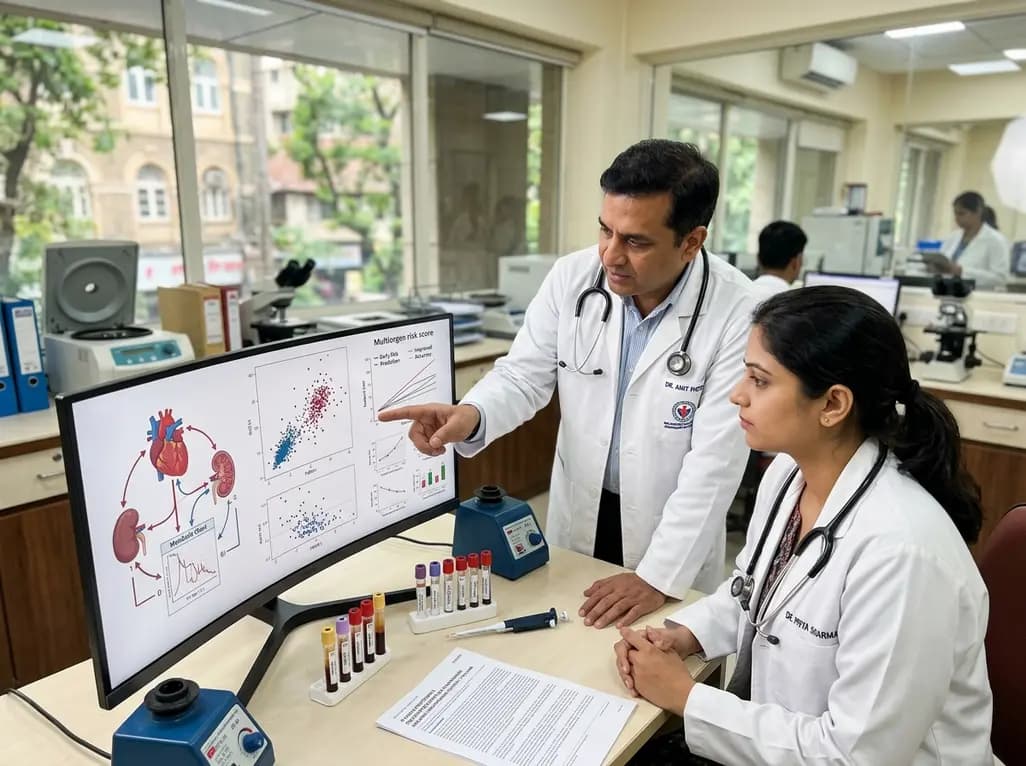
A large UK Biobank study reveals that plasma proteomic signatures capture preclinical organ damage and improve multiorgan risk prediction across early CKM syndrome stages 0 to 2 beyond traditional PREVENT clinical models.
Today

A retrospective CBCT study reveals that superior TMJ space asymmetry correlates moderately with occipital condyle-atlas-axis asymmetry in unilateral TMJ osteoarthritis, highlighting an imaging correlate between jaw biomechanics and upper cervical alignment rather than a standalone diagnostic marker.
Today

A Bayesian multilevel meta-analysis reveals that aerobic training combined with moderate carbohydrate restriction modestly lowers HbA1c in type 2 diabetes. However, sparse data and very low certainty leave incremental benefits over exercise or diet alone unproven, highlighting the need for individualized care.
Today
