.webp&w=384&q=75)

Loading, please wait...
Loading, please wait...
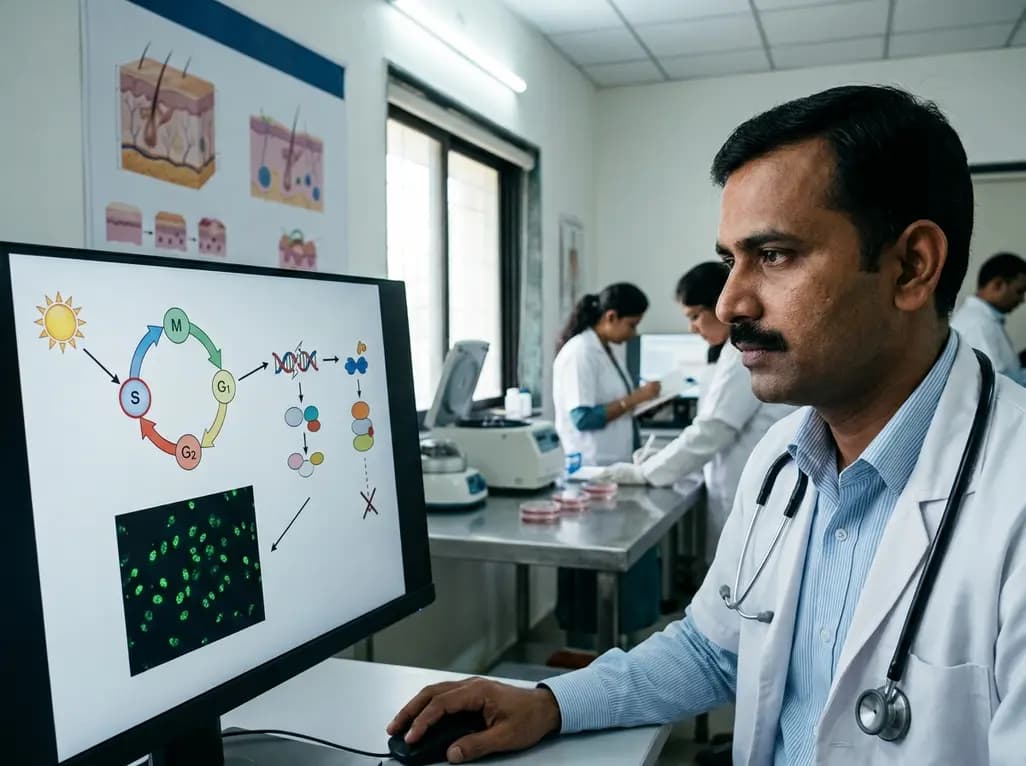
Ultraviolet B (UVB) radiation, spanning wavelengths of 280-320 nm, represents a major environmental threat to skin health. It directly damages the DNA within epidermal cells, serving as a primary driver for skin cancer. Recent research highlights that the UVB DNA damage response in human keratinocytes is highly specific to the cell cycle. Specifically, cells in the S phase exhibit the most robust activation of signaling pathways. This discovery clarifies how the skin attempts to maintain genomic integrity during active DNA replication.
When UVB hits keratinocytes, the cells initiate a complex DNA damage response (DDR). This process involves several critical protein kinases, including ATR (ataxia telangiectasia and Rad3-related), ATM (ataxia telangiectasia mutated), and DNA-PKcs. These kinases act as sensors and signal transducers that recruit essential repair proteins. For instance, they promote the accumulation of phosphorylated H2AX and p53 at sites of damage. Interestingly, confocal microscopy shows these proteins forming discrete subnuclear foci primarily during the S phase. Consequently, this suggests that the replication machinery itself may interact with UVB-induced lesions to trigger the signaling cascade.
One of the most significant findings of this study is the relationship between the UVB DNA damage response and oxidative stress. While UVB exposure certainly increases intracellular reactive oxygen species (ROS), the DDR signaling appears decoupled from this oxidative damage. Researchers tested this by depleting intracellular glutathione, which drastically increased ROS levels. However, this depletion did not significantly alter the activation of DDR proteins. Therefore, the study confirms that the signaling pathways triggered by UVB are a direct result of DNA lesions rather than a secondary effect of oxidative stress.
Understanding these molecular mechanisms is vital for clinicians and researchers. Because the response is S phase-dependent, cells undergoing rapid division are potentially more susceptible to mutations if the DDR fails. Furthermore, knowing that oxidative stress does not drive this specific signaling suggests that antioxidant-only therapies might not fully prevent UVB-induced genomic instability. Consequently, future preventive strategies may need to focus more directly on enhancing the efficiency of the ATR/ATM-mediated repair pathways.
The S phase of the cell cycle shows the most pronounced activation of DNA damage response signaling. This is likely because the replication process encounters UVB-induced lesions, leading to double-strand breaks and higher recruitment of repair proteins.
While oxidative stress increases following UVB exposure, the specific DNA damage response signaling involving ATR and DNA-PKcs in S phase cells occurs independently of reactive oxygen species (ROS) levels.
Disclaimer: This content is for informational and educational purposes only. It does not constitute medical advice or establish a doctor-patient relationship. Refer to the latest local and national guidelines for clinical practice.
References
An Y et al. UVB Light Activates an S Phase-Dependent DNA Damage Response in Human Keratinocytes Independent of Oxidative Stress. Toxicol Sci. 2026 Jun 10. doi: undefined. PMID: 42268659.
Yajima H, Lee KJ, Chen BP. ATR-dependent phosphorylation of DNA-dependent protein kinase catalytic subunit in response to UV-induced replication stress. Mol Cell Biol. 2006;26(20):7520-7528. doi: 10.1128/MCB.00048-06.
Nishigori C. UV-induced DNA damage in carcinogenesis and its repair. J Dermatol Sci. 2006;44(1):1-10. doi: 10.1016/j.jdermsci.2006.07.001.
"
Read summarized clinical updates, watch expert medical content, and earn CME certifications right from your smartphone.
Open your smartphone camera to scan and install.





A groundbreaking study reveals that UVB-induced DNA damage response in human keratinocytes is specifically activated during the S phase of the cell cycle. Notably, this signaling pathway operates independently of oxidative stress, providing new insights into the molecular mechanisms of skin carcinogenesis.
last month

Andhra Pradesh reported 10 new Covid-19 cases, taking the state tally to 49 while deaths remain at four. With 24 patients hospitalized and 16 under home isolation, the Health Department has intensified monitoring. Medical professionals should review regional distribution, diagnostic protocols, and management plans.
Yesterday

An 11-year Swedish registry study of 618 uterine sarcoma patients found that minimally invasive surgery yielded survival comparable to open surgery in early stages. However, adjuvant chemotherapy conferred no survival benefit in localized or advanced disease, highlighting stage and histology as key outcomes.
4 days back

A cross-sectional study evaluates post-intensive care syndrome in cardiac patients 2-4 weeks post-ICU discharge, highlighting cognitive, psychological, and functional impairments and the need for structured multidisciplinary rehabilitation.
4 days back

Anterior cruciate ligament reconstruction failure lacks uniform definition. A narrative review proposes an integrative framework incorporating objective and subjective instability, persistent pain, restricted motion, graft rupture, and secondary meniscal injury to standardize clinical reporting.
4 days back

A UK Biobank study of 471,540 participants reveals that metabolic syndrome increases incident gastric cancer risk by 36% (HR=1.36). A positive trend was observed with accumulating metabolic components, with waist circumference showing the strongest association, highlighting modifiable risk targets.
5 days back
