.webp&w=384&q=75)

Loading, please wait...
Loading, please wait...
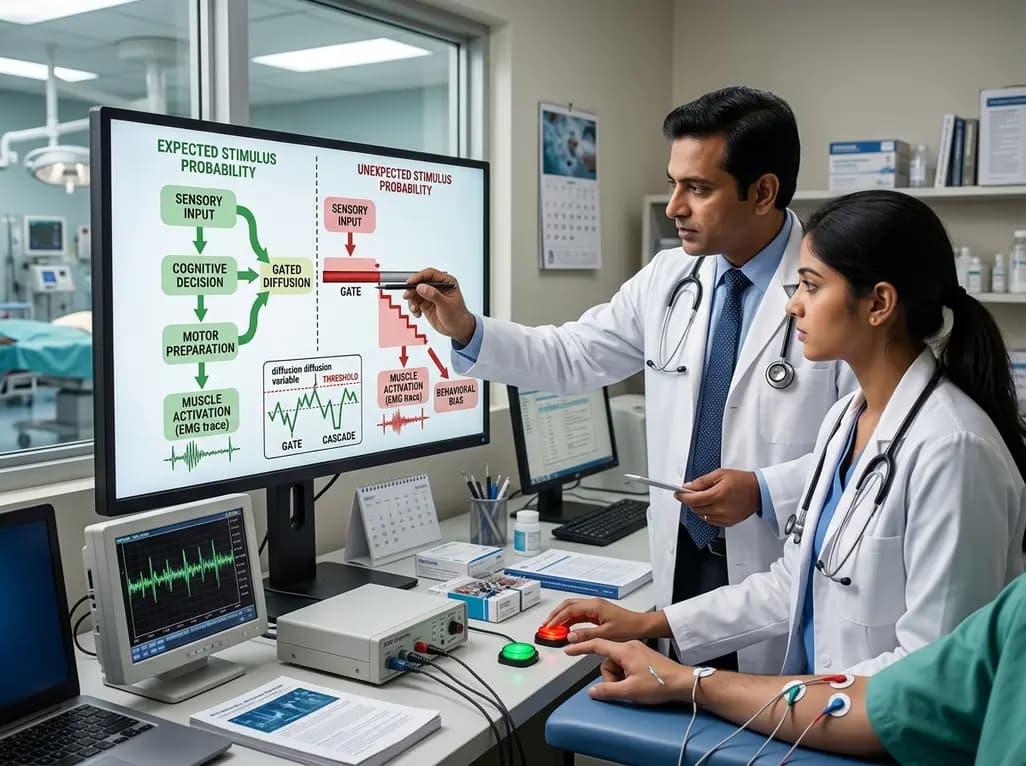
Recent neuroscientific research has shed light on the decision-motor cascade, the complex process where cognitive choices transform into physical actions. Historically, sequential sampling models focused primarily on the starting point of evidence accumulation within the brain. However, new findings suggest that motor execution plays a far more active role in behavioral biases than previously thought. Specifically, when the probability of a stimulus changes, it alters both the speed of the decision and the efficiency of the motor response.
To investigate this phenomenon, researchers utilized electromyographic (EMG) recordings during a random dot motion task. This method allowed them to track muscle activity with high precision. They found that stimulus probability strongly influences the interval between the onset of a stimulus and the initial activation of the muscles. For expected stimuli, muscle onsets occurred significantly earlier during correct trials. Conversely, when a stimulus was unexpected, this timing pattern reversed, particularly during incorrect responses. These insights provide a clearer picture of how our expectations prime our physical bodies for action.
The study further explored how the decision-motor cascade manages subthreshold muscle activations. These are tiny bursts of muscle activity that do not always lead to a full response. Interestingly, when the first activation occurred in the correct response channel, accuracy was notably higher for expected stimuli. However, if the initial activation appeared in the opposite channel, the bias for expected stimuli reversed. This suggests that the motor system is not just a passive recipient of a completed decision but is actively engaged in the process of evidence accumulation.
Moreover, the researchers applied the gated cascade diffusion model to analyze these behavioral shifts. This computational framework successfully linked cognitive decision-making with motor preparation. The model revealed that stimulus probability introduces an additive bias to the rate of evidence accumulation. Furthermore, it identified an evidence-independent urgency signal at the motor level. This signal is engaged earlier for response alternatives linked to expected stimuli, effectively "fast-tracking" the motor pathway for predicted outcomes.
Understanding these mechanisms is crucial for clinicians dealing with motor control disorders or behavioral biases in psychiatric conditions. Consequently, the research highlights that behavioral outcomes are a result of integrated processing across multiple levels of the nervous system. By identifying how urgency signals and evidence accumulation interact, medical professionals can better understand the nuances of response inhibition and reaction time variability in patients. These findings advance our grasp of how the human brain and body coordinate to navigate uncertain environments.
The decision-motor cascade describes the continuous flow of information from the cognitive decision-making stage in the brain to the actual activation of muscles for a physical response.
Higher stimulus probability leads to earlier muscle activation for expected outcomes. When a stimulus is expected, the motor system prepares the response earlier, reducing overall reaction time.
This model is vital because it bridges the gap between abstract decision models and physical muscle activity. It accounts for both behavioral accuracy and the timing of electromyographic signals during tasks.
Disclaimer: This content is for informational and educational purposes only. It is not intended to be a substitute for professional medical advice, diagnosis, or treatment. Refer to the latest local and national guidelines for clinical practice.
References
Dendauw E et al. Separating decision and motor contributions to behavioral biases induced by manipulating stimulus probability. Cogn Psychol. 2026 Jun 11. doi: undefined. PMID: 42275738.
Forster et al. Two Paths to Bias: Distinct influences of stimulus probability and previous choice on drift diffusion parameters. ResearchGate. 2026 May 12.
Dendauw E et al. The gated cascade diffusion model: An integrated theory of decision making, motor preparation, and motor execution. Psychol Rev. 2024 Jul 15.
"
Read summarized clinical updates, watch expert medical content, and earn CME certifications right from your smartphone.
Open your smartphone camera to scan and install.





Recent research highlights how stimulus probability influences the decision-motor cascade, affecting both decision-making and motor execution stages. Using EMG data and the gated cascade diffusion model, the study explains how expectations bias muscle activation and response times.
4 months ago

Review how tailored exercise programs benefit frail older patients with heart failure. Explore pathophysiological mechanisms, individualized training prescriptions, and strategies to overcome adherence barriers in clinical practice.
Today

Leucine Rich Bio has introduced South Asia's first comprehensive vaginal microbiome test, BugSpeaks. By profiling microbial dysbiosis, pathogens, and antimicrobial resistance, this next-generation diagnostic platform provides clinicians with deeper insights into recurrent infections, fertility, and reproductive health.
Today

In high-risk pulmonary embolism complicated by severe anemia and active uterine bleeding, systemic thrombolysis is contraindicated. Large-bore aspiration thrombectomy provides rapid hemodynamic rescue without fibrinolysis, supported by inferior vena cava filter placement and multidisciplinary critical care.
Today

This comparative study evaluates posterior labral tears with and without glenohumeral instability, highlighting distinct demographic patterns, MRI underestimation in stable shoulders, and successful arthroscopic repair outcomes.
Today

A clinical study demonstrates that early intervention with tocilizumab, either as monotherapy or bridged with corticosteroids, achieves significant proptosis reduction and resolves active inflammation in treatment-naive thyroid eye disease.
Today
