.webp&w=384&q=75)

Loading, please wait...
Loading, please wait...
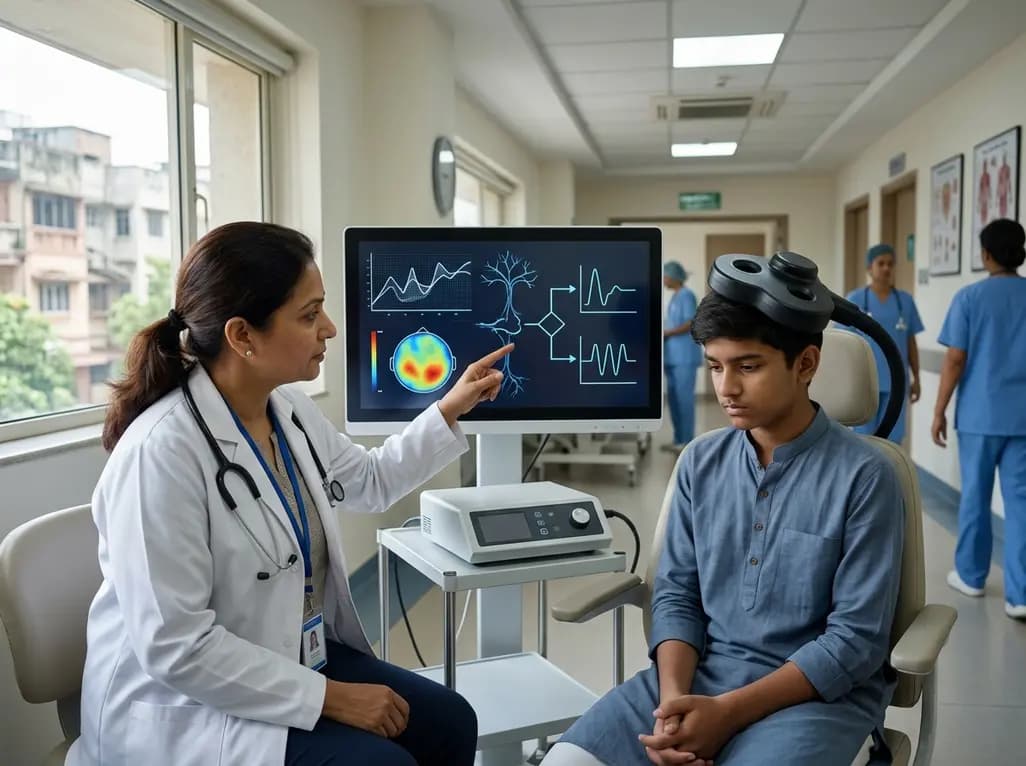
Major depressive disorder (MDD) among adolescents is a significant global health concern, frequently requiring robust and innovative treatment strategies. While traditional therapies like psychotherapy and pharmacology are first-line interventions, a substantial portion of the pediatric population remains non-responsive. Consequently, researchers have turned to neurostimulation, specifically repetitive transcranial magnetic stimulation (rTMS), to fill this gap. Using TMS for adolescent depression has gained traction, yet clinical application has historically lagged due to a lack of age-specific dosing protocols and validated biomarkers. This study represents a pivotal step in refining these parameters for younger patients.
Clinicians often struggle with selecting the most effective stimulation frequency, typically choosing between low-frequency (1-Hz) and high-frequency (10-Hz) protocols. Understanding how individual brain physiology interacts with these pulses is essential for personalized medicine. Therefore, identifying biological indicators that predict treatment response is a top priority in pediatric psychiatry. This research specifically evaluates how glutamatergic measures can guide the selection of TMS parameters to improve clinical outcomes in adolescents with moderate-to-severe depression.
Intracortical facilitation (ICF) is a neurophysiological measure obtained through paired-pulse TMS, reflecting the activity of glutamatergic N-methyl-d-aspartate (NMDA) receptors. In the context of TMS for adolescent depression, ICF serves as a window into the excitatory mechanisms of the motor cortex. Glutamate is the primary excitatory neurotransmitter in the human brain, and its dysregulation is heavily implicated in the pathophysiology of mood disorders. By measuring ICF, researchers can assess the balance of excitation and inhibition within the cortical circuits of depressed youth.
Interestingly, this study found that ICF remains remarkably stable over a six-week treatment period. Unlike some markers that shift with symptomatic improvement, ICF appears to be a tonic, trait-like measure of NMDA receptor-mediated neurotransmission. This stability is crucial because it suggests that baseline ICF levels can reliably inform long-term treatment planning. Furthermore, low baseline ICF may signify a specific state of glutamatergic activity that is particularly receptive to certain types of magnetic stimulation, allowing for more precise therapeutic targeting than traditional trial-and-error methods.
The core of the study involved a randomized comparison between 1-Hz and 10-Hz TMS regimens. Traditionally, 10-Hz stimulation is considered excitatory and applied to the left prefrontal cortex, while 1-Hz is considered inhibitory. However, the neurobiological response in the developing adolescent brain can differ significantly from that of adults. During the trial, 41 participants received 30 sessions of either frequency, stratified by their baseline ICF measures. Notably, both groups showed overall improvement in depressive symptoms as measured by the Children's Depression Rating Scale-Revised (CDRS-R).
However, the most significant finding emerged when analyzing the interaction between frequency and the ICF biomarker. For participants identified with low ICF at the start of the trial, 1-Hz TMS resulted in lower symptom severity compared to those receiving 10-Hz. This suggests that the 1-Hz protocol may utilize long-term depression-like mechanisms to stabilize synaptic plasticity in these specific individuals. Consequently, the assumption that high-frequency stimulation is always superior for depression is being challenged, particularly when biological subtypes are considered in the adolescent population.
The primary outcome of the study focused on the change in CDRS-R scores over six weeks. While both treatment arms were effective, the biomarker-informed approach provided a clearer path for optimization. Specifically, the data indicated that adolescents with low ICF responded significantly better to 1-Hz TMS. This finding is revolutionary because it provides a tangible metric for clinicians to use when choosing a starting frequency. Instead of selecting 10-Hz by default, a baseline neurophysiological assessment could point toward 1-Hz as a more effective alternative for a subset of patients.
Moreover, the study emphasized that ICF did not change weekly despite clinical improvement. This confirms that ICF is not a "state" marker reflecting the current level of depression but a "trait" marker reflecting the underlying neural architecture. Therefore, clinicians can rely on an initial ICF reading to guide the entire course of treatment. This stability reduces the need for repeated, complex biomarker testing during the acute phase of therapy. Such insights are invaluable for streamlining TMS for adolescent depression in busy clinical settings where efficiency and accuracy are paramount.
For psychiatrists and pediatricians, these results offer a practical framework for integrating neurostimulation into practice. When treating adolescents who have not responded to standard care, assessing glutamatergic function through ICF can now be viewed as a valid stratification tool. If a patient presents with low ICF, the evidence strongly supports starting with a 1-Hz regimen. This personalized approach not only potentially increases the speed of recovery but also minimizes the time spent on less effective protocols, which is critical given the high risks associated with untreated adolescent depression.
In addition to frequency selection, the study underscores the safety and feasibility of 30-session TMS protocols in youth. The rigor of the trial, including the inclusion of diverse populations and sex balance, enhances the generalizability of the findings. Clinicians should also note that the CDRS-R remains a reliable tool for monitoring these improvements. As neurostimulation becomes more accessible in countries like India, adopting these evidence-based, biomarker-informed strategies will be essential for improving the standard of care for teen mental health across various demographic groups.
The success of this study opens several doors for future research in TMS for adolescent depression. First, exploring whether other biomarkers, such as GABAergic inhibition measures, provide similar predictive value could lead to a multi-faceted biological profile for every patient. Additionally, larger-scale trials are needed to confirm these findings across even broader populations. Investigating the long-term durability of the improvements seen with 1-Hz TMS in low-ICF patients will also be vital for understanding maintenance requirements.
Furthermore, as we move toward more integrated mental health services, the combination of TMS with other therapies should be examined. For instance, does psychotherapy enhance the synaptic plasticity changes initiated by 1-Hz stimulation? The stability of ICF as a trait marker also suggests it could help identify at-risk youth even before the onset of severe depressive episodes. Ultimately, the goal is to transition from a generalized treatment model to a precision-based one, ensuring that every adolescent receives the specific dose and frequency required for their unique neurobiology.
Research indicates that adolescents with low baseline intracortical facilitation (ICF) show better symptom reduction with 1-Hz TMS. This lower frequency may optimize NMDA receptor activity and stabilize synaptic plasticity more effectively than the 10-Hz protocol in this specific biological subgroup, leading to superior clinical outcomes in depressive symptoms.
ICF is measured using paired-pulse TMS to assess glutamatergic neurotransmission. Because it is a stable, trait-like measure, a single baseline assessment can help clinicians decide which TMS frequency is most likely to succeed. It serves as a predictive tool for personalizing neurostimulation protocols rather than a measure of daily mood changes.
Yes, clinical trials involving 30 sessions of TMS have shown it to be a safe and effective intervention for adolescents with moderate-to-severe depression. Significant improvements in Children's Depression Rating Scale-Revised (CDRS-R) scores were observed across both 1-Hz and 10-Hz groups, suggesting its viability as a treatment for treatment-resistant cases.
Disclaimer: This content is for informational and educational purposes only. It does not constitute medical advice or a substitute for professional healthcare consultation. Always seek the advice of a physician or other qualified health provider with any questions regarding a medical condition. Refer to the latest local and national guidelines for clinical practice.
References
Lewis CP et al. A Dose-Finding, Biomarker Validation, and Effectiveness Study of Transcranial Magnetic Stimulation for Adolescents With Depression. J Am Acad Child Adolesc Psychiatry. 2025 Oct. doi: 10.1016/j.jaac.2024.08.487. PMID: 39245178.
Croarkin PE et al. Cortical inhibitory and excitatory correlates of depression severity in children and adolescents. Journal of Affective Disorders. 2016; 190: 209-217.
Wall CA et al. Magnetic resonance imaging-guided, open-label, high-frequency repetitive transcranial magnetic stimulation for adolescents with major depressive disorder. Journal of Clinical Psychiatry. 2011; 72(9): 1263-1269.

Read summarized clinical updates, watch expert medical content, and earn CME certifications right from your smartphone.
Open your smartphone camera to scan and install.





A recent study investigates optimal dosing for TMS in adolescents with depression, revealing that low intracortical facilitation (ICF) biomarkers may help clinicians choose between 1-Hz and 10-Hz protocols for better symptom relief.
3 months ago

As monsoon seasons elevate arboviral disease threats, Tamil Nadu has initiated an ICMR-monitored evaluation of the tetravalent dengue vaccine in Tenkasi district. Clinicians emphasize clinical monitoring, public prevention, and high-quality early pediatric care to reduce disease morbidity across endemic regions.
Today

Leucine Rich Bio has introduced South Asia's first comprehensive vaginal microbiome test, BugSpeaks. By profiling microbial dysbiosis, pathogens, and antimicrobial resistance, this next-generation diagnostic platform provides clinicians with deeper insights into recurrent infections, fertility, and reproductive health.
Today

Review how tailored exercise programs benefit frail older patients with heart failure. Explore pathophysiological mechanisms, individualized training prescriptions, and strategies to overcome adherence barriers in clinical practice.
Today

This comparative study evaluates posterior labral tears with and without glenohumeral instability, highlighting distinct demographic patterns, MRI underestimation in stable shoulders, and successful arthroscopic repair outcomes.
Today

A clinical study demonstrates that early intervention with tocilizumab, either as monotherapy or bridged with corticosteroids, achieves significant proptosis reduction and resolves active inflammation in treatment-naive thyroid eye disease.
Today
