.webp&w=384&q=75)

Loading, please wait...
Loading, please wait...
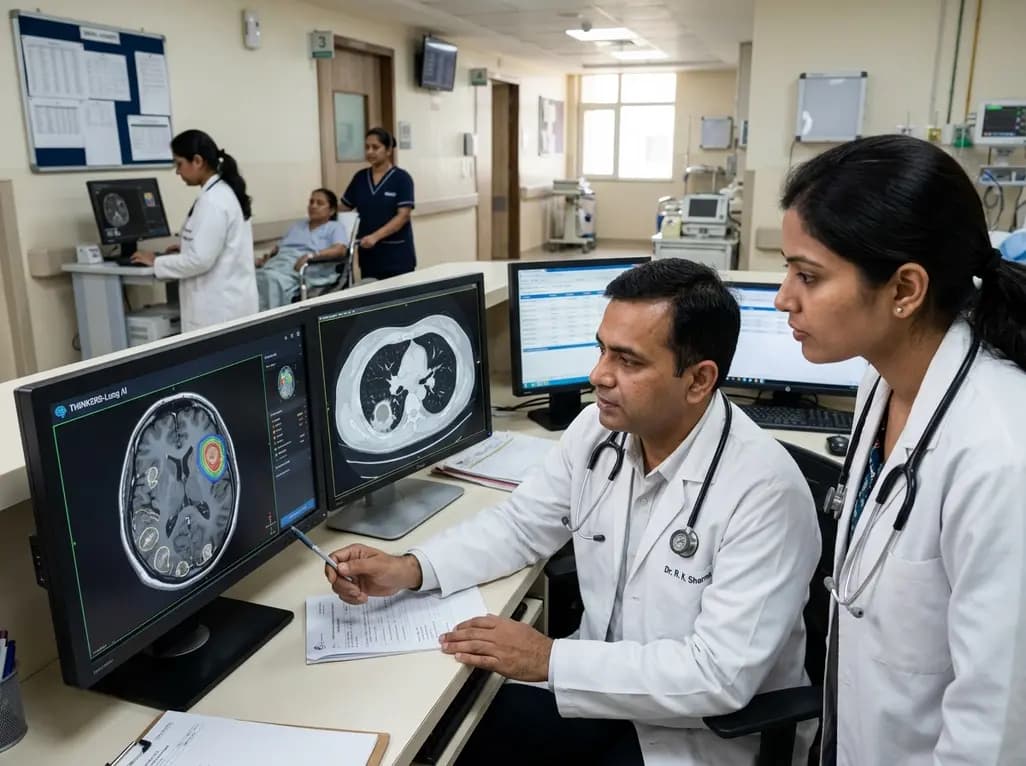
Lung cancer frequently metastasizes to the central nervous system, creating severe therapeutic dilemmas for multidisciplinary clinical teams. Stereotactic radiosurgery (SRS) serves as an essential frontline intervention for patients presenting with secondary intracranial disease. However, selecting the optimal prescription dose for lung cancer brain metastases has historically relied on broad empirical guidelines rather than personalized tumor biology. Clinicians regularly balance intracranial disease control against the devastating risks of radiation necrosis without quantitative, lesion-specific forecasting tools. To address this persistent clinical challenge, researchers developed THINKERS-Lung, a pioneering artificial intelligence framework. This novel computational platform combines neural networks with knowledge-based expert reasoning to evaluate radiosurgical doses for individual intracranial lesions. By moving beyond one-size-fits-all prescriptions, the system introduces a data-driven approach to optimize therapeutic efficacy and improve patient care.
Secondary intracranial tumors develop in nearly half of all individuals diagnosed with advanced non-small cell lung cancer. Consequently, intracranial disease control represents a primary determinant of neurological preservation, cognitive functioning, and overall survival. Stereotactic radiosurgery delivers highly focused, ablative radiation doses directly to intracranial targets while sparing adjacent healthy brain parenchyma. Despite continuous technological advances in Gamma Knife and linear accelerator delivery systems, dose prescription practices remain largely standardized. Most radiation oncologists utilize static dose tiers established by historical trials based primarily on lesion diameter.
However, this generalized approach overlooks crucial lesion-specific heterogeneity, prior systemic therapy responses, and individual failure dynamics. Under-dosing a radiosensitive lesion can lead to early local failure and subsequent neurological deterioration. Conversely, excessive radiation doses significantly increase the risk of symptomatic radiation-induced necrosis and debilitating cerebral edema. Therefore, clinicians urgently require objective decision-support architectures capable of simulating treatment outcomes across multiple candidate dose levels. By forecasting tumor-specific control trajectories, oncologists can tailor radiation margins and prescription doses with unmatched precision.
The THINKERS-Lung platform utilizes a sophisticated mixture-of-experts (MoE) deep neural network integrated with discrete-time survival modeling. Investigators trained this artificial intelligence framework using a substantial single-center cohort of 767 patients harboring 3,728 treated lung brain metastases. Importantly, the development team restricted baseline input variables exclusively to clinical and imaging parameters available prior to or at the time of radiosurgical intervention. This strict parameter selection ensures seamless clinical applicability during pre-treatment radiosurgical planning sessions.
Furthermore, the computational architecture integrates the radiosurgical margin dose as an explicit, modifiable input variable. This unique mathematical design allows the algorithm to perform repeated evaluations across candidate dose levels for each specific tumor. Rather than providing an isolated, static risk score, THINKERS-Lung simulates how different dose prescriptions influence local control probabilities over time. Consequently, the hybrid intelligence system bridges machine learning predictions with practical radiosurgical decision-making. By incorporating both statistical neural patterns and expert clinical domain knowledge, the model avoids black-box opacity and offers actionable therapeutic guidance.
The predictive performance of THINKERS-Lung demonstrates remarkable accuracy across multiple rigorous statistical benchmarks. During grouped 5-fold cross-validation, the mixture-of-experts model achieved an impressive mean Area Under the Curve (AUC) of 0.876 for 12-month local failure. Additionally, the model recorded a mean absolute error (MAE) of 0.99 months in estimating time to failure. These metrics highlight the system's robust capability to capture complex, non-linear tumor responses.
Moreover, the researchers evaluated the architecture on an independent grouped holdout test split by patient to assess clinical generalizability. In this test cohort, the platform maintained high diagnostic accuracy, achieving an AUC of 0.863 (95% CI, 0.776–0.942) and an MAE of 1.26 months (95% CI, 0.44–1.49). Probabilistic calibration analysis further confirmed clinical reliability, yielding a Brier score of 0.061, a calibration intercept of 0.18, and a calibration slope of 0.87. Consequently, these statistical results prove that the model provides dependable, well-calibrated risk forecasts rather than overconfident probability estimates.
Integrating AI-guided dose simulation into clinical workflows could transform modern neuro-oncology and radiosurgical practice. Currently, radiation oncologists select margin doses using consensus guidelines that categorize lesions into broad size brackets. In contrast, THINKERS-Lung enables interactive dose exploration before finalizing stereotactic treatment plans. Clinicians can model how increasing or decreasing the prescription margin alters expected 12-month failure rates for each distinct metastasis.
Thus, radiation oncologists can identify situations where escalating the dose yields substantial local control benefits. Conversely, the model reveals cases where higher radiation doses provide negligible therapeutic gain while elevating toxicity risks. Furthermore, this computational framework assists multidisciplinary tumor boards in coordinating radiosurgery with targeted therapies and immune checkpoint inhibitors. By personalizing dose prescriptions for each discrete metastasis, clinicians can minimize radiation injury to healthy brain tissue and enhance long-term cognitive outcomes.
While retrospective validation demonstrates strong proof-of-concept, successful clinical implementation requires prospective multi-center trials. Future studies must evaluate whether AI-recommended dose adjustments translate into tangible improvements in patient survival, local control, and quality of life. Additionally, expanding the dataset across diverse international demographics and non-Gamma Knife platforms will ensure broad clinical generalizability across varied healthcare environments.
Furthermore, integrating molecular biomarkers, such as EGFR mutations and ALK rearrangements, could enhance future iterations of the THINKERS architecture. Modern systemic therapies cross the blood-brain barrier and significantly modify intracranial response kinetics. Therefore, combining genomic profiles with radiosurgical modeling will establish a truly holistic precision oncology paradigm. As artificial intelligence technologies mature, explainable decision-support systems like THINKERS-Lung will empower oncologists globally to optimize brain metastasis management safely and effectively.
The THINKERS-Lung AI model provides personalized decision support for stereotactic radiosurgery in lung cancer brain metastases. By analyzing pre-treatment clinical and anatomical features, the system predicts 12-month local failure risk. It helps radiation oncologists select optimal, lesion-specific prescription doses rather than relying solely on generalized size-based treatment protocols.
The platform incorporates the prescription margin dose as an explicit input variable within a mixture-of-experts deep neural network. Consequently, clinicians can simulate multiple candidate dose levels for a single lesion. This allows the system to evaluate how varying radiation intensity impacts the expected timing and likelihood of local tumor recurrence.
In grouped patient holdout testing, THINKERS-Lung achieved an AUC of 0.863 for predicting 12-month local failure. It also demonstrated a mean absolute error of 1.26 months and an excellent Brier score of 0.061. These strong metrics confirm high predictive accuracy and reliable probabilistic calibration for clinical radiosurgical evaluation.
Disclaimer: This content is for informational and educational purposes only. It is not intended as medical advice, nor does it replace professional judgment. Refer to the latest local and national guidelines for clinical practice.
References

Read summarized clinical updates, watch expert medical content, and earn CME certifications right from your smartphone.
Open your smartphone camera to scan and install.





THINKERS-Lung is an innovative AI mixture-of-experts model designed to personalize stereotactic radiosurgery dose selection for lung cancer brain metastases. By accurately predicting local failure dynamics, this hybrid intelligence framework bridges computational neural networks with clinical radiation oncology.
last month

A systematic review of 41 preclinical studies reveals that baicalin dampens systemic inflammation, inhibits NF-κB and NLRP3 pathways, and improves organ preservation in sepsis models. However, substantial study heterogeneity and a complete lack of human clinical trials highlight the need for further translational research.
Today
Discover the crucial distinctions between mesonephric and mesonephric-like proliferations of the female genital tract. Learn the key histomorphologic, immunohistochemical, and molecular differences essential for accurate diagnosis and clinical management.
Today
A large UK Biobank study reveals that plasma proteomic signatures capture preclinical organ damage and improve multiorgan risk prediction across early CKM syndrome stages 0 to 2 beyond traditional PREVENT clinical models.
Today
A narrative review investigates whether the articularis genus muscle functions as an independent anatomical entity or blends with the vastus intermedius. We evaluate its morphology, role in retracting the suprapatellar bursa, and direct clinical significance in anterior knee pain and arthroplasty.
Today

A Bayesian multilevel meta-analysis reveals that aerobic training combined with moderate carbohydrate restriction modestly lowers HbA1c in type 2 diabetes. However, sparse data and very low certainty leave incremental benefits over exercise or diet alone unproven, highlighting the need for individualized care.
Today
