.webp&w=384&q=75)

Loading, please wait...
Loading, please wait...
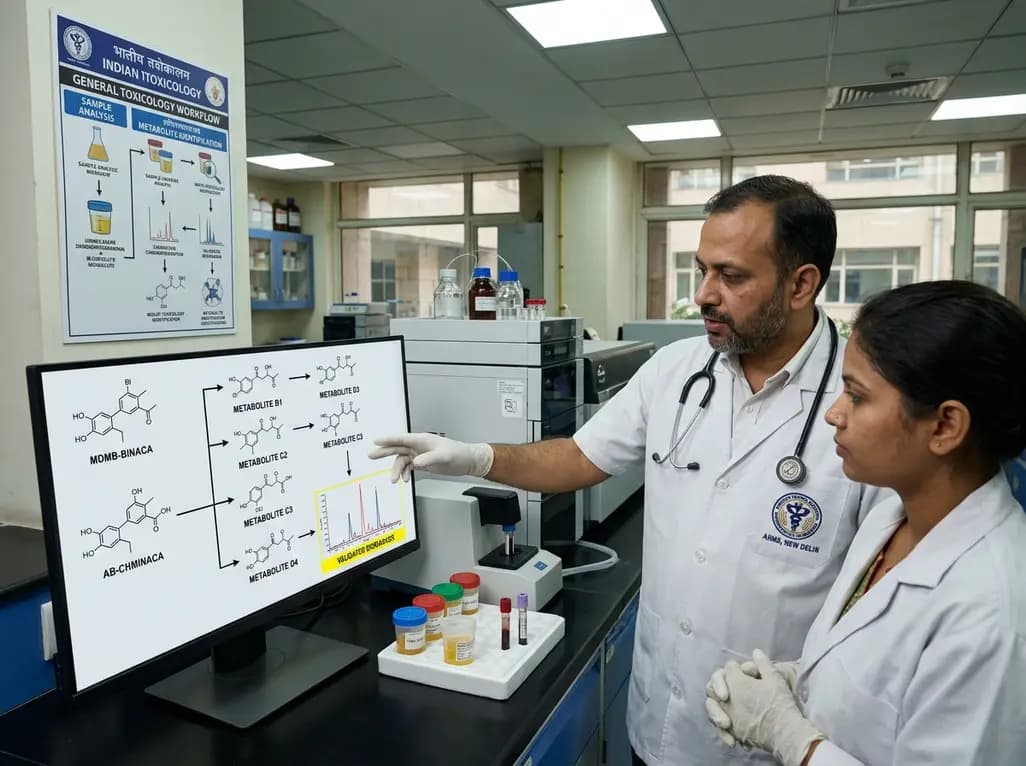
The illicit market for synthetic cannabinoid receptor agonists (SCRAs) has evolved significantly since 2010. Following a class-wide ban in China in 2021, potent older drugs have re-emerged through unregulated precursors. This shift significantly impacts public health in India, where forensic identification remains challenging. Consequently, clinicians need a deeper understanding of synthetic cannabinoid metabolism to manage acute intoxications effectively.
A recent study published in the Journal of Analytical Toxicology utilized human liver microsome (HLM) incubation to map these drugs. The researchers focused on MDMB-BINACA (also known as MDMB-BUTINACA), MDMB-PICA, and AB-CHMINACA. Furthermore, they used liquid chromatography-quadrupole time-of-flight mass spectrometry (LC-QTOF-MS) to analyze the resulting biotransformations.
Testing for parent drugs is often difficult because they metabolize rapidly. Therefore, identifying stable metabolites is crucial for extending the detection window in biological samples. The study identified nine distinct metabolites for MDMB-BINACA. In addition, the team verified five of these through retrospective analysis of authentic patient samples.
Both MDMB-PICA and AB-CHMINACA also yielded nine metabolites each. Specifically, the researchers observed biotransformations including ester and amide hydrolysis, oxidation, and dealkylation. These results help forensic toxicologists choose the right targets for urine and blood testing. Moreover, such data assists emergency physicians in India when treating patients with suspected synthetic drug use.
Synthetic cannabinoids are far more potent than natural cannabis. They can cause seizures, agitation, and cardiovascular collapse. While parent compounds often disappear from the system, these newly identified biomarkers provide a reliable way to confirm exposure. Consequently, hospitals should consider updating their screening protocols to include these specific metabolic targets. Additionally, understanding these pathways helps in the interpretation of forensic casework and forensic toxicology reports.
Standard immunoassays often miss synthetic cannabinoids because they differ chemically from natural THC. Furthermore, these drugs metabolize so quickly that the parent compound is rarely detectable in urine shortly after use.
According to recent studies, the primary pathways include ester and amide hydrolysis, oxidation, carboxylation, and dealkylation. These processes create several metabolites that stay in the body longer than the original drug.
The ban led to the re-emergence of older, highly potent SCRAs using unregulated precursors. Manufacturers often sell these via grey-market websites to circumvent global regulations. Consequently, this has increased the risk of severe intoxication outbreaks locally.
Disclaimer: This content is for informational and educational purposes only. It does not constitute professional medical advice, diagnosis, or treatment. Always seek the advice of your physician or other qualified healthcare provider with any questions you may have regarding a medical condition. Refer to the latest local and national guidelines for clinical practice.
References

Read summarized clinical updates, watch expert medical content, and earn CME certifications right from your smartphone.
Open your smartphone camera to scan and install.





A metabolic profiling study of MDMB-BINACA, MDMB-PICA, and AB-CHMINACA identifies new biomarkers to improve forensic and clinical toxicology detection....
4 months ago

Discover the crucial role of glymphatic dysfunction in stroke, where perivascular clearance failure and neuroinflammation exacerbate cerebral edema and post-stroke brain injury.
Today

A prenatal case highlights severe glutaric acidemia type II presenting as bilateral hyperechoic cystic kidneys at 18 weeks. Whole-exome sequencing revealed a novel homozygous ETFDH frameshift variant, demonstrating the power of rapid genetic testing in fetal renal anomalies.
Today

Review how tailored exercise programs benefit frail older patients with heart failure. Explore pathophysiological mechanisms, individualized training prescriptions, and strategies to overcome adherence barriers in clinical practice.
Yesterday

This comparative study evaluates posterior labral tears with and without glenohumeral instability, highlighting distinct demographic patterns, MRI underestimation in stable shoulders, and successful arthroscopic repair outcomes.
Yesterday

A clinical study demonstrates that early intervention with tocilizumab, either as monotherapy or bridged with corticosteroids, achieves significant proptosis reduction and resolves active inflammation in treatment-naive thyroid eye disease.
Yesterday
