.webp&w=384&q=75)

Loading, please wait...
Loading, please wait...

The Strengths and Difficulties Questionnaire serves as an essential behavioral screening tool across pediatric populations globally. Mental health practitioners regularly utilize this instrument to identify emotional and behavioral difficulties in children. In addition, the inventory assesses prosocial behaviors that reflect adaptive psychosocial functioning. However, clinicians often face substantial diagnostic hurdles when applying standardized behavioral instruments across diverse cultural environments. Marginalized populations experience unique psychological distress that standard measurement tools may fail to capture accurately. Therefore, researchers must evaluate whether traditional psychometric constructs maintain structural stability in conflict-affected regions. Adolescent refugees face chronic displacement, structural deprivation, and severe social adversity. Consequently, these stressors alter how young people perceive emotional difficulties and interpersonal interactions. When healthcare teams implement Western screening measures without local validation, they risk systematic misclassification. Furthermore, diagnostic inaccuracies can misdirect scarce mental health resources in vulnerable communities. Pediatric clinicians must understand these measurement limitations to deliver equitable psychiatric care. By critically appraising psychometric performance, clinicians can better differentiate acute psychological trauma from normative cultural responses. Ultimately, validated screening instruments enable clinicians to establish meaningful baseline measurements for vulnerable adolescents worldwide.
A recent cross-sectional validation study examined the psychometric integrity of this screening tool among adolescent girls. The investigation evaluated 2,828 Palestinian refugee adolescents residing within registered refugee camps in the West Bank and Jordan. Ultimately, 2,725 participants completed the questionnaire and contributed to the definitive structural analysis. The researchers first conducted confirmatory factor analysis on the original five-factor model. This traditional configuration measures emotional symptoms, conduct problems, hyperactivity-inattention, peer problems, and prosocial behavior. However, the confirmatory factor analysis revealed exceptionally poor goodness-of-fit parameters for this original five-factor framework. Specifically, the comparative fit index and Tucker-Lewis index remained below 0.40. In addition, the root mean square error of approximation reached 0.081, while standardized root mean square residual was 0.110. Several items demonstrated unacceptably low standardized factor loadings within their assigned clinical domains. For example, items measuring peer relationship problems and somatic complaints performed inconsistently across the cohort. These unfavorable psychometric indices indicate that the standard five-domain structure fails to capture psychological constructs reliably in this population. Consequently, clinicians cannot assume that standard scoring thresholds yield valid clinical interpretations among conflict-affected adolescent refugees.
Because the original questionnaire showed inadequate structural fit, investigators explored alternative latent factorial models. The team performed exploratory factor analysis to uncover underlying behavioral dimensions that better represented youth experiences. Subsequently, researchers evaluated these alternative configurations through secondary confirmatory factor analyses. A modified four-factor model demonstrated improved fit after removing several unstable items. However, a streamlined three-factor solution delivered the most robust psychometric performance across all diagnostic indicators. Specifically, this three-factor model yielded a comparative fit index of 0.942 and a Tucker-Lewis index of 0.930. Furthermore, the root mean square error of approximation dropped to 0.034, confirming excellent structural fit. This refined inventory retained fifteen performance-tested items across three core clinical dimensions. These dimensions comprised internalizing emotional symptoms, externalizing behavioral difficulties, and positive prosocial competencies. In addition, the three-factor model demonstrated satisfactory convergent validity and reliable criterion concurrent validity against established clinical indicators. The streamlined instrument also maintained acceptable internal consistency across multiple reliability testing metrics. Therefore, restructuring the questionnaire into broader dimensional constructs substantially enhances measurement accuracy. Clinicians gain clearer diagnostic insights when utilizing psychometrically refined scales tailored to adolescent populations experiencing chronic adversity.
Psychiatric assessment tools developed in high-income Western countries frequently reflect specific linguistic and cultural conventions. When practitioners translate these instruments without structural re-evaluation, cultural nuances often distort patient responses. For instance, adolescents living under prolonged geopolitical conflict frequently express emotional distress through somatic manifestations. Moreover, community cohesion and peer dynamics operate differently within densely populated refugee settings. As a result, questions addressing independent socialization or solitary play may carry unintended diagnostic meanings. Adolescents might avoid peer gatherings due to community security risks rather than social anxiety or conduct pathology. Similarly, attentional fluctuations in classroom settings may stem from continuous environmental distress rather than inherent neurodevelopmental deficits. Consequently, clinicians must distinguish chronic environmental trauma responses from primary psychiatric pathology. Standardized tools often confound externalizing behavioral reactivity with adaptive survival strategies in high-stress environments. Therefore, transcultural psychiatry requires rigorous psychometric adaptation before clinicians adopt standardized tools in clinical screening programs. Healthcare providers must recognize how structural violence and displacement reshape psychological presentations among youth. Ultimately, culturally validated screening tools safeguard adolescents against misdiagnosis and unnecessary psychiatric stigmatization.
These psychometric insights offer critical clinical guidance for pediatricians, psychiatrists, and family physicians evaluating marginalized adolescent populations. In resource-limited regions and diverse communities, healthcare providers frequently encounter young individuals impacted by displacement, poverty, and social disruption. When utilizing behavioral screening tools, clinicians should avoid over-relying on isolated subscale scores. Instead, practitioners should prioritize broader composite metrics, such as internalizing and externalizing symptom groupings. Furthermore, healthcare teams must implement multi-informant assessment protocols, integrating observations from parents, educators, and the adolescents themselves. Clinicians must also provide linguistically accessible, confidential screening environments to mitigate youth fear of social stigma. Additionally, primary care centers must establish structured psychiatric referral pathways before initiating widespread community screening. Identifying adolescent distress without accessible therapeutic services generates ethical dilemmas and compromises continuity of care. Clinicians should also support local validation studies to establish population-specific psychometric benchmarks within their regional healthcare systems. By blending culturally calibrated psychometric instruments with compassionate clinical interviews, physicians can ensure precise diagnosis, equitable care delivery, and targeted interventions for vulnerable adolescents.
The original five-factor model showed poor fit because unique environmental stressors and cultural perceptions altered how refugee adolescents understood specific items. Several questions assessing peer difficulties and somatic symptoms exhibited weak factor loadings. Consequently, the conventional five-domain structure failed to capture underlying emotional and behavioral constructs accurately in this population.
The refined three-factor model condenses fifteen reliable items into internalizing symptoms, externalizing behaviors, and prosocial skills. This streamlined structure delivered superior goodness-of-fit indices and robust internal reliability. Furthermore, broad dimensional grouping reduces cultural measurement error, enabling healthcare clinicians to assess psychological distress and functional strengths more accurately among vulnerable youth.
Clinicians should avoid relying solely on unvalidated Western cut-off scores when screening diverse pediatric groups. Instead, practitioners should verify local psychometric validity, gather collateral histories from parents and teachers, and prioritize broad dimensional symptom clusters. In addition, clinicians must contextualize screening scores within the patient's cultural background, living conditions, and adverse life experiences.
Disclaimer: This content is for informational and educational purposes only... Refer to the latest local and national guidelines for clinical practice.
References

Read summarized clinical updates, watch expert medical content, and earn CME certifications right from your smartphone.
Open your smartphone camera to scan and install.





A validation study of the Strengths and Difficulties Questionnaire (SDQ) in adolescent refugee girls revealed poor fit for the original five-factor scale. A modified three-factor structure offered superior psychometric validity, highlighting the necessity of tailoring mental health screening tools across diverse youth.
Today
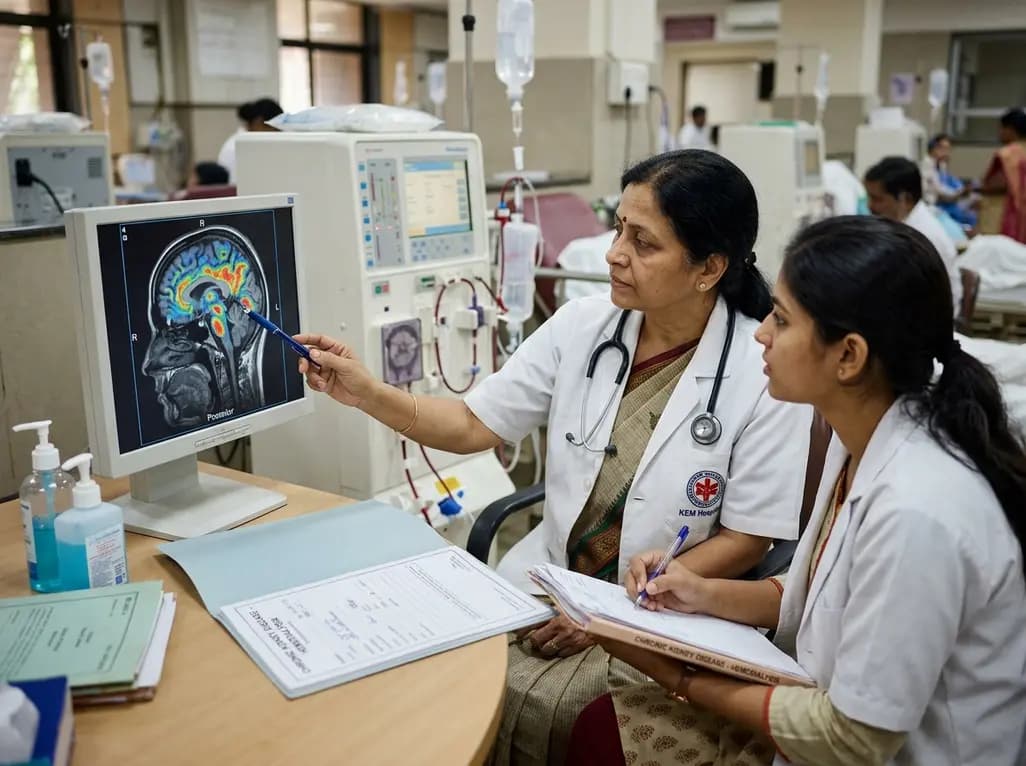
A retrospective clinical analysis reveals that hemodialysis-associated cognitive dysfunction arises from synergistic pathological mechanisms, including severe chronic anemia, worsening renal clearance, abnormal regional brain iron deposition, and an imbalance between neuroinflammatory and neurotrophic factors.
Today

A multiparametric MRI approach combining quantitative T2 shading, apparent diffusion coefficient (ADC) measurements, and morphological signs provides superior diagnostic accuracy over subjective evaluation to differentiate ovarian endometriomas from benign hemorrhagic cysts.
Today

Discover a novel laparoscopic approach for iatrogenic diaphragmatic hernia repair following pedicled omentoplasty. This modified Sugarbaker technique integrates dorsal pedicle lateralization and round ligament reinforcement to secure the diaphragmatic defect while preserving vital omental vascularity.
Today

Evaluating Hill-Sachs lesion size and the distance to dislocation is critical in recurrent shoulder instability. As bone loss concepts shift from binary on-track classifications to continuous risk assessment, clinicians must identify when isolated Bankart repair is insufficient and supplementary procedures are needed.
Today

New research reveals that M1 macrophage-derived exosomes aggravate diabetic nephropathy by transferring WTAP to stabilize S1PR2 mRNA. Silencing WTAP in these vesicles attenuates endothelial injury and renal fibrosis, pointing toward innovative nanomedicine therapies.
Today
