

Loading, please wait...
Loading, please wait...

Surgical reconstruction of cranial base defects remains one of the most demanding phases of skull base surgery. Minimally invasive approaches have expanded dramatically, making endoscopic endonasal dural suturing an indispensable technique to achieve watertight reconstruction and prevent postoperative cerebrospinal fluid leaks. However, mastering precise needle maneuvering and knot tying through narrow corridors poses significant challenges for surgical trainees. Recent clinical validation of the low-cost Smiley graded-zone simulator demonstrates an effective, reproducible pathway to flatten this steep learning curve.
Expanded endoscopic endonasal approaches provide direct access to ventral skull base lesions, yet dural closure within this deep corridor requires profound technical dexterity. Surgeons must manipulate long, single-shaft instruments through restricted nostrils while viewing two-dimensional monitors that lack direct tactile feedback. Consequently, technical errors during needle driving or tension management can compromise the dural seal, resulting in tension pneumocephalus or persistent cerebrospinal fluid fistulas. Traditional multi-layered vascularized flaps significantly lower leak rates, but direct primary dural suturing provides mechanical reinforcement that ensures durable stability. Unfortunately, clinical operating rooms do not permit unguided trial and error, creating an urgent demand for structured dry-lab training tools.
To address accessibility barriers, researchers designed the Smiley model box trainer as an affordable benchtop platform specifically targeting psychomotor skills. The simulator isolates the core biomechanics of needle handling, path traversal, and knot placement without relying on costly anatomic replicas. In addition, the platform incorporates concentric graded difficulty zones configured like a smile, challenging trainees to adapt their needle angles dynamically. Participants execute a four-handed technique using an external slip knot and an internal loop knot across varied corridors. By deliberately focusing on pure instrument handling rather than complex sinonasal anatomy, the model provides an accessible training solution suitable for resource-constrained residency programs globally.
Objective validation confirmed that the simulator effectively discriminates between surgical skill tiers, demonstrating robust construct validity. Specialists consistently outperformed beginners and junior residents across all objective parameters, including needle orientation, depth precision, and knot integrity. Specifically, expert surgeons achieved superior mean total performance scores (16/20) compared to beginners (10.75/20) and first-session junior residents (10.63/20). Furthermore, specialists demonstrated marked efficiency, completing complex knots in an average of 6.63 minutes compared to more than 15 minutes required by novices. Content validity analysis yielded an impressive average index of 0.875, indicating that seasoned skull base surgeons consider the exercises directly relevant to operative practice.
Simulation platforms must facilitate rapid skill acquisition to justify inclusion in crowded surgical residency curricula. Notably, junior residents in this study underwent a second testing session just one week after their baseline trial. During this follow-up assessment, junior trainees demonstrated remarkable improvements in instrument trajectory, knot stability, and overall economy of movement. Moreover, their completion times decreased substantially, bringing their technical metrics closer to intermediate practitioners. Self-assessed proficiency scores among beginners rose from 2.5/10 to 6.92/10, while junior residents improved from 2.5/10 to 7.13/10. These statistically significant gains confirm that deliberate practice on low-cost simulators rapidly builds muscle memory and spatial familiarity.
High-fidelity synthetic models and cadaveric dissection courses provide superb anatomical realism, but exorbitant costs and logistical constraints severely restrict routine access. This disparity is particularly pronounced across developing surgical centers in India and other resource-limited settings. In contrast, the Smiley box trainer relies on basic materials, making fabrication inexpensive and highly replicable across academic departments. Because the platform intentionally decouples basic instrument triangulation from complex sinonasal anatomy, junior trainees can build fundamental dexterity before entering cadaver dissections or live procedures. Integrating such cost-effective models democratizes skull base education, ensuring that structured psychomotor training becomes universally accessible regardless of institutional budgets.
While benchtop models deliberately omit mucosal bleeding and bone anatomy, the biomechanical maneuvers directly mirror high-stakes operative realities. Mastering the four-handed technique on a box trainer enables otolaryngologists and neurosurgeons to establish synchronized workflow dynamics. During live expanded endonasal procedures, this refined coordination prevents mutual instrument collisions and shortens reconstruction duration. In addition, mastering secure slip knots and delicate internal loop knots reduces dural tearing during intracranial reconstruction. As surgical training paradigms continue transitioning toward competency-based benchmarks, validated task trainers like the Smiley simulator provide measurable milestones that safeguard patient outcomes.
The procedure requires surgeons to operate long, rigid instruments within deep, extremely narrow corridors under two-dimensional endoscopic visualization. These constraints significantly impair natural depth perception, limit instrument triangulation, and increase the risk of tearing fragile dural margins during needle passage. Additionally, coordinating instruments with an assistant demands exceptional bimanual dexterity and constant practice to ensure secure, watertight dural closure without damaging surrounding neurovascular structures.
The simulator utilizes a validated scoring rubric combined with objective time-to-completion metrics. Evaluators grade participants on hand-eye coordination, needle driving precision, tissue handling, and the integrity of both external slip knots and internal loop knots across graded zones. Because expert surgeons complete tasks significantly faster and achieve markedly higher objective scores than novices, the platform successfully establishes construct validity across distinct training levels.
Cadaveric specimens offer exceptional anatomical realism but remain expensive, non-reusable, and subject to stringent regulatory limitations. In contrast, the Smiley box trainer provides an inexpensive, portable platform that allows repeated practice sessions focused entirely on psychomotor coordination. Trainees can master instrument mechanics and knot tying at minimal cost before refining anatomical nuances in the cadaver laboratory or operating room.
Disclaimer: This content is for informational and educational purposes only and should not be considered medical advice. Always consult a qualified healthcare provider for diagnosis and treatment decisions. Refer to the latest local and national guidelines for clinical practice.
References
Vedhapoodi AG et al. Evaluation of Low-Cost Smiley Graded-Zone Simulator for Endoscopic Endonasal Dural Suturing Training. Laryngoscope. 2026 Nov 19. doi: 10.1002/lary.71068. PMID: 43058024.
Prevedello LM, Doglietto F, Jane JA Jr, et al. History of endoscopic endonasal skull base surgery: From pituitary surgery to expanded approaches. World Neurosurg. 2014;82(6 Suppl):S12-S20.
Zeng Y, Lu G, Chen J, et al. Application of dural suturing in the endoscopic endonasal approach to the sellar region. Front Surg. 2022;9:945532.

Read summarized clinical updates, watch expert medical content, and earn CME certifications right from your smartphone.
Open your smartphone camera to scan and install.





A validation study evaluates the low-cost Smiley graded-zone simulator for endoscopic endonasal dural suturing, demonstrating robust construct validity, shortened operative learning curves, and significant improvements in technical proficiency across surgical training levels.
Today
A systematic review and meta-analysis evaluates the clinical outcomes of metformin in patients with advanced chronic kidney disease, assessing all-cause mortality, cardiovascular endpoints, end-stage kidney disease progression, and the true incidence of lactic acidosis in clinical practice.
Today

The GESS-AEEM consensus establishes a clear clinical implementation framework for testosterone therapy in postmenopausal women with hypoactive sexual desire disorder, focusing on transdermal dosing, precise laboratory monitoring, and safety communication.
Today

A Bayesian component network meta-analysis of 130 RCTs reveals that self-monitoring and gamification provide the clearest positive effects in mHealth physical activity interventions, while social comparison may have adverse psychological trade-offs.
Today
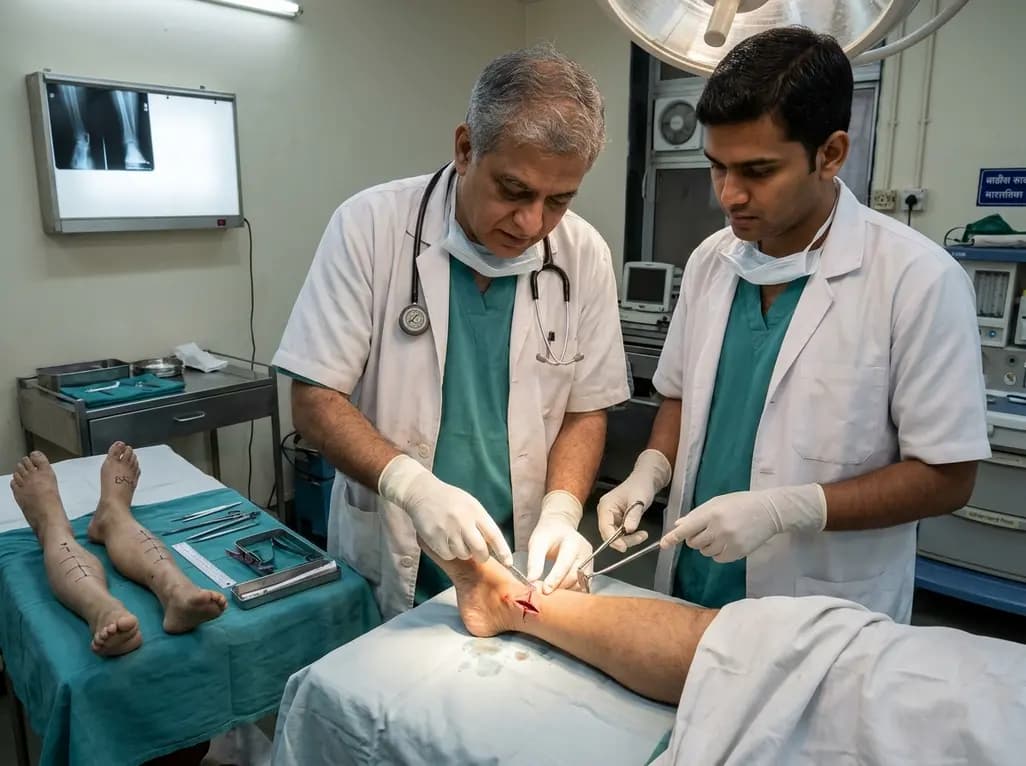
A paired cadaveric study compared triple and quintuple percutaneous Achilles tendon lengthening. While quintuple hemisection showed numerically greater elongation, differences were not statistically significant.
2 days back
A randomized pilot trial shows that consuming a prebiotic functional soda significantly reduces gastrointestinal symptom burden and improves gut tolerance in adults undergoing GLP-1-based weight management therapy.
Today
