.webp&w=384&q=75)

Loading, please wait...
Loading, please wait...
Singlet oxygen generation is a critical process for sustainable oxidation and advanced environmental remediation. Traditionally, the energy-free activation of ambient molecular oxygen under neutral conditions has been difficult due to sluggish proton-transfer kinetics. However, researchers have now engineered a specialized interfacial proton-relay microenvironment between molybdenum disulfide (MoS2) and copper chloride (CuCl). This innovative design facilitates the energy-free conversion of oxygen into highly reactive singlet oxygen (1O2) without external energy inputs.
The study reveals that electron-deficient sulfur sites on the catalyst act as a robust proton reservoir by forming S-H species. Consequently, these sites enable directional proton migration through specifically engineered Cu-S-Mo channels. This migration effectively activates adsorbed oxygen on electron-rich copper sites. Furthermore, the coupled electron-proton relay accelerates the hydrogenation of hydroperoxyl intermediates (*OOH). Therefore, the system maintains ideal binding levels that suppress O-O bond cleavage, favoring a dominant 1O2 pathway for superior oxidation performance.
This breakthrough has significant implications for water safety and infectious disease control. For instance, the MoS2-CuCl system achieved quantitative pollutant removal during pilot-scale membrane filtration tests. Moreover, it maintained sustained operation for over 16 hours, demonstrating high stability. Such autonomous catalytic platforms offer a scalable and general strategy to overcome existing proton-transfer limitations. Additionally, this interfacial design is broadly applicable to other transition metal sulfides, potentially advancing clinical disinfection and sustainable environmental remediation efforts.
Singlet oxygen is a potent reactive oxygen species used in photodynamic therapy and water disinfection. It inactivates bacteria and viruses by inducing oxidative damage to microbial membranes and essential proteins.
Traditional catalysts often require acidic environments or external energy to produce reactive oxygen. This MoS2-CuCl microenvironment operates under neutral conditions and is entirely self-driven, making it more sustainable for large-scale public health applications.
Disclaimer: This content is for informational and educational purposes only. It does not constitute medical advice or endorse specific catalytic products for clinical use. Refer to the latest local and national guidelines for clinical practice.
References
Gao Q et al. Interfacial Proton-Relay Microenvironment Enables Self-Driven Singlet Oxygen Generation under Neutral Conditions. Adv Sci (Weinh). 2026 Jun 10. doi: 10.1002/advs.76027. PMID: 42267528.
Minami S et al. Significance of Singlet Oxygen Molecule in Pathologies. PMC. 2023 Feb 1;12(3):573.
He X et al. Bacterial Inactivation by a Singlet Oxygen Bubbler: Identifying Factors Controlling the Toxicity of 1O2 Bubbles. Environ Sci Technol. 2012 Nov 6;46(21):12011-7.

Read summarized clinical updates, watch expert medical content, and earn CME certifications right from your smartphone.
Open your smartphone camera to scan and install.





A breakthrough in materials science has enabled the energy-free generation of singlet oxygen under neutral conditions. By engineering a MoS2/CuCl proton-relay microenvironment, researchers achieved quantitative pollutant removal, offering a sustainable strategy for environmental and clinical disinfection.
4 months ago
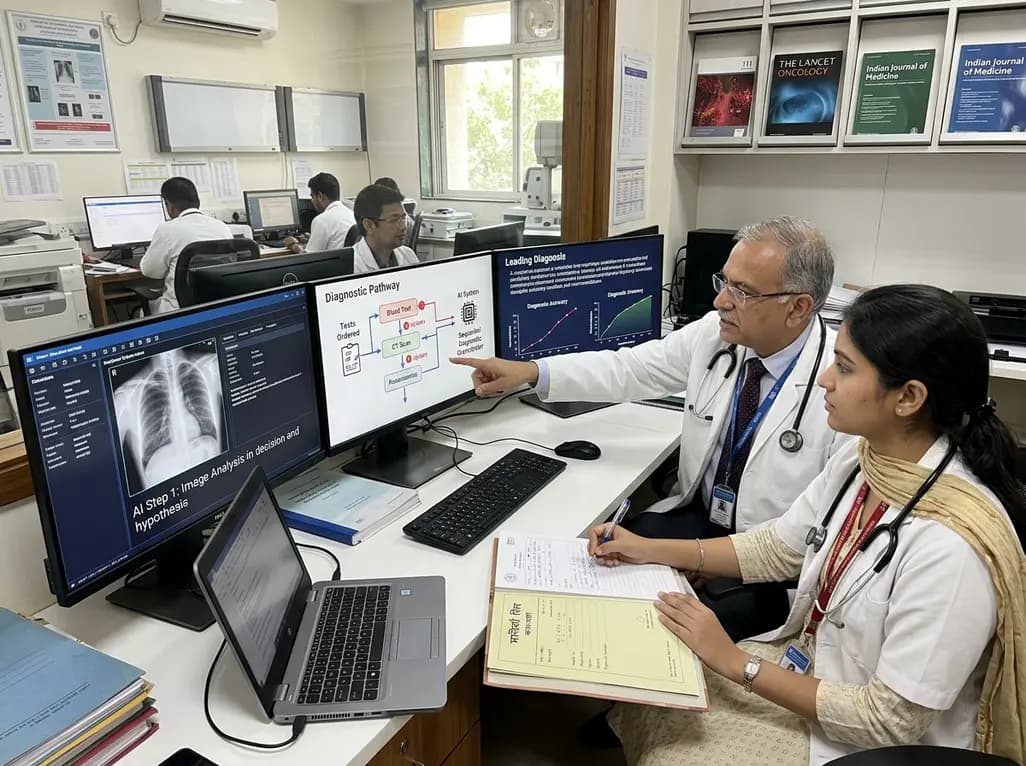
A breakthrough peer-reviewed study demonstrates that a sequential AI diagnosis system can mirror real-world clinical reasoning. By ordering stepwise tests and updating hypotheses dynamically, this multi-agent orchestrator achieved superior diagnostic accuracy while reducing investigative costs.
Today

A prenatal case highlights severe glutaric acidemia type II presenting as bilateral hyperechoic cystic kidneys at 18 weeks. Whole-exome sequencing revealed a novel homozygous ETFDH frameshift variant, demonstrating the power of rapid genetic testing in fetal renal anomalies.
Today

Review how tailored exercise programs benefit frail older patients with heart failure. Explore pathophysiological mechanisms, individualized training prescriptions, and strategies to overcome adherence barriers in clinical practice.
Yesterday

This comparative study evaluates posterior labral tears with and without glenohumeral instability, highlighting distinct demographic patterns, MRI underestimation in stable shoulders, and successful arthroscopic repair outcomes.
Yesterday

A clinical study demonstrates that early intervention with tocilizumab, either as monotherapy or bridged with corticosteroids, achieves significant proptosis reduction and resolves active inflammation in treatment-naive thyroid eye disease.
Yesterday
