.webp&w=384&q=75)

Loading, please wait...
Loading, please wait...

Reproductive health education is a cornerstone of societal well-being and future planning. However, healthcare professionals today navigate a complex landscape of shifting regulations and rapidly advancing scientific data. To provide effective care, practitioners must bridge the gap between clinical knowledge and community needs. Consequently, understanding the structural and social barriers in this field is essential for improving patient outcomes. Moreover, practitioners must manage unmotivated clients alongside their demanding clinical duties.
Regulatory changes have helped clarify professional tasks in recent decades. Nevertheless, the workload remains overwhelming for many obstetricians, midwives, and public health nurses. Specifically, reproduction remains a sensitive or taboo topic in many communities, which hinders open dialogue. Therefore, professionals must use new methods to engage couples effectively. Additionally, the rapid pace of scientific discovery requires constant updating of educational materials, adding to the burden on overworked staff.
Success in this field relies heavily on intersectoral cooperation. For instance, doctors, nurses, and family educators must work together as a cohesive team to provide consistent messaging. Additionally, focusing on families and couples rather than individuals can improve motivation levels significantly. Because preventative work is often undervalued, healthcare systems should prioritize these educational initiatives. Furthermore, embracing digital tools and community-based outreach may help bridge the gap in underserved areas.
Professionals often face rapid scientific updates, cultural taboos, and the challenge of engaging unmotivated clients within a limited timeframe.
Intersectoral cooperation between doctors, midwives, and specialists ensures a holistic approach to patient care and more effective health promotion.
Disclaimer: This content is for informational and educational purposes only and does not constitute medical advice or a professional relationship. Refer to the latest local and national guidelines for clinical practice.
References
Gyulai A et al. [Changes and challenges in the work of professionals dealing with health promotion and reproductive health education]. Orv Hetil. 2026 Mar 29. doi: 10.1556/650.2026.33497. PMID: 41904796.
National Health Mission (NHM). RMNCAH+N Strategy. Government of India. 2024.
Center for Reproductive Rights. UN Human Rights Committee Recommends India Improve Access to SRH Services and Education. 2024.

Read summarized clinical updates, watch expert medical content, and earn CME certifications right from your smartphone.
Open your smartphone camera to scan and install.





A study on the challenges professionals face in reproductive health education, highlighting overwork, cultural taboos, and the need for intersectoral teamwo...
6 months ago

A retrospective cohort study of 7,716 ICU patients from the MIMIC-IV database demonstrates that Gradient Boosting Decision Trees significantly outperform traditional SOFA scores in predicting in-hospital mortality among patients with sepsis and diabetes, with SHAP analysis providing clinical interpretability.
Today
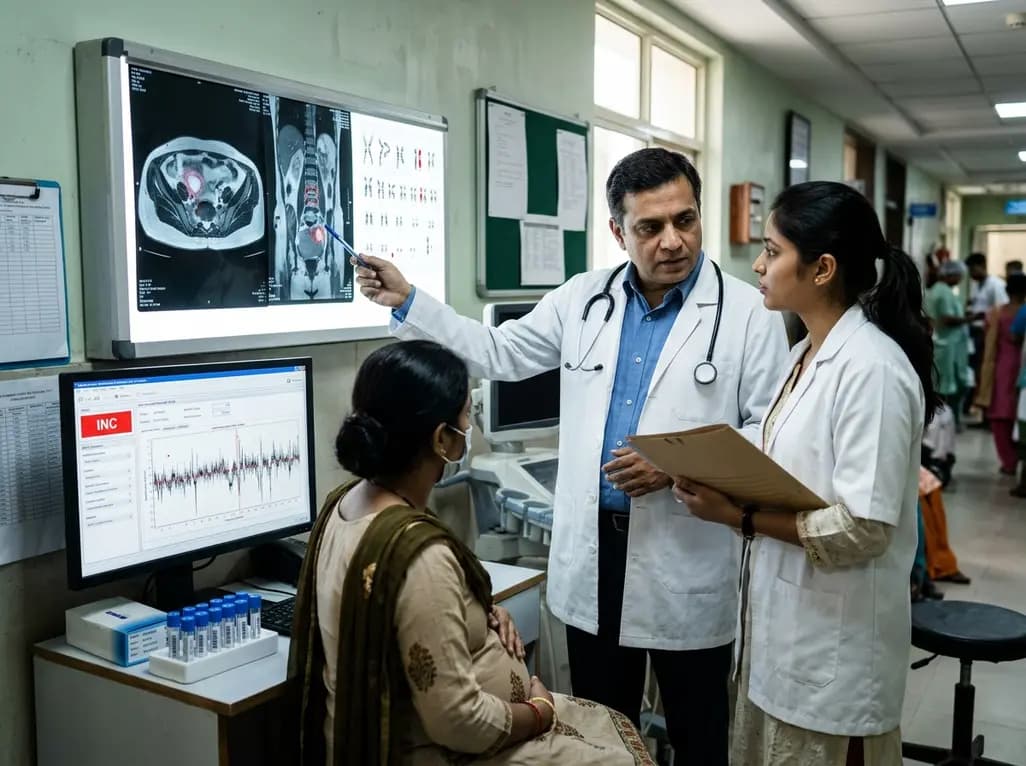
Occult maternal malignancy accounts for 3.82% of persistent unreportable NIPT results with genomic noise. Multiple chromosomal aberrations, notably on chromosome 18, warrant thorough oncological evaluation and whole-body MRI to ensure timely maternal diagnosis while preserving fetal care.
Today
This article reviews the forensic and clinical complexities of acute myocarditis arising on left ventricular hypertrophy in children, highlighting early diagnostic red flags and multidisciplinary postmortem autopsy protocols.
Today

This comparative study evaluates posterior labral tears with and without glenohumeral instability, highlighting distinct demographic patterns, MRI underestimation in stable shoulders, and successful arthroscopic repair outcomes.
Yesterday

A clinical study demonstrates that early intervention with tocilizumab, either as monotherapy or bridged with corticosteroids, achieves significant proptosis reduction and resolves active inflammation in treatment-naive thyroid eye disease.
Yesterday
