.webp&w=384&q=75)

Loading, please wait...
Loading, please wait...
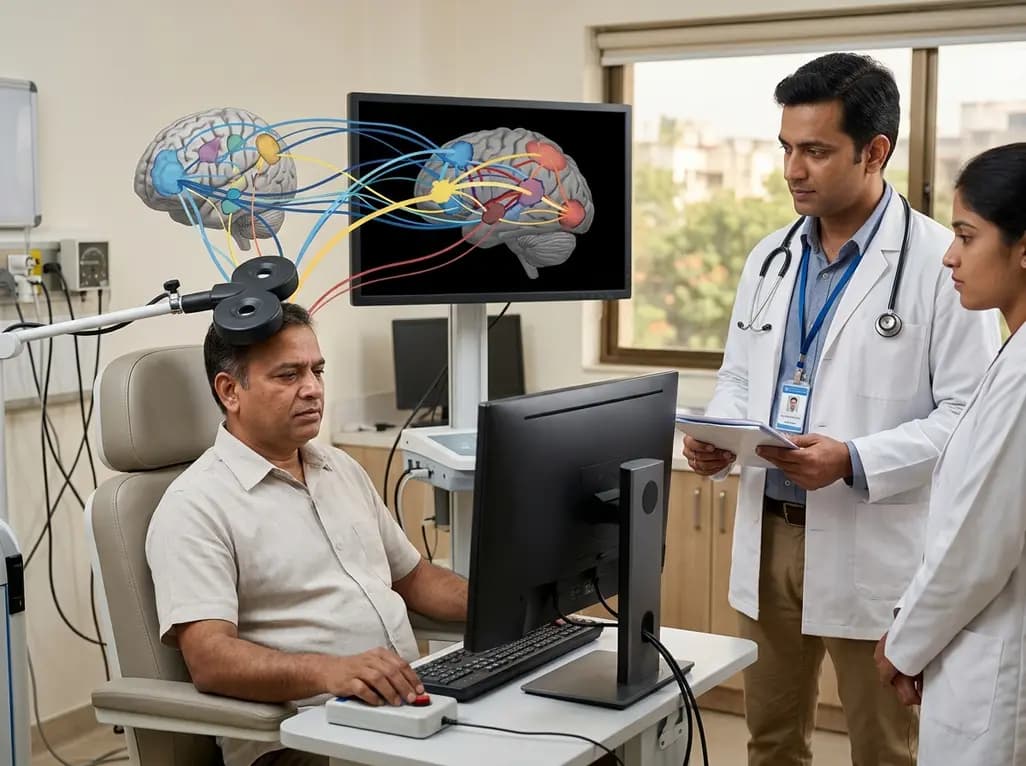
Major depressive disorder affects millions worldwide and often causes substantial disability. Although clinicians frequently focus on affective symptoms, cognitive dysfunction represents a core feature of depression. Patients routinely report severe impairment in attention, processing speed, and executive control. Furthermore, these persistent cognitive deficits strongly predict daily functioning and occupational impairment. Impairments in sustained attention manifest as elevated intra-individual reaction time variability during standardized cognitive tasks. Consequently, understanding reaction time variability offers critical insights into underlying neural circuit alterations in patients suffering from treatment-resistant depression.
Traditional pharmacological interventions primarily target mood symptoms, often leaving cognitive deficits unaddressed. Furthermore, residual cognitive impairment remains a major contributor to functional disability even after partial mood remission. Baseline resting-state functional magnetic resonance imaging provides a unique window into intrinsic brain network organization. Analyzing network connectivity in relation to performance metrics allows researchers to identify precise neural targets for therapeutic intervention. Consequently, mapping these circuit alterations provides a foundation for developing targeted neurostimulation protocols that improve patient outcomes.
Human cognition relies on the coordinated interaction of several large-scale neural networks. The executive control network manages top-down cognitive control, goal-directed behavior, and externally focused attention. In contrast, the default mode network supports self-referential thought, internal mentation, and depressive rumination. Under normal conditions, these two networks operate in opposition; activation of executive circuits typically suppresses default mode activity. However, in patients with treatment-resistant depression, this balance is often disturbed, leading to abnormal co-activation of competing networks. Consequently, internal ruminative thoughts continuously intrude upon external task performance.
The salience network plays a central role in modulating this competitive dynamic. Specifically, the salience network identifies key internal and external stimuli and dynamically directs cognitive resources. When functioning optimally, the salience network engages executive control circuits while suppressing default mode interference. However, alterations in salience network connectivity disrupt this critical gating mechanism. As a result, patients experience frequent attentional lapses and inconsistent cognitive processing, highlighting the neurobiological underpinnings of severe depression.
A pivotal neuroimaging investigation evaluated baseline functional connectivity in 209 patients with moderate-to-severe treatment-resistant depression. These participants underwent resting-state functional MRI scans prior to receiving neuromodulation therapy in the BRIGhTMIND clinical trial. Researchers evaluated cognitive performance using a choice reaction time task, applying a sophisticated three-parameter ex-Gaussian model to isolate distinct components of response behavior. Specifically, this mathematical approach parsed standard response speed from extreme attentional lapses, providing a comprehensive characterization of individual task performance across a large clinical cohort.
The analysis revealed a strong neurobiological link between brain network organization and task performance. Specifically, greater intra-individual variability directly correlated with increased functional connectivity between the executive control network and default mode network. Elevated connectivity between these networks reflects an inability to suppress internal self-referential processing while attempting external tasks. Consequently, patients with stronger executive-default mode coupling exhibited greater task instability and slower overall reaction times. Importantly, these findings demonstrate that abnormal network cross-talk directly compromises real-time processing efficiency in depressed individuals.
The study demonstrated that the salience network plays a decisive role in regulating network cross-talk and reaction time variability. Specifically, functional connectivity between the salience network and the executive control network modulated the direct connection between executive control and default mode networks. Higher salience-executive connectivity was significantly associated with reduced executive-default mode co-activation. Consequently, robust salience network engagement appears to insulate executive control circuits from default mode intrusion, thereby stabilizing cognitive focus and performance.
Furthermore, increased functional connectivity between the salience network and executive control network correlated directly with faster mean reaction times. Patients who exhibited stronger salience-executive coupling demonstrated more flexible and rapid cognitive processing. In contrast, reduced connectivity within this pathway led to slowed and inflexible response patterns. Notably, both intra-individual reaction time variability and mean reaction time strongly predicted real-world psychosocial and occupational functioning. Patients presenting with slowed, variable response patterns experienced significantly poorer overall daily functioning, underscoring the critical importance of salience network modulation.
Significantly, the observed associations between network connectivity and cognitive performance occurred largely independent of depressive mood severity. This finding indicates that cognitive impairment in major depressive disorder represents a distinct neurobiological domain rather than a simple byproduct of depressed mood. Consequently, traditional antidepressant therapies that primarily target mood symptoms may fail to resolve core attentional deficits. Clinicians must recognize that achieving full functional recovery requires targeted interventions specifically designed to restore cognitive circuit integrity in treatment-resistant depression.
These neuroimaging findings provide a compelling rationale for developing precision neuromodulation strategies in clinical psychiatry. Non-invasive brain stimulation techniques, such as repetitive transcranial magnetic stimulation and theta-burst stimulation, can directly target dysfunctional cortical nodes. Specifically, applying personalized neurostimulation to enhance salience network connectivity could reduce harmful executive-default mode co-activation. As a result, restoring network balance may effectively treat sustained attention deficits and improve patient quality of life.
Intra-individual reaction time variability measures the fluctuations in a patient's response speed during cognitive tasks. In treatment-resistant depression, higher variability reflects impaired sustained attention and executive dysfunction. Consequently, these cognitive lapses lead to significant difficulties in daily occupational performance and functional capacity, independent of overall mood severity.
Cognitive performance depends on dynamic interactions between the executive control network, default mode network, and salience network. The salience network prioritizes critical stimuli and modulates connectivity between executive control and default mode networks. Stronger salience-executive connectivity reduces unwanted default mode interference, thereby stabilizing focus and accelerating processing speed.
Functional magnetic resonance imaging identifies specific network abnormalities that cause cognitive deficits. By mapping individual patterns of network connectivity, clinicians can target specific brain circuits using transcranial magnetic stimulation or theta-burst stimulation. Consequently, personalized neuromodulation therapies can specifically restore salience network control and alleviate cognitive impairment in depressed patients.
Disclaimer: This content is for informational and educational purposes only and does not constitute medical advice, diagnosis, or treatment. Always seek the advice of a qualified healthcare provider with any questions regarding a medical condition. Refer to the latest local and national guidelines for clinical practice.
References

Read summarized clinical updates, watch expert medical content, and earn CME certifications right from your smartphone.
Open your smartphone camera to scan and install.





A BRIGhTMIND trial study reveals that reaction time variability in treatment-resistant depression correlates with functional connectivity between default mode, executive control, and salience networks, highlighting potential targets for precision neuromodulation.
Today

The Food Safety and Standards Authority of India (FSSAI) has rejected industry appeals and directed beverage manufacturers to remove the term 'energy drink' and unapproved therapeutic claims within 90 days. This regulation aims to curb misbranding and ensure clear labeling across commercial food products.
Today

Johnson & Johnson announced a $5.5 billion settlement to resolve nearly 69,000 lawsuits alleging its talc-based baby powder caused ovarian cancer. This comprehensive deal covers 99.75% of active claims. Read about the legal strategy, scientific evidence on talc exposure, and clinical counseling for patients.
Today

A cross-sectional study evaluates post-intensive care syndrome in cardiac patients 2-4 weeks post-ICU discharge, highlighting cognitive, psychological, and functional impairments and the need for structured multidisciplinary rehabilitation.
4 days back

Anterior cruciate ligament reconstruction failure lacks uniform definition. A narrative review proposes an integrative framework incorporating objective and subjective instability, persistent pain, restricted motion, graft rupture, and secondary meniscal injury to standardize clinical reporting.
3 days back

A UK Biobank study of 471,540 participants reveals that metabolic syndrome increases incident gastric cancer risk by 36% (HR=1.36). A positive trend was observed with accumulating metabolic components, with waist circumference showing the strongest association, highlighting modifiable risk targets.
4 days back
