.webp&w=384&q=75)

Loading, please wait...
Loading, please wait...
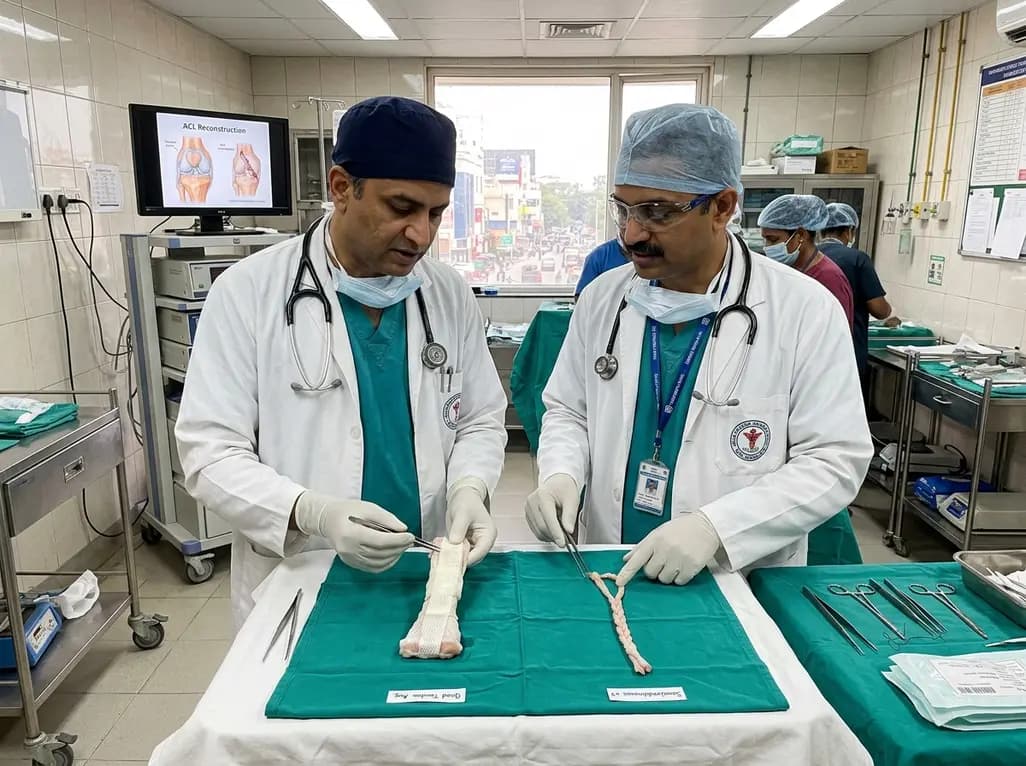
Anterior cruciate ligament (ACL) rupture represents one of the most common sports-related knee injuries encountered by orthopaedic surgeons worldwide. Surgical reconstruction aims to restore mechanical stability, kinematics, and functional performance to the knee joint. Traditionally, surgeons have relied on bone-patellar tendon-bone or quadrupled hamstring constructs as the primary autograft choices. However, recent surgical trends highlight a shift toward utilizing a quadriceps tendon autograft due to its robust cross-sectional area, reliable mechanical strength, and decreased donor-site morbidity. Selecting the optimal graft material requires a careful balancing of mechanical properties, fixation security, and donor-site safety. As surgical techniques evolve, understanding how soft-tissue constructs withstand cyclic loading and ultimate tensile failure becomes vital for clinical decision-making. Consequently, researchers continue to evaluate novel harvesting and preparation protocols to refine graft stability. By evaluating comparative biomechanical performance under standardized conditions, clinicians can better predict how reconstructed ligaments will endure physiological stresses during early post-operative rehabilitation. Furthermore, graft selection influences long-term patient outcomes, return-to-sport rates, and overall joint longevity.
The soft-tissue quadriceps tendon autograft has gained notable popularity because it offers flexible sizing options while sparing the extensor mechanism's bony architecture. Historically, harvesting a bone block accompanied the quadriceps graft, but all-soft tissue techniques now minimize anterior knee pain and extensor lag. In contrast, the quadrupled semitendinosus construct remains a widely accepted standard that delivers reliable tensile strength when properly tensioned and secured. To determine whether the soft-tissue quadriceps tendon autograft matches the mechanical performance of hamstring grafts, researchers conducted comparative cadaveric testing. Using nine human cadaveric quadriceps grafts and eleven quadrupled semitendinosus constructs, investigators evaluated load-to-failure, stiffness, and failure modes under standardized laboratory protocols. For the quadriceps grafts, surgeons applied a suture tape-integrated adjustable loop suspensory fixation device at both ends. For the semitendinosus grafts, surgeons quadrupled the tendon and secured it using two adjustable loops alongside buried-knot stitching. These preparations mirrored real-world operating room techniques, providing realistic data regarding initial mechanical stability before tissue integration occurs.
Biomechanical evaluation revealed statistically significant differences in mechanical strength between the two soft-tissue construct configurations. The quadrupled semitendinosus constructs demonstrated a higher ultimate load-to-failure compared to the tape-augmented soft-tissue quadriceps tendon autograft preparations. Specifically, the hamstring constructs achieved an average load-to-failure of 806.1 N, whereas the soft-tissue quadriceps tendon autograft constructs reached an average load-to-failure of 577.9 N. This difference highlights the superior ultimate tensile capacity of multi-strand hamstring preparations under axial tensile pull. Furthermore, structural stiffness differed between the experimental cohorts, with the semitendinosus constructs displaying greater resistance to deformation under load. However, both construct types successfully withstood standard cyclic loading protocols without premature catastrophic failure. These findings demonstrate that while the soft-tissue quadriceps tendon autograft provides predictable initial stability, its ultimate tensile load remains lower than that of a quadrupled hamstring graft when subjected to maximal axial loading forces in a cadaveric model.
Suture tape augmentation has emerged as a promising strategy to enhance construct stiffness and protect healing tissue during early rehabilitation. In the evaluated quadriceps tendon autograft protocol, researchers integrated suture tape into the adjustable loop suspensory fixation devices. This augmentation aimed to share tensile loads across the construct and minimize elongation during repetitive stress. Although suture tape integration enhances overall structural integrity, the biomechanical data indicates that graft architecture and intrinsic tendon properties still primary dictate ultimate load limits. The quadrupled semitendinosus graft benefits from four parallel soft-tissue strands acting in unison, creating a dense mechanical structure. Conversely, an all-soft tissue quadriceps graft relies heavily on uniform suture grasp and tension distribution across a broader, flatter tendon geometry. Consequently, surgeons utilizing quadriceps tendon autografts must optimize stitch pattern, suture density, and construct pretensioning to maximize initial mechanical strength. Refining these technical nuances may narrow the performance gap observed between quadriceps and hamstring autograft preparations.
For orthopaedic surgeons and sports medicine specialists, biomechanical data provides essential context for operative planning and postoperative rehabilitation design. Although the quadrupled semitendinosus graft exhibited higher peak load-to-failure values, clinical failure rarely occurs solely due to tensile overload exceeding 500 N during early recovery. Instead, graft slippage, fixation loosening, or inadequate biological integration frequently cause early surgical failure. Therefore, the soft-tissue quadriceps tendon autograft remains a highly viable clinical choice, especially for patients requiring preservation of hamstring function or those with small-diameter hamstring tendons. Surgeons must recognize that laboratory biomechanical testing reflects immediate post-fixation strength prior to biological healing and ligamentization. Consequently, aggressive early rehabilitation protocols should accommodate the lower ultimate load threshold of quadriceps constructs by protecting against excessive anterior shear stresses. Future research should focus on optimizing suture tape augmentation techniques and evaluating long-term clinical outcomes in active patient cohorts to confirm whether these biomechanical differences translate into clinical variance.
Selecting the optimal graft for anterior cruciate ligament reconstruction requires careful consideration of patient characteristics, athletic demands, and graft-specific biomechanics. The soft-tissue quadriceps tendon autograft represents a versatile, tissue-sparing alternative that offers favorable clinical handling and low donor-site morbidity. While cadaveric testing demonstrates higher ultimate load resistance in quadrupled semitendinosus grafts, both constructs meet foundational mechanical requirements for early joint stability. Continued advancements in fixation technology, suture tape material, and tissue preparation techniques will likely further enhance the performance of quadriceps constructs. Clinicians should maintain a balanced perspective, weighing mechanical laboratory data alongside individualized patient factors when choosing graft materials. Ultimately, tailored graft selection combined with precise surgical execution and structured rehabilitation ensures the best possible outcomes for patients recovering from complex ligamentous knee injuries.
Biomechanical testing shows that quadrupled semitendinosus autografts generally exhibit higher ultimate load-to-failure values and structural stiffness compared to soft-tissue quadriceps tendon autografts. The quadrupled hamstring configuration provides multiple dense strands acting in parallel, which enhances overall tensile capacity. However, quadriceps tendon autografts offer superior cross-sectional area and lower donor-site morbidity, making them a mechanically robust and clinically viable alternative for knee reconstruction procedures.
Suture tape augmentation is utilized to increase initial construct stiffness, reduce elongation during cyclic loading, and protect the healing biological tissue during early rehabilitation. By sharing the mechanical load across the fixation construct, suture tape helps maintain joint stability before complete tendon-to-bone healing occurs. This technical refinement is particularly valuable when securing soft-tissue grafts with adjustable loop suspensory devices.
Not necessarily. While cadaveric load-to-failure tests measure maximum tensile force until mechanical construct breakdown, clinical success depends on multiple factors including biological integration, graft orientation, fixation security, and patient compliance. The load limits observed in quadriceps tendon constructs easily exceed typical forces encountered during initial daily activities, meaning clinical failure rates remain comparable when appropriate rehabilitation protocols are followed.
Disclaimer: This content is for informational and educational purposes only and does not constitute medical advice, diagnosis, or treatment. Always seek the advice of a qualified healthcare provider with any questions regarding a medical condition. Refer to the latest local and national guidelines for clinical practice.
References
Sator T et al. Biomechanical properties of an all-soft tissue quadriceps tendon autograft compared with a quadrupled semitendinosus autograft: a cadaveric study. Knee Surg Relat Res. 2026 Aug 07. doi: undefined. PMID: 42568082.
Sasaki N, Farraro KF, Kim KE, et al. Biomechanical evaluation of the quadriceps tendon autograft for anterior cruciate ligament reconstruction: a cadaveric study. Am J Sports Med. 2014;42(3):723-730.
Strauss MJ, Miles JW, Kennedy ML, et al. Full thickness quadriceps tendon grafts with bone had similar material properties to bone-patellar tendon-bone and a four-strand semitendinosus grafts: a biomechanical study. Knee Surg Sports Traumatol Arthrosc. 2022;30(5):1786-1794.

Read summarized clinical updates, watch expert medical content, and earn CME certifications right from your smartphone.
Open your smartphone camera to scan and install.





A cadaveric study compares the biomechanical strength, load-to-failure, and stiffness of tape-augmented all-soft tissue quadriceps tendon autografts against quadrupled semitendinosus constructs in ACL reconstruction, providing crucial insights for orthopaedic surgeons regarding graft selection and fixation.
last month

A retrospective cohort study demonstrates that comprehensive pharmacy transitions of care—including admission medication history, discharge review, and 72-hour telephone follow-up—significantly reduced 30-day readmission rates in acute care patients, highlighting the value of pharmacist-led clinical interventions.
Today

Meghalaya recorded a historic 55% reduction in maternal deaths, dropping from 244 to 107 over five years. Through the MOTHER app, dedicated transit homes, and expanded infrastructure like the 150-bed Tura Maternity Hospital with its first public NICU, the state demonstrates an effective public health model.
Today

Explore modern perioperative management protocols for clinical xenotransplantation. Learn how costimulation blockade, anti-inflammatory perfusion, and coagulopathy rescue overcome interspecies hurdles.
Today
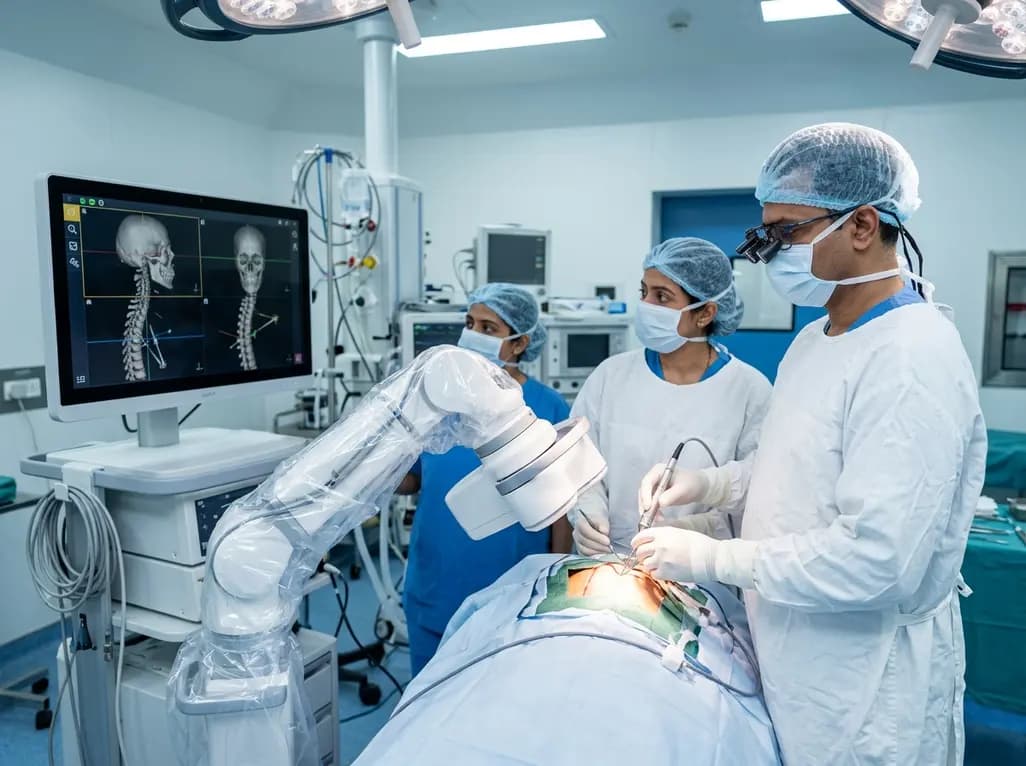
North India's first Centre of Excellence for Brain and Spine at Amrita Hospital Faridabad integrates Brainlab's Loop-X mobile robot. This landmark facility combines cone-beam computed tomography with surgical navigation to elevate precision, optimize operative workflows, and enhance specialized clinician training.
Today

At Homa CME 2026 at Hyderabad's T-Hub, healthcare leaders emphasized moving beyond routine metrics through digital calculators and precision stratification. Discover why characterizing individual insulin secretion, resistance patterns, and vascular risks transforms chronic metabolic care in India.
Today
