.webp&w=384&q=75)

Loading, please wait...
Loading, please wait...
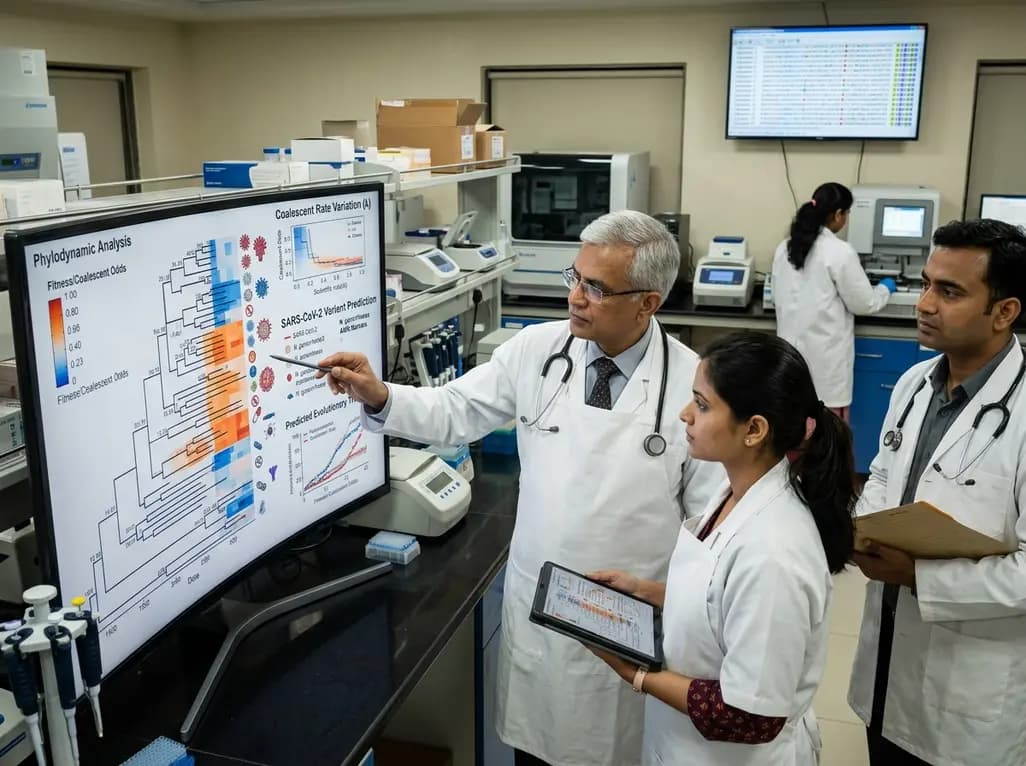
Genomic epidemiology has transformed our ability to track infectious disease outbreaks across populations. However, traditional phylodynamic models often assume neutral evolution, which can obscure critical differences in lineage fitness during rapid transmission. A breakthrough statistical framework published by Volz and Didelot addresses this limitation by offering a mathematical tool for predicting pathogen evolution through coalescent rate variation. By relaxing selective neutrality, this novel approach allows coalescent rates to evolve as a continuous heritable trait across phylogenetic trees. Consequently, researchers can quantify lineage growth propensities before variants achieve widespread clinical dominance.
Within this framework, every viral or bacterial lineage receives a relative coalescent propensity score. Pairwise products of these propensities form coalescent odds ratios, serving as a metric for evaluating reproductive success. Therefore, public health epidemiologists gain a tree-based proxy for relative fitness without relying solely on retrospective case counts. Estimating coalescent odds provides real-time insights into natural selection acting on emerging genetic variants, significantly enhancing early detection systems for drug-resistant bacteria and viral strains.
Standard coalescent theory assumes circulating lineages share an identical probability of reproducing over time. While this assumption simplifies computation, it fails during real-world infectious disease outbreaks driven by positive selection. In contrast, the continuous heritable trait model allows coalescent rates to vary dynamically across different branches of a phylogenetic tree. As a result, lineages experiencing strong positive selection display distinct coalescent odds compared to neutral background populations.
Moreover, this dynamic framework calculates hyperparameter calibrations automatically to govern how coalescent propensities evolve. By incorporating continuous trait variation, the model sensitively detects small selective advantages even when rare variants initially emerge in small numbers. Statistical procedures also cluster phylogenies into clades based on shared coalescent propensities. Consequently, public health researchers can isolate high-fitness clades earlier than standard surveillance methods permit, improving our understanding of microbial adaptability in hospital settings.
A persistent challenge in genomic epidemiology stems from non-uniform sample collection. Geographic regions with robust sequencing infrastructure frequently oversample pathogens, whereas resource-limited settings underreport data. Unadjusted models can mistake regional oversampling for true biological growth, creating misleading fitness estimates. To overcome this bottleneck, the statistical framework introduces robust adjustments for non-uniform sampling probabilities. Specifically, weighted least-squares estimators recalibrate coalescent odds using auxiliary sampling metadata.
Consequently, the model maintains high accuracy even when confronted with severely imbalanced global datasets. Simulation studies demonstrate that recalibration effectively prevents false-positive signals generated by localized sequencing spikes. Furthermore, the approach accounts for demographic confounders without altering underlying mechanistic lineage fitness. For infectious disease specialists, these bias-correction techniques ensure emerging variant alerts reflect true evolutionary advantages rather than sampling artifacts, allowing global surveillance networks to allocate resources far more efficiently.
To demonstrate practical utility, researchers applied this coalescent framework to a historical dataset of Neisseria gonorrhoeae genomes. Antimicrobial resistance in gonococcal infections presents a grave public health challenge, requiring vigilant genomic surveillance. Analyzing historic genomic sequences allowed the authors to evaluate whether coalescent odds could foresee the expansion of resistant bacterial lineages. Strikingly, bacterial lineages displaying elevated coalescent odds consistently harbored unique antibiotic resistance patterns prior to their widespread clinical expansion.
This retrospective analysis proves that coalescent rate variation presages the trajectory of drug-resistant bacterial strains before conventional epidemiology detects widespread outbreaks. Early detection of multi-drug resistant gonococcal lineages enables timely adjustments to empirical antibiotic treatment guidelines. Moreover, identifying high-odds bacterial clades allows public health authorities to implement targeted containment strategies before resistant strains become endemic. Integrating coalescent modeling into routine bacterial surveillance strengthens global stewardship against resistant pathogens.
The utility of coalescent odds extends equally well to viral pathogens during fast-moving pandemics. Researchers re-analyzed global SARS-CoV-2 genomic data spanning major variants of concern from 2020 through 2023. They compared estimated coalescent odds directly against independent reproduction number estimates derived from epidemiological surveillance. Results revealed an exceptional correlation, confirming that coalescent odds function as an accurate tree-based proxy for relative viral fitness across successive pandemic waves.
Unlike traditional epidemiological metrics requiring weeks of consistent case reporting, coalescent odds derive directly from sequenced viral trees. Public health teams can evaluate the growth potential of new SARS-CoV-2 subvariants almost immediately after initial genomic sequencing. Furthermore, this tree-based approach operates reliably even when case reporting drops or clinical testing infrastructure faces strain. As SARS-CoV-2 evolves, tree-based fitness proxies provide vital lead time for updating vaccine compositions and preparing healthcare infrastructure.
Translating mathematical phylodynamics into actionable clinical insights bridges the gap between molecular biology and bedside medicine. As genomic sequencing becomes routine in hospital laboratories, clinicians gain access to real-time phylogenetic data for hospital-acquired infections and community outbreaks. By deploying automated algorithms that estimate coalescent odds, diagnostic networks can quickly flag emerging bacterial or viral lineages exhibiting heightened reproductive success.
In addition, these advanced statistical tools support precision public health policies by differentiating between transient localized spikes and sustained evolutionary expansions. Healthcare systems can optimize antimicrobial formulary decisions, refine infection control protocols, and deploy targeted diagnostic assays long before resistant strains dominate clinical presentations. As microbial surveillance continues to expand, coalescent rate modeling offers a foundational framework for proactive pandemic preparedness and effective infectious disease management.
Coalescent odds represent a statistical metric derived from phylogenetic trees that quantifies a lineage's propensity to coalesce relative to others. By relaxing traditional assumptions of selective neutrality, this model links coalescent rates to heritable biological fitness. Consequently, lineages with higher coalescent odds reproduce faster and expand more rapidly within host populations. This tree-based statistic provides an early, accurate proxy for relative evolutionary fitness before traditional epidemiological data becomes fully available.
Non-uniform sampling often distorts phylogenetic analysis because overrepresented geographic regions appear falsely successful. To resolve this issue, the coalescent framework integrates weighted least-squares estimators that adjust for sample inclusion probabilities. By incorporating auxiliary geographic and demographic data, the model effectively decouples sampling bias from true biological growth. Consequently, public health surveillance systems obtain highly reliable fitness estimates even when global sequencing efforts remain severely unbalanced across different healthcare settings.
Monitoring coalescent rate variation allows public health teams to detect drug-resistant bacterial clades early in their evolutionary expansion. For instance, in Neisseria gonorrhoeae, lineages with high coalescent odds exhibited distinct resistance profiles well before expanding globally. By identifying these high-fitness resistant clades early, clinicians can update empirical treatment protocols, implement targeted containment measures, and preserve antibiotic efficacy before multi-drug resistant strains achieve widespread clinical prevalence.
Disclaimer: This content is for informational and educational purposes only and does not constitute formal medical advice, diagnosis, or treatment. Healthcare professionals must exercise independent clinical judgment when interpreting evolutionary modeling or genomic surveillance data. Refer to the latest local and national guidelines for clinical practice.
References

Read summarized clinical updates, watch expert medical content, and earn CME certifications right from your smartphone.
Open your smartphone camera to scan and install.





A novel phylodynamic model relaxes selective neutrality to quantify coalescent rate variation, enabling early prediction of pathogen evolution. Validated on SARS-CoV-2 variants and Neisseria gonorrhoeae, estimated coalescent odds serve as a robust tree-based proxy for lineage fitness and drug resistance.
last month

Modern renal nutrition is shifting toward additive-aware dietary guidance. This paradigm differentiates between intrinsic nutrients in whole foods and hyper-bioavailable inorganic additives, offering practical strategies to mitigate additive stacking and toxicity without restricting nutritious whole foods.
Today

A multiparametric MRI approach combining quantitative T2 shading, apparent diffusion coefficient (ADC) measurements, and morphological signs provides superior diagnostic accuracy over subjective evaluation to differentiate ovarian endometriomas from benign hemorrhagic cysts.
Today

A landmark case report reveals a donor heart beating for a century in a 63-year-old recipient, challenging conventional age limits in cardiac transplantation and offering critical lessons on organ longevity, donor selection, and long-term graft survival.
Today

A new randomized crossover trial reveals that a hinged ulnar gutter orthosis significantly improves hand function and weight-bearing tolerance compared to standard volar splints in patients with degenerative triangular fibrocartilage complex lesions, supporting functionally permissive orthotic designs.
Today
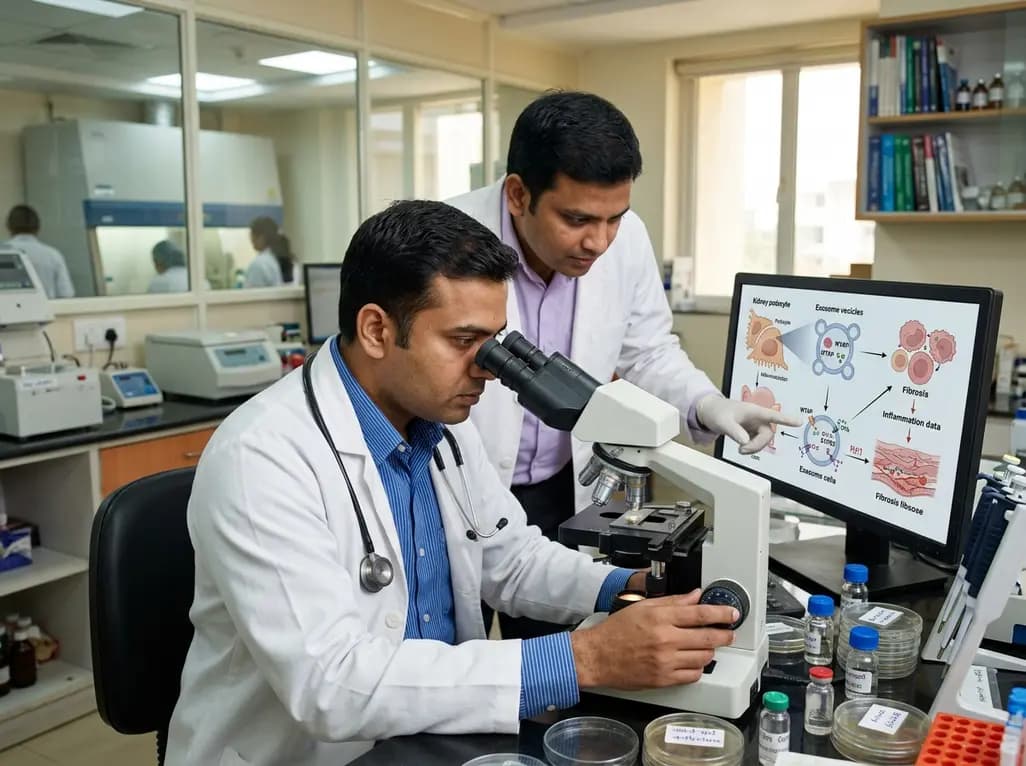
New research reveals that M1 macrophage-derived exosomes aggravate diabetic nephropathy by transferring WTAP to stabilize S1PR2 mRNA. Silencing WTAP in these vesicles attenuates endothelial injury and renal fibrosis, pointing toward innovative nanomedicine therapies.
Yesterday
