

Loading, please wait...
Loading, please wait...

Modern neurocognitive monitoring increasingly relies on remote, decentralized testing technologies to track subtle neurological shifts over time. In recent years, digital cognitive assessments have transformed the landscape of clinical research and longitudinal screening in older populations. Traditionally, clinicians viewed practice effects—the score gains observed when individuals repeat cognitive tasks—as statistical noise or measurement artifact. However, contemporary cognitive neuroscience reframes these gains as vital clinical markers of neural plasticity and cognitive reserve. When a patient demonstrates expected improvement across repeated exposures, their brain exhibits preserved associative encoding and procedural learning. Conversely, diminished learning trajectories can indicate early, preclinical neurodegenerative pathology before overt functional decline appears. As emerging disease-modifying therapies for Alzheimer's disease enter clinical practice, early detection becomes paramount. Longitudinal monitoring requires clear normative benchmarks to differentiate expected practice gains from genuine cognitive stability or subtle decay. Therefore, understanding the magnitude and trajectory of practice effects across diverse neurocognitive domains represents a critical priority for both clinical trials and daily geriatric care. Furthermore, establishing robust longitudinal digital baselines helps clinicians separate genuine therapeutic efficacy from simple task familiarity.
To evaluate these dynamic cognitive patterns, researchers conducted a longitudinal observational investigation using participants from the renowned Framingham Heart Study. Specifically, the team recruited 717 cognitively intact older adults who completed quarterly evaluations over a full one-year period. Participants utilized the Defense Automated Neurocognitive Assessment platform, an established digital system cleared by the United States Food and Drug Administration. The cohort had an average age of 64.1 years, included 65.4% women, and comprised 67.1% college-educated individuals. Participants self-administered three specialized tasks every three months across four discrete time points. These tasks represented a deliberate gradient of cognitive complexity. First, the Simple Reaction Time task evaluated fundamental motor processing speed. Second, the Go/No-Go paradigm assessed response inhibition and fronto-executive control. Finally, the Code Substitution task challenged complex associative learning and immediate working memory capacity. By analyzing cognitive efficiency—a composite index balancing response velocity and accuracy—the investigators effectively mapped how repetition impacts diverse neural domains in non-supervised home settings. Moreover, this home-based assessment model demonstrated high feasibility among older adults. Consequently, the protocol provides an effective real-world model for decentralized cognitive surveillance.
The investigation yielded compelling evidence regarding domain-specific performance trajectories over serial administrations. Participants demonstrated quantifiable practice effects across all administered tasks, although the magnitude varied substantially by cognitive domain. For example, associative learning showed the most pronounced gains on the Code Substitution task, registering a Cohen d effect size of 0.43. Similarly, executive inhibition improved meaningfully on the Go/No-Go task, exhibiting an effect size of 0.32. In contrast, the Simple Reaction Time task produced minimal gains, registering an effect size of only 0.16, which fell below conventional significance thresholds. These findings demonstrate that tasks requiring complex associative networks and deliberate executive strategies elicit much stronger practice gains than rudimentary psychomotor responses. Consequently, clinicians must recognize that practice gains do not manifest uniformly across distinct cognitive abilities. While simple motor speed quickly reaches an operational ceiling, higher-order computational tasks continue to reflect procedural adaptation over multiple exposures. Therefore, test complexity directly determines the degree of expected longitudinal improvement in healthy aging cohorts. In addition, these divergent trajectories prove that digital platforms must assess multiple distinct domains rather than relying on a single cognitive test.
Demographic variables strongly shaped baseline performance, yet only one factor influenced longitudinal learning curves over time. At baseline, advancing age predicted lower performance across all three neurocognitive tasks. In addition, female participants exhibited lower baseline scores on reaction time and inhibitory control measures compared to male peers. Higher educational attainment consistently predicted superior baseline cognitive efficiency across every domain. However, when investigators analyzed longitudinal trajectories, age emerged as the sole demographic moderator of practice effects. Specifically, participants aged 65 years or older demonstrated significantly attenuated performance gains on the Code Substitution task compared to younger cohorts. Educational background and sex did not alter the rate of learning across repeated testing sessions. This age-related reduction in practice effects highlights an important neurobiological shift in fluid cognition and processing plasticity during later life. Thus, older chronological age specifically dampens the ability to optimize performance through repetition, establishing an essential clinical benchmark for evaluating cognitive decline. Furthermore, these findings emphasize that older individuals retain procedural learning capacity, but their associative adaptation occurs at a measurably moderated rate.
These longitudinal findings offer vital practical insights for clinicians managing brain health in an aging population. As telemedicine and remote monitoring expand, self-administered digital cognitive assessments provide a scalable bridge between annual clinic visits. Nevertheless, clinicians must interpret longitudinal test scores with calibrated precision. If a healthy patient demonstrates no improvement on serial assessments, physicians should not immediately assume stable baseline cognition. Instead, an absence of expected practice effects may indicate subtle synaptic failure or early neuropathological accumulation. Clinicians must account for baseline age, recognizing that individuals over 65 naturally exhibit smaller practice gains on demanding associative tasks. Moreover, healthcare systems should avoid relying solely on static screening cutoffs. Integrating serial digital measurements allows practitioners to construct personalized learning trajectories, thereby identifying cognitive divergence months or years before overt symptoms emerge. Ultimately, tracking practice effects equips physicians with a dynamic biomarker to refine diagnostic triage and monitor therapeutic interventions effectively. Therefore, primary care practitioners and geriatricians can harness longitudinal digital tracking to initiate timely secondary prevention and individualized neurological workups.
Practice effects represent performance improvements that occur when an individual repeats cognitive tests over time. These gains stem from task familiarity, procedural learning, and strategic adaptation. In healthy adults, robust practice effects indicate preserved neural plasticity and functional cognitive reserve. However, when a patient fails to show expected gains, clinicians often suspect subtle neurodegenerative changes. Thus, tracking these trajectories provides valuable diagnostic insight into early preclinical cognitive decline.
Patient age significantly moderates the magnitude of practice gains on complex cognitive tasks. While younger older adults demonstrate robust performance gains through repeated testing, individuals aged 65 years and older exhibit attenuated improvements, particularly in associative learning. This difference reflects subtle, age-related changes in fluid intelligence and processing speed. Consequently, clinicians evaluating longitudinal test results must adjust their normative expectations based on age rather than assuming identical learning curves.
Simple reaction time tasks show minimal practice effects because they measure basic psychomotor processing speed rather than complex cognitive integration. Motor responses quickly reach a neurobiological ceiling where repetition cannot produce substantial mechanical acceleration. In contrast, complex tasks like code substitution engage working memory and associative networks. These higher-level executive processes allow participants to develop sophisticated cognitive strategies over serial sessions, producing significantly larger observable practice gains across repeated quarterly assessments.
Disclaimer: This content is for informational and educational purposes only... Refer to the latest local and national guidelines for clinical practice.
References
Christianson K et al. Practice Effects on Repeated Self-Administered Digital Cognitive Assessments in Cognitively Intact Older Adults from the Framingham Heart Study: Longitudinal Observational Study. JMIR Aging. 2026 Oct 19. doi: 10.2196/87208. PMID: 42896150.
Goldberg TE, Harvey PD, Wesnes KA, Snyder PJ, Schneider LS. Practice effects due to serial cognitive assessment: Implications for preclinical Alzheimer's disease randomized controlled trials. Alzheimers Dement (Amst). 2015;1(1):103-111.
Jutten RJ, Papp KV, Hendrix S, et al. Why a clinical trial needs practice effects: A commentary on cognitive and clinical outcome measures in early-stage Alzheimer disease. Alzheimers Dement (N Y). 2021;7(1):e12208.

Read summarized clinical updates, watch expert medical content, and earn CME certifications right from your smartphone.
Open your smartphone camera to scan and install.





Framingham Heart Study data show cognitively intact older adults display robust practice effects across digital cognitive assessments, but learning attenuates after age 65.
Today
A case-control study reveals that severe poverty and silica dust exposure significantly increase tuberculosis risk among artisanal miners. This analysis reviews pathophysiology, clinical management, and targeted screening protocols relevant to clinicians treating occupational lung disease in high-burden settings.
Today

New research reveals that HPV16 E7 exosomes significantly upregulate PD-L1 on tumor-infiltrating lymphocytes in cervical cancer, driving local immune suppression and correlating with poorer patient survival. These findings expose key mechanisms of immune evasion with direct relevance to checkpoint blockade therapies.
Today
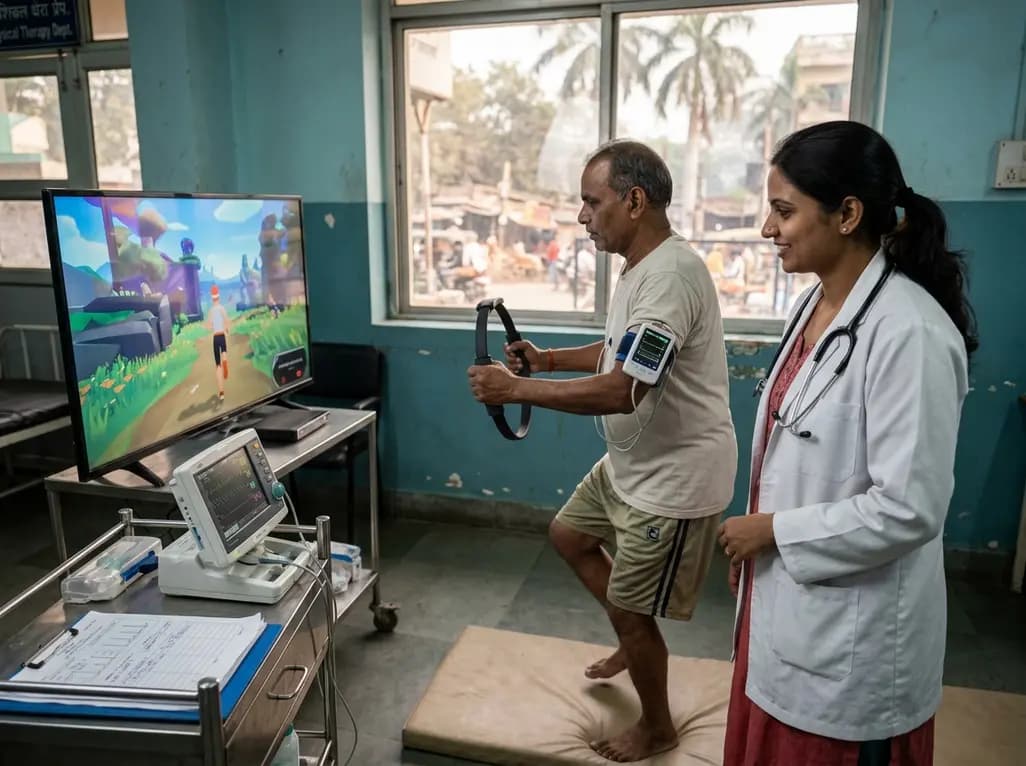
A clinical study evaluated Ring Fit Adventure in adults with chronic conditions, revealing that exergaming achieves moderate-to-vigorous exercise intensity while maintaining hemodynamic stability, high enjoyment, and zero adverse events.
Today
A retrospective cohort study reveals that selecting the touched vertebra as the lowest instrumented vertebra in thoracic adolescent idiopathic scoliosis yields a 20.8% distal add-on rate, driven by remnant motion segments and axial rotational discrepancies.
Today

A study evaluates a cardiometabolic HFpEF model combining metabolic stress with chronic mineralocorticoid excess. The findings reveal profound diastolic stiffness, endothelial dysfunction, and pulmonary hypertension, illuminating key pathophysiological mechanisms for targeted cardiopulmonary therapies.
Today
