.webp&w=384&q=75)

Loading, please wait...
Loading, please wait...
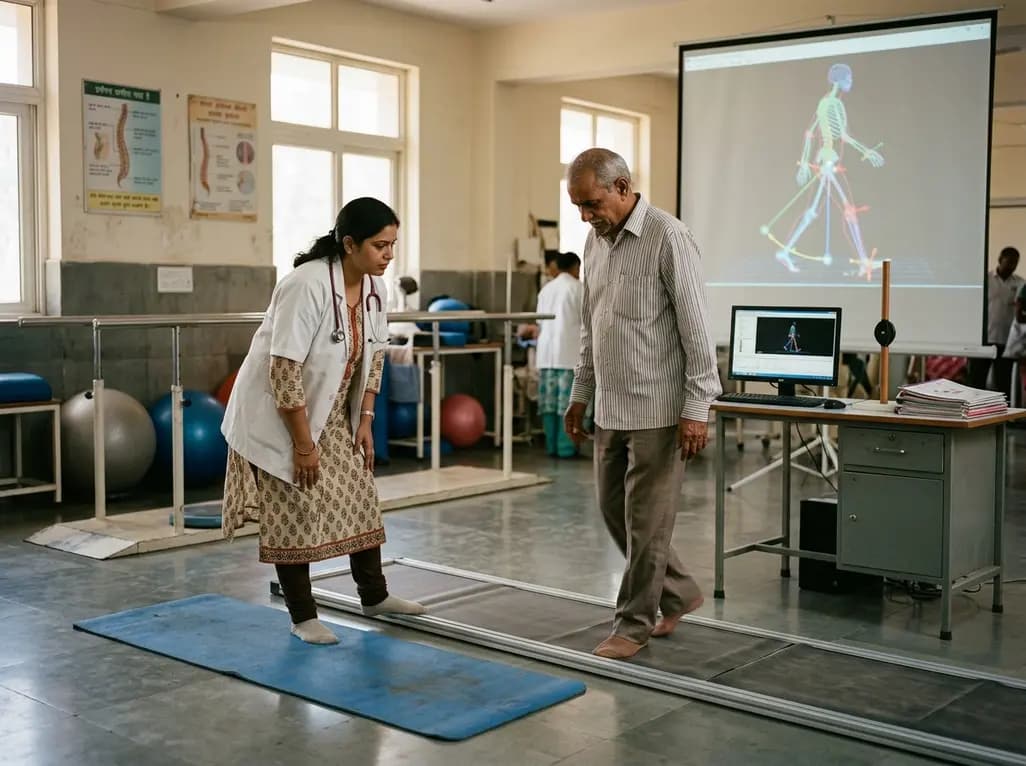
Human upright posture requires precise coordination between sensory inputs, neural processing, and musculoskeletal effectors. Clinicians frequently evaluate balance during quiet standing and functional locomotion. However, deciphering how the central nervous system coordinates complex feedback loops has historically challenged researchers. Emerging biomechanical evidence indicates that complex postural stabilization mechanisms share an overarching task-level objective across diverse motor activities. Although the mechanical demands of static standing and dynamic walking differ substantially, the body regulates center of mass trajectories through harmonized control laws. Understanding these shared dynamics enables neurologists, physiatrists, orthopedic surgeons, and geriatricians to design more targeted interventions for individuals suffering from postural instability, vestibular impairment, or neurological gait disorders.
To quantify upright motor control, researchers applied lumped stabilization models that correlate delayed center of mass kinematics with ground reaction forces. Intrinsic musculoskeletal stiffness and active sensorimotor feedback control act simultaneously to stabilize upright posture. Therefore, evaluating their lumped effects provides essential clarity regarding whole-body balance control. In a recent biomechanical investigation, investigators examined fifteen healthy young adults who completed both treadmill walking and three distinct standing tasks. Specifically, the participants performed quiet bipedal standing, unipedal standing, and a tandem step posture. The researchers collected full-body kinematic data and continuous ground reaction forces to estimate neural delays alongside lumped feedback gains. Consequently, this model architecture allowed direct comparisons between quiet stance and steady-state gait. The data revealed that model fits were significantly higher during static standing than during continuous walking. This discrepancy occurs because dynamic stepping introduces phase-dependent mechanical interactions and continuous limb transitions. Nonetheless, the unified mathematical model effectively captured core regulatory dynamics across both operational regimes.
The study demonstrated notable variations in stabilization gains and effective delays depending on movement direction and task demands. For instance, effective neural delays in the mediolateral direction were significantly longer during walking than during static standing. In contrast, anteroposterior delays remained broadly comparable across all assessed conditions. Mediolateral stabilization during gait requires deliberate foot placement adjustments and lateral hip abductor modulation. Consequently, the neuromuscular system requires longer processing intervals to integrate sensory feedback across the gait cycle. Furthermore, the stabilization gains varied markedly across movement planes and task constraints. Anteroposterior control relies heavily on ankle plantarflexor regulation, whereas mediolateral control recruits hip strategies and base-of-support modifications. Thus, the nervous system actively redistributes control efforts based on biomechanical geometry. When individuals adopt challenging postures, such as unipedal standing or tandem stance, the central nervous system scales feedback responsiveness to maintain equilibrium. Therefore, balance assessment must evaluate multidirectional motor responses rather than relying solely on single-plane metrics.
A central finding of this biomechanical evaluation involves how the body manages critical stiffness and damping ratios. In physical modeling, critical stiffness represents the threshold necessary to counter gravitational destabilization. Lumped position gains exceeded critical stiffness during most standing conditions. In contrast, average position gains during walking dropped below the critical stiffness boundary. This distinction occurs because forward momentum and continuous foot adjustments assist dynamic stability during gait. Furthermore, lumped velocity gains remained consistently within under-damped ranges across all tasks. Interestingly, the numerical ratio of position gain to velocity gain in standing aligned closely with the body's natural eigenfrequency. The extrapolated center of mass concept precisely predicts this mathematical relationship. During walking, this ratio converged toward the natural eigenfrequency during gait phases characterized by active stabilization. Consequently, all stabilizing mechanisms collaborate to maintain a uniform weighting between position and velocity contributions, guiding center of mass movement along an inverted pendulum trajectory.
These biomechanical discoveries offer valuable practical guidance for medical practitioners managing mobility impairments. Clinicians treating patients with cerebellar ataxia, Parkinson's disease, peripheral neuropathy, or post-stroke hemiparesis frequently observe disintegrated postural responses. Because neural control preserves an optimal ratio between position and velocity feedback, rehabilitation protocols should challenge both positional awareness and velocity detection. For instance, traditional balance training often emphasizes static stance on compliant surfaces. However, therapeutic exercises must also incorporate rapid perturbations that force patients to calibrate velocity-dependent ground reaction forces. Additionally, physical therapists should integrate multidirectional drills because mediolateral control relies on distinct delayed feedback mechanisms compared to anteroposterior balance. Similarly, orthopedic clinicians managing post-operative joint reconstruction can utilize these principles to evaluate functional recovery. Restoring passive joint stability is insufficient if delayed sensorimotor feedback loops remain uncalibrated. Therefore, comprehensive rehabilitation programs must systematically train dynamic pendulum mechanics alongside static posture maintenance.
Fall risk poses an urgent public health challenge, particularly among aging populations and individuals with chronic mobility restrictions. Age-related degradation of proprioception, prolonged conduction delays, and sarcopenia impair the body's ability to maintain optimal stabilization gains. Consequently, older adults struggle to generate sufficient ground reaction forces when center of mass velocity escalates unexpectedly. To counter these deficits, clinicians should implement multidimensional fall prevention screenings that measure dynamic recovery steps rather than static sway alone. For example, reactive balance training utilizing brief treadmill decelerations or harness-supported perturbations trains neuromuscular circuits to restore under-damped velocity gains. Furthermore, sports medicine physicians can apply these insights to screen athletic performance and reduce lower-extremity injury risks. When athletes exhibit delayed mediolateral stabilization, targeted neuromuscular training can restore balanced inverted pendulum dynamics. Ultimately, recognizing that standing and walking share a common task-level stabilization objective empowers clinicians to develop cohesive, evidence-based mobility interventions.
Static standing primarily uses continuous ankle and hip strategies to counter gravitational destabilization, maintaining position gains above critical stiffness. In contrast, walking features lower mean position gains because dynamic momentum and cyclic stepping naturally assist equilibrium. Furthermore, walking involves significantly longer effective delays in the mediolateral plane due to phase-dependent sensory processing, whereas anteroposterior delays remain relatively comparable across both movement modalities.
The ratio of position gain to velocity gain reflects how the central nervous system balances spatial displacement against movement speed. In healthy individuals, this ratio matches the body's natural eigenfrequency, validating inverted pendulum control models. When neurological disease or aging disrupts this optimal weighting, patients exhibit delayed corrections, hypermetric sway, or dynamic instability, thereby dramatically elevating their overall risk of injurious falls.
Clinicians can incorporate these findings by transitioning beyond static balance exercises to dynamic, velocity-dependent rehabilitation paradigms. Because mediolateral stabilization requires distinct neural control channels, therapy programs should emphasize lateral stepping, perturbation training, and dual-task locomotion drills. These targeted interventions train patients to recalibrate delayed ground reaction forces, optimizing functional center of mass control during complex daily activities.
Disclaimer: This content is for informational and educational purposes only... Refer to the latest local and national guidelines for clinical practice.
References

Read summarized clinical updates, watch expert medical content, and earn CME certifications right from your smartphone.
Open your smartphone camera to scan and install.





New biomechanical research reveals how postural stabilization mechanisms coordinate delayed sensory feedback and ground reaction forces to preserve pendulum-like center of mass motion across standing and walking, providing vital insights for balance rehabilitation and fall prevention.
Today

A nationwide Korean cohort study of 265,610 individuals reveals that the link between benzodiazepine use and dementia attenuates after adjusting for comorbidity, with no accelerated progression to severe dementia.
Today

A landmark case report evaluated maternal MOG autoantibodies in plasma, breast milk, and infant blood. Despite antibody detection, the infant remained clinically asymptomatic throughout 18 months, confirming that maternal transmission does not heighten infant MOGAD risk and supporting safe lactation.
Today

A landmark systematic review and meta-analysis establishes age-specific normative reference values for pediatric pulse wave velocity, revealing a nonlinear trajectory of arterial stiffness from early childhood through adolescence.
Today

A landmark cross-sectional study in Asian adults with type 2 diabetes identifies novel urinary metabolites linked to mild cognitive impairment. Elevated urinary sucrose and altered metabolites highlight non-invasive pathways for early cognitive risk stratification and targeted metabolic management.
Today
