.webp&w=384&q=75)

Loading, please wait...
Loading, please wait...
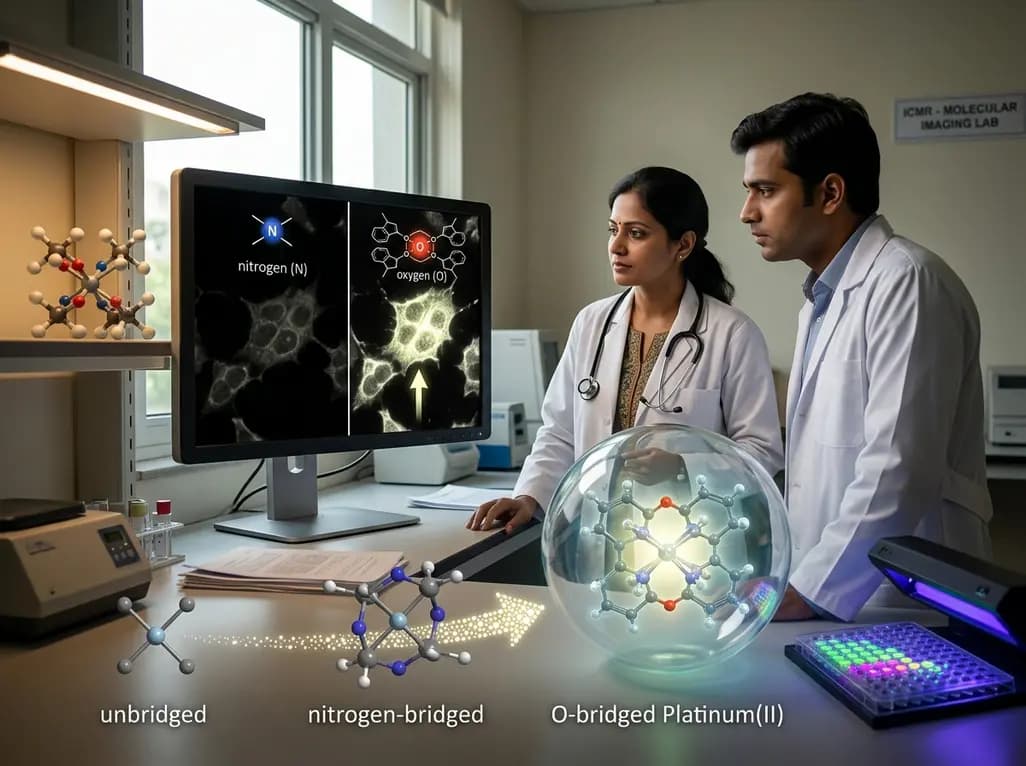
Platinum(II) complexes have long occupied a central position in the landscape of medicinal chemistry, primarily recognized for their potent role in oncology as chemotherapeutic agents. However, a significant shift in research focus has emerged recently, positioning these transition metal complexes as vital tools in the realm of diagnostic technology. Specifically, Platinum(II) complexes bioimaging has become an area of intense exploration because these molecules possess unique electronic configurations that allow for tunable luminescent properties. Researchers are now looking beyond traditional therapy to harness these complexes as high-precision contrast agents and molecular probes. By modifying the chemical structure of these complexes, scientists can significantly improve their brightness, stability, and tissue penetration capabilities. The recent study by Matharu and colleagues delves into the intricate relationship between molecular architecture and light-emitting efficiency. Their work specifically compares bridged and unbridged cyclometalated complexes to understand how small structural changes can lead to massive differences in diagnostic performance. Consequently, this research provides a roadmap for clinicians and researchers aiming to develop more effective tracers for early-stage disease detection and real-time monitoring of biological processes.
The core of this photophysical investigation lies in the comparison between tetradentate complexes and their unbridged counterparts. In the study, the researchers examined complexes bearing Oxygen and Nitrogen elemental bridges between 2-phenylpyridine units. Specifically, they compared these to the well-known unbridged Pt(phpy) structure. Furthermore, the introduction of a bridging atom fundamentally alters the geometry and rigidity of the molecular framework. Unlike the unbridged versions, the bridged architectures exhibit significantly different intermolecular interactions in the solid state. For instance, single-crystal X-ray diffraction analysis revealed that the N-bridged complex demonstrated no notable Pt路路路Pt interactions. This lack of metal-to-metal interaction significantly impacts how the molecule behaves when it encounters other molecules in a cellular environment. In contrast, the O-bridged complex showcased a distinct structural arrangement that facilitates more favorable photophysical outcomes. Because the tetradentate ligands provide a more rigid environment, they effectively suppress non-radiative decay pathways. Therefore, the simple act of "bridging" the ligands creates a more stable and reliable platform for bioluminescence, which is essential for consistent imaging results across various tissue types and clinical conditions.
One of the most critical findings in the research involves how the electronegativity of the bridging atom affects the emission spectra. Specifically, the O-bridged complex displays a significant blue-shifted spectrum compared to its N-bridged or unbridged counterparts. Using density functional theory (DFT) calculations, the team explained that the more electronegative oxygen atom leads to substantial HOMO stabilization. Consequently, this stabilization widens the energy gap, resulting in higher energy, shorter-wavelength emission. This spectroscopic tuning is not merely a laboratory curiosity; it is fundamentally important for the practical application of Platinum(II) complexes bioimaging in a clinical setting. For example, the ability to fine-tune emission wavelengths allows for multiplexed imaging, where different biological targets are labeled with different colors simultaneously. Moreover, the study highlights that even minor atomic differences can result in macroscopic changes in property performance. While the Nitrogen-bridged complex behaves predictably, the Oxygen-bridged version offers superior control over light output. Thus, by selecting specific bridging atoms, chemical engineers can create bespoke imaging agents tailored to specific diagnostic needs, potentially reducing background noise and enhancing the signal-to-noise ratio in complex biological environments.
A major hurdle in the development of traditional fluorescent probes is the relatively short lifetime of the emission, which often overlaps with naturally occurring tissue autofluorescence. However, the introduction of a bridging atom in these Platinum(II) complexes successfully "turns on" room-temperature phosphorescence (RTP). This phenomenon is particularly valuable for medical imaging because phosphorescent lifetimes are significantly longer than fluorescent ones. By employing time-gated detection techniques, clinicians can effectively eliminate background interference, leading to much clearer images of deep-seated tumors or metabolic markers. Furthermore, the transition from unbridged to bridged structures marks a significant improvement in quantum yield. Notably, unbridged complexes often require cryogenic temperatures to exhibit strong phosphorescence, which is obviously impractical for clinical use. In contrast, the bridged complexes described in this research function efficiently at room temperature and within physiological environments. Consequently, this advancement brings us one step closer to utilizing high-contrast, phosphorescent metal complexes in routine diagnostic procedures. Additionally, the stability provided by the tetradentate ligand ensures that the probe remains active long enough for thorough clinical assessment, which is vital for complex radiological evaluations.
Perhaps the most fascinating aspect of this study is the behavior of these complexes when they aggregate. In high concentrations or when bound to specific targets, many traditional imaging agents suffer from aggregation-caused quenching (ACQ), where the light signal effectively turns off. The N-bridged complex in this study unfortunately experienced this significant quenching effect, limiting its utility in concentrated environments. Conversely, the O-bridged complex displayed a remarkable phenomenon known as aggregation-induced emission (AIE) switching. Specifically, it demonstrated a transition from red-to-green emission resulting from excimer formation. This "turn-on" or "switching" capability is highly sought after in biosensing applications. For instance, an imaging agent that only glows or changes color when it aggregates at a tumor site provides much higher specificity than a constantly glowing probe. Moreover, this red-to-green switching allows for a dual-channel verification of target binding, which increases diagnostic confidence. Therefore, the O-bridged complex represents a superior scaffold for Platinum(II) complexes bioimaging, as it circumvents the limitations of quenching and provides a dynamic, responsive signal that can be easily monitored by existing radiological equipment.
Ultimately, the goal of this research is to streamline the rational design of new functional molecules for healthcare. By investigating the core photophysical properties of this popular family of Platinum complexes, the authors provide a foundation for future bio-engineering. Instead of relying on trial-and-error, scientists can now use the principles of HOMO stabilization and bridging atom selection to predict how a new molecule will perform. Specifically, the data regarding AIE switching and phosphorescence lifetimes provides a clear metric for success in diagnostic agent development. Furthermore, these findings are highly relevant to the Indian healthcare context, where oncology and precision medicine are rapidly advancing. As we move toward personalized medicine, the demand for highly specific, non-toxic, and bright imaging tracers will only increase. Consequently, the ability to design molecules that switch signals upon reaching a target could revolutionize how we monitor treatment response and disease progression. Although these complexes are currently in the laboratory phase, their unique photophysical profiles suggest they will play a pivotal role in the next generation of diagnostic contrast agents. Specifically, the transition from fundamental chemistry to clinical utility is paved by such detailed investigations into molecular structure and light emission behavior.
Platinum(II) complexes are exceptionally suitable for bioimaging due to their square planar geometry and strong spin-orbit coupling. This structure allows for highly tunable luminescent properties, including long-lived phosphorescence that helps bypass natural tissue autofluorescence. Furthermore, their stability in physiological conditions and well-understood chemistry make them reliable candidates for developing molecular probes that can target specific biological markers with high precision and clarity.
Bridging the ligands in Platinum(II) complexes significantly increases the rigidity of the molecular structure. This increased rigidity suppresses non-radiative decay pathways, effectively "turning on" room-temperature phosphorescence that is often absent in unbridged versions. Consequently, the complexes become much brighter and more stable, providing a consistent signal that is essential for accurate medical imaging and reducing the likelihood of signal loss during clinical procedures.
Aggregation-induced emission is clinically significant because it allows for "turn-on" sensing. Traditional dyes often lose their signal when they accumulate at a target site, but AIE-active complexes like the O-bridged Platinum(II) structure actually become brighter or change color. This ensures that the signal is only strong where the probe is concentrated, such as at a tumor site, providing a highly specific and high-contrast image for the radiologist.
Disclaimer: This content is for informational and educational purposes only and does not constitute medical advice, diagnosis, or treatment. Always seek the advice of your physician or other qualified health provider with any questions you may have regarding a medical condition. The research discussed is fundamental in nature and has not yet been approved for human clinical use. Refer to the latest local and national guidelines for clinical practice.
References
Matharu GK et al. Comparing the Photophysical Properties of Bridged and Unbridged Platinum(II) Cyclometalated Complexes. Inorg Chem. 2026 Jul 05. doi: 10.1021/acs.inorgchem.6c02137. PMID: 42402204.
Tang BZ, et al. Aggregation-Induced Emission: Together we shine, united we soar! Chem Commun. 2017;53:11-25.
Zhao Q, et al. Phosphorescent Platinum(II) Complexes in Bioimaging and Biosensing. Coordination Chemistry Reviews. 2011;255(17-18):2161-2191.

Read summarized clinical updates, watch expert medical content, and earn CME certifications right from your smartphone.
Open your smartphone camera to scan and install.





Recent research compares bridged and unbridged Platinum(II) complexes, revealing how bridging atoms like Oxygen and Nitrogen transform photophysical properties for bioimaging. This study highlights the superiority of O-bridged complexes in aggregation-induced emission, offering a new path for medical diagnostics.
3 months ago

Explore vital recurrent stroke predictors in lacunar stroke patients managed with intensive blood pressure lowering. This analysis examines trial findings from SPS3 to uncover residual vascular risks, metabolic factors, and targeted secondary prevention strategies for high-risk neurological patients.
Today

Odisha has established India's first state-level clinical protocol specifically tailored for pregnant women with sickle cell disease. Developed with NHM and UNICEF, the framework provides structured antenatal screening, crisis mitigation, standardized referral pathways, and specialized interdisciplinary care.
Today

The Directorate General of Health Services directs Indian states to halt the hazardous reuse and reprocessing of single-use medical devices. Discover regulatory implications under the Drugs and Cosmetics Act, critical infection risks, legal liabilities, and operational changes required across clinical specialties.
Today

Mitochondria-targeted nanoparticles self-assembled from EGCG and L-glutamic acid effectively restore mitochondrial homeostasis, suppress synovial inflammation, and attenuate chondrocyte senescence in osteoarthritis, offering a promising disease-modifying nanotherapy.
Today

India is advancing preventive healthcare by integrating genomics, artificial intelligence, and quantum technologies. With the SANGAM programme sequencing one million Indian genomes, clinicians can unlock personalized therapies, detect cardiometabolic risks early, and curb the burden of diabetes and heart disease.
Today
