.webp&w=384&q=75)

Loading, please wait...
Loading, please wait...
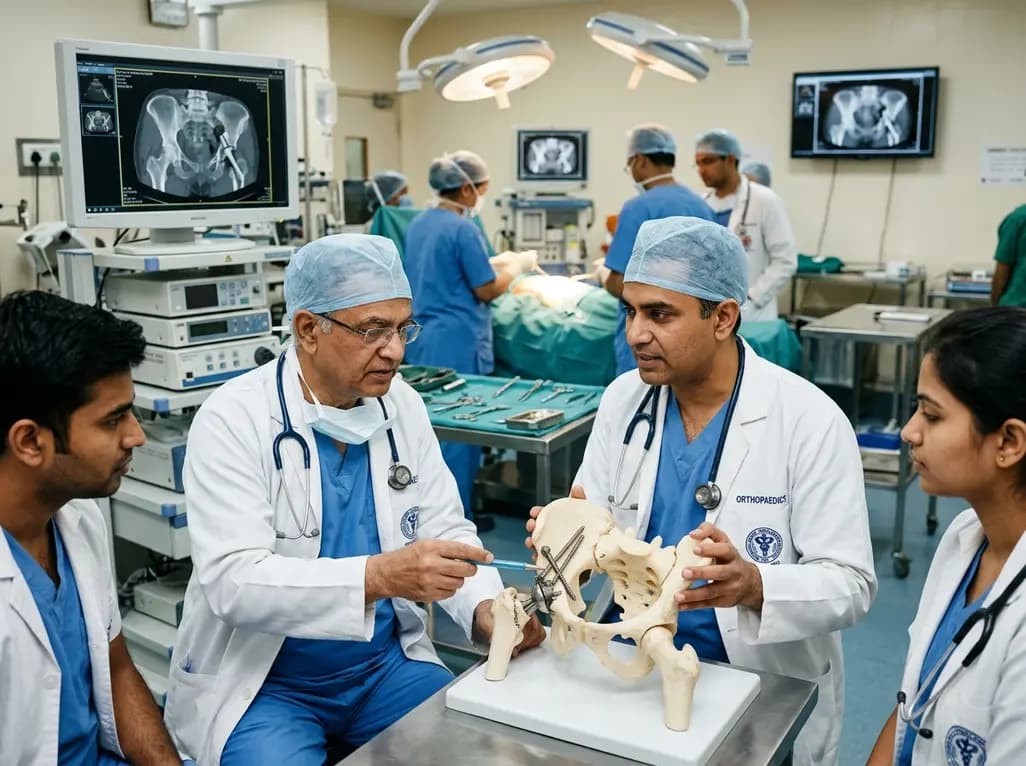
Revision hip arthroplasty presents formidable surgical challenges when surgeons encounter severe acetabular bone defects. Historically, massive pelvic bone loss and structural pelvic discontinuity disrupt normal joint mechanics and undermine standard implant stability. Consequently, traditional hemispherical cups often fail because they depend on insufficient native host bone. A groundbreaking bio-inspired engineering approach now introduces the pile foundation reconstruction prosthesis to solve these reconstructive limitations.
Orthopedic surgeons frequently encounter severe bone loss during complex revision total hip arthroplasty. Specifically, Paprosky type III defects and pelvic discontinuity compromise mechanical pelvic integrity. When massive osteolysis erodes the periacetabular rim, traditional reconstructive options struggle to provide durable stability. Standard hemispherical cups rely directly on the inner surface bone stock of the acetabulum. However, severe cavitary and segmental loss eliminates this essential supporting platform. As a result, reconstructive implants suffer from inadequate contact area, leading to early mechanical loosening and catastrophic migration.
Furthermore, treating these complex bone deficiencies often demands extensive structural bone allografts or massive custom metal augments. While modular porous tantalum augments and anti-protrusio cages offer salvage pathways, they carry noticeable failure rates. In particular, biological graft incorporation remains unpredictable in compromised host tissue beds. In addition, irregular defect morphology makes standard implant positioning extremely demanding. Surgeons therefore require an innovative biomechanical philosophy that circumvents the damaged inner acetabular wall entirely. By shifting load transfer from deficient superficial bone surfaces to resilient deeper pelvic architecture, clinicians can achieve immediate and durable structural stability. Consequently, novel implant designs represent a critical evolutionary step in modern revision hip surgery.
To resolve persistent reconstructive hurdles, biomechanical researchers adapted deep foundation principles from civil engineering. In civil construction, engineers anchor massive skyscrapers into bedrock using deep structural piles whenever superficial soil layers lack sufficient bearing capacity. Similarly, the pile foundation reconstruction prosthesis applies this foundational principle to the human pelvis. Instead of relying on deteriorated inner acetabular bone, this novel implant anchors deeply into robust periacetabular columns.
Specifically, the prosthetic design stabilizes the main acetabular component through rigid pile screws directed into healthy, remote pelvic bone stock. These long anchoring piles bypass peripheral bone defects and engage dense cortical corridors within the surrounding pelvis. Moreover, this structural architecture effectively converts destructive sheer and tilting stresses into axial compressive forces along the bone columns. As a result, the construct reduces dangerous micromotion across the reconstructive interface. Furthermore, the prosthesis decouples cup seating from the irregular cavity floor, thereby allowing surgeons to restore the anatomical center of hip rotation accurately. Therefore, by adopting robust architectural foundations, the prosthesis provides exceptional primary stability even in severely compromised anatomical environments. This structural paradigm shift establishes a dependable mechanical platform for lasting biological osseointegration.
Finite element analysis reveals crucial biomechanical details regarding pelvic load transmission through the prosthesis. In native gait cycles, the pelvis experiences multi-directional forces during weight-bearing activities. Therefore, computational studies evaluated stress distribution across various screw orientations and pelvic contact points. Initial finite element models demonstrated that the posterior iliac pile and the pubic pile function as the primary load-bearing pillars. Together, these two components carry the vast majority of physiological forces transmitted across the reconstructed hip.
However, two anchoring points alone cannot prevent rotational instability and out-of-plane displacement. Consequently, the research team established that a minimum triangular configuration is essential to achieve complete structural equilibrium. This fundamental tripod arrangement incorporates a posterior iliac pile, a pubic pile, and an ischial pile. Together, these three diverging anchors form a self-stabilizing structural scaffold that rigidly supports the central acetabular cup. Moreover, fatigue mechanical testing verified that this three-pile geometry withstands repetitive physiological loading cycles without loosening or fatigue fracture. In addition, the triangular scaffold creates uniform stress distribution throughout the surrounding bone bed. Thus, this balanced configuration protects residual periacetabular bone from localized stress concentrations, effectively preventing further bone resorption.
To confirm widespread clinical utility, investigators validated the prosthesis against real-world patient defect morphologies. Researchers conducted a comprehensive cluster analysis on a historical clinical cohort comprising 137 revision hip arthroplasty cases. Through this quantitative morphological assessment, the investigators categorized complex bone defects into four distinct clinical types. Each category reflected unique anatomical deficiency patterns, ranging from localized column loss to severe pelvic ring disruptions.
Subsequently, the team evaluated the pile foundation reconstruction prosthesis against the most severe defect manifestation within each individual category. Finite element simulations confirmed that the three-pile construct consistently maintained mechanical rigidity across all four morphological types. Even in the most extreme Paprosky type IIIB defects, the prosthesis limited interface micromotion well below critical thresholds required for bone ingrowth. Furthermore, the modular pile screws successfully engaged sufficient cortical bone across varying anatomical deformities. As a result, the construct demonstrated versatile adaptability without requiring individualized, custom-milled cup shells for every patient. Consequently, this modular three-pile strategy provides orthopedic surgeons with a standardized, reliable method to manage diverse anatomical challenges encountered during complex pelvic revisions.
Implementing the pile foundation reconstruction prosthesis demands careful preoperative planning and refined surgical execution. Orthopedic surgeons must obtain high-resolution three-dimensional computed tomography scans to evaluate residual pelvic columns accurately. Preoperative digital planning software helps clinicians determine optimal trajectory angles for the iliac, pubic, and ischial pile screws. Furthermore, these virtual simulations ensure that long screws safely navigate complex pelvic corridors without breaching major neurovascular structures. In particular, surgeons must avoid injury to the external iliac vessels and the sciatic nerve during drilling.
Intraoperatively, accurate bone preparation remains paramount for surgical success. Surgeons meticulously clear fibrous scar tissue while preserving viable pelvic bone stock. Next, the operating team positions the central cup guide to establish the correct anatomic hip center. Subsequently, drill guides assist in creating precise pilot channels into the posterior ilium, pubis, and ischium. Once surgeons seat the three anchoring piles securely, they lock the components into the central acetabular shell. Additionally, clinicians can pack morselized cancellous bone graft into contained voids around the implant. This step promotes biological bone regeneration around the stable hardware. Ultimately, this systematic technique restores pelvic stability and enables early, confident patient rehabilitation.
Traditional revision cups rely on direct contact with the inner surface of the acetabular bone. When severe bone loss destroys this surface, conventional cups lose mechanical support and loosen rapidly. In contrast, the pile foundation reconstruction prosthesis mimics civil engineering deep foundation piles. It bypasses superficial defects and anchors long pile screws deeply into robust periacetabular columns. Consequently, this design provides immediate primary mechanical stability regardless of local cavity deficiencies.
Finite element analysis demonstrates that the posterior iliac and pubic piles carry the majority of physiological loads. However, two anchoring points cannot resist rotational moments and multi-axial sheer stresses during normal walking. Therefore, adding an ischial pile completes a rigid triangular tripod structure. Furthermore, this three-point configuration neutralizes out-of-plane forces and minimizes implant micromotion below fifty micrometers. As a result, the construct prevents mechanical fatigue and fosters durable biological fixation over time.
Yes, cluster analysis of 137 revision cases confirmed the broad applicability of this prosthetic system across four distinct bone defect categories. Even in severe Paprosky type IIIB defects with extensive column loss, the modular piles effectively achieved solid cortical purchase in unaffected pelvic regions. Moreover, surgeons can adjust the trajectory of each pile screw to match residual bone anatomy. Consequently, this technique provides versatile stability without requiring expensive patient-specific custom implants for every revision case.
Disclaimer: This content is for informational and educational purposes only... Refer to the latest local and national guidelines for clinical practice.
References

Read summarized clinical updates, watch expert medical content, and earn CME certifications right from your smartphone.
Open your smartphone camera to scan and install.





A bio-inspired pile foundation reconstruction prosthesis offers stable fixation for severe Paprosky III acetabular bone defects and pelvic discontinuity. Anchored by a three-pile triangular configuration in deep periacetabular bone stock, it delivers robust biomechanical stability across diverse defect types.
Today

Newly recognized orthonairoviruses like Wetland virus trigger lethal hepatic dysfunction via caspase-3-gasdermin E pyroptosis and fatty acid synthase-dependent steatosis. This crucial link between inflammatory cell death and metabolic dysregulation highlights novel avenues for host-directed antiviral therapies.
Today

A cross-sectional study of 700 college students highlights significant contraceptive knowledge disparities between sexually active and inactive young adults. The findings demonstrate a critical need for proactive, comprehensive sexual health counseling before sexual debut.
Today

A landmark nationwide cohort study reveals that older adults with dementia who undergo cardiac catheterization for STEMI spend meaningful time alive at home, particularly community-dwelling individuals. Cognitive impairment alone should not preclude acute invasive revascularization.
Today

A randomized controlled trial demonstrates that theory-driven personalized mobile messaging reduces the risk of consecutive walking goal failures by 33 percent, highlighting the vital role of digital health tools in sustaining long-term exercise habits and chronic disease prevention.
Today
