.webp&w=384&q=75)

Loading, please wait...
Loading, please wait...
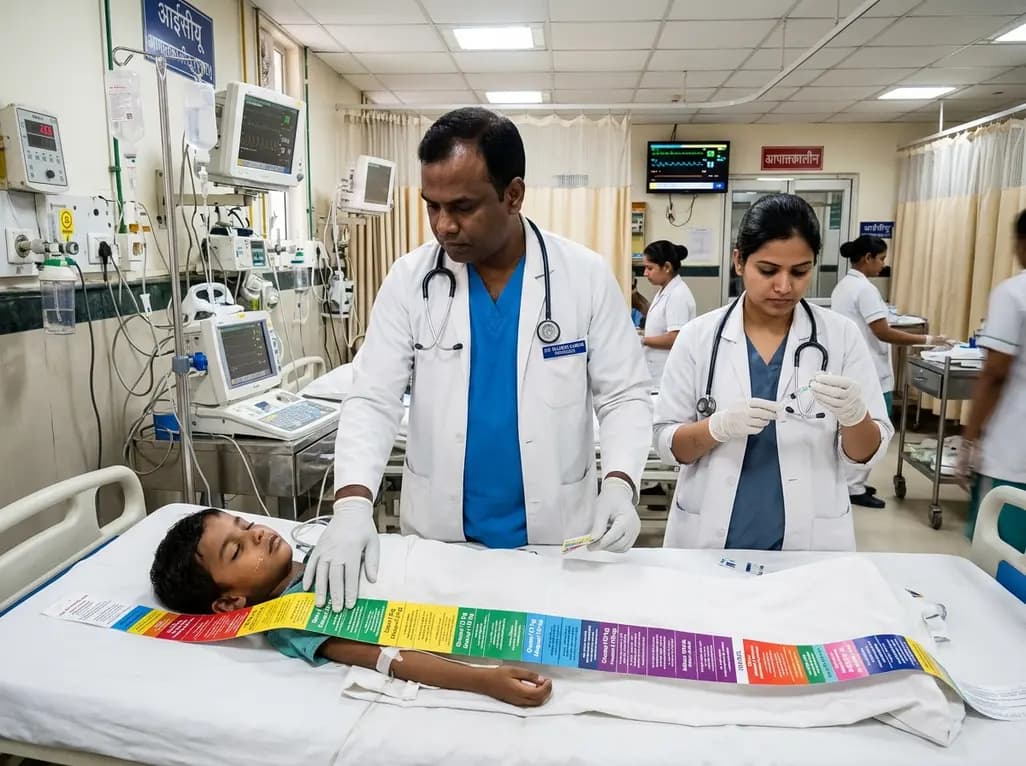
Accurate and rapid assessment remains the bedrock of successful pediatric resuscitation in acute critical care settings. When managing critically ill infants and children, pediatric emergency weight estimation is essential because healthcare providers calculate virtually every medication dosage, fluid bolus, and equipment dimension based on body mass. Unfortunately, placing an unstable, intubated, or convulsing child on a conventional weighing scale is practically impossible during life-threatening crises. Consequently, clinicians worldwide have relied on length-based estimation tapes to guide urgent interventions. A landmark multicentre validation study in India has now introduced a calibrated resuscitation tape designed specifically around the growth patterns of Indian children.
In acute pediatric emergencies, every second counts, and therapeutic errors can lead to irreversible adverse outcomes. Emergency physicians, intensivists, and nursing staff must calculate weight-dependent pharmacotherapy rapidly during resuscitation. For instance, medications such as epinephrine, sedative agents, anticonvulsants, and inotropic infusions have very narrow therapeutic windows. Therefore, an incorrect weight estimate directly translates into inappropriate dosing, which either causes therapeutic failure or severe toxicity. In addition, selecting endotracheal tubes, defibrillation paddles, suction catheters, and central venous lines demands precise body metrics. When physical weighing is unfeasible due to physiological instability, healthcare teams urgently need rapid, objective, and standardized surrogate measures. Length-based tools provide a practical bedside solution by correlating supine body length directly to expected weight categories. However, the underlying growth references that govern these correlations dictate their real-world accuracy. If the reference cohort differs physiologically from the local patient population, the estimation tool inherently introduces systematic clinical discrepancies. Thus, developing population-specific clinical instruments is crucial for optimizing patient safety during acute life-support interventions across intensive care wards and emergency units. Healthcare providers can thereby eliminate guesswork and deliver targeted therapies with greater clinical confidence.
For decades, resuscitation teams in India have widely utilized the Broselow pediatric emergency tape. The Broselow tape relies heavily on historic growth data collected from American pediatric populations. However, extensive clinical research indicates that Indian children generally exhibit different body habitus and lower median weights for corresponding heights compared to Western cohorts. Consequently, standard Broselow tapes frequently overestimate the actual weight of Indian pediatric patients across multiple age groups. This systematic overestimation creates substantial clinical risk in daily intensive care practice. When clinicians administer emergency drugs based on inflated weight projections, children inadvertently receive higher medication doses and oversized airway equipment. In critical conditions such as septic shock, severe head trauma, or status epilepticus, excessive drug delivery can provoke severe cardiopulmonary depression, arrhythmias, or neurotoxicity. Although researchers previously recognized this mismatch, emergency teams lacked an accessible, validated, and ready-to-use bedside alternative derived from domestic growth data. Moreover, attempts to manually calculate adjusted formulas during chaotic emergencies increase cognitive burden and mathematical calculation errors among healthcare providers. Therefore, frontline clinicians needed a calibrated visual tool that would accurately reflect local anthropometric realities without requiring complex manual conversions. An indigenous, validated solution remained an urgent clinical necessity.
To resolve this long-standing clinical dilemma, researchers at Jehangir Hospital and the Hirabai Cowasji Jehangir Medical Research Institute in Pune developed the Indianized Pediatric ALS tape. Specifically, the investigative team recalibrated length boundaries for each distinct weight category using contemporary Indian multicenter growth data. Importantly, the newly developed tape maintains the identical color-coding sequence and physical format as the traditional Broselow system. As a result, pediatricians, residents, and nursing staff can seamlessly adopt the device without requiring exhaustive operational retraining. Furthermore, the Indianized tape integrates drug dosing schedules and resuscitation equipment sizes aligned strictly with Indian Academy of Pediatrics Pediatric Advanced Life Support (IAP-PALS) protocols. By adjusting the median height-to-weight relationships, the tool matches the physiological profile of Indian children while delivering standardized, precalculated emergency resuscitation parameters right at the bedside. Consequently, clinical teams can rapidly identify appropriate endotracheal tube internal diameters, laryngoscope blade sizes, and chest tube calibers based on the child's measured recumbent length. This intuitive design bridges the gap between anthropometric precision and rapid emergency execution. In addition, the durable construction of the tape allows rapid sanitization and bedside deployment during time-critical pediatric resuscitations. Hospital emergency units can thus maintain continuous operational readiness.
A comprehensive prospective study evaluated the performance of the Indianized Pediatric ALS tape across 13 tertiary pediatric intensive care units in India. Researchers analyzed data from 2,253 critically ill children under twelve years of age across diverse geographical zones. The findings, published in the journal Indian Pediatrics, demonstrated remarkable clinical concordance and reliability. Overall, the tape correctly identified the precise weight band in 79.9% of critically ill children. Furthermore, 78.6% of estimated weights fell within a strict 10% margin of the measured weight, expanding to 84.6% within a 15% margin. The overall mean bias remained exceptionally small, underestimating body mass by merely 0.6 kg across the entire study population. In addition, interrater reliability among healthcare personnel proved strong, confirming that diverse clinical staff members obtain consistent readings under high-pressure intensive care conditions. Although slight underestimation occurred in the lowest weight bands and mild overestimation appeared in higher weight bands, the tool maintained clinically acceptable safety margins. These robust multicentric results confirm the viability of the tape as an evidence-based clinical replacement. Consequently, intensive care teams can rely on these validated metrics to guide immediate fluid administration, vasoactive titrations, and electrical cardioversion energy selections with minimal systematic error.
The clinical implementation of this indigenous tape represents a major advancement for emergency pediatric critical care throughout South Asia. By replacing Western reference charts with data calibrated to Indian children, healthcare centers can significantly minimize medication errors during critical resuscitation windows. Participating centers, including Indraprastha Apollo Hospital, Rainbow Children’s Hospital, Kalinga Institute of Medical Sciences, and Gandhi Medical College, highlighted the universal applicability of the tool. Moreover, the tape demonstrated superior predictive performance compared to earlier domestic alternatives like the InChiTape. Nevertheless, investigators emphasize that ongoing studies should evaluate real-world clinical outcomes and directly compare the tool against conventional devices across varied nutritional demographics. Incorporating this calibrated instrument into standardized emergency carts and ambulance kits will elevate pediatric trauma and life-support standards across regional networks. Ultimately, adopting culturally and anthropometrically calibrated resuscitation instruments ensures equitable, safe, and precise critical care delivery for every hospitalized child. Continued national dissemination through medical societies will strengthen emergency preparedness across primary, secondary, and tertiary pediatric care facilities. Furthermore, integrating this tool into medical training curricula will familiarize young residents with regional growth nuances, promoting safer pharmacotherapeutic practices from the very start of their clinical careers.
Q1: Why is the Broselow tape less accurate for Indian children?
The Broselow tape was developed using anthropometric growth data derived from American pediatric populations. Because Indian children typically display distinct body compositions and lower average weights for a given height, the Broselow tape frequently overestimates their body weight. Consequently, this systematic overestimation can lead to unintentional drug overdosing, fluid overload, and incorrect equipment sizing during high-stakes pediatric resuscitation emergencies in emergency departments.
Q2: How does the Indianized Pediatric ALS tape differ from the standard Broselow tape?
The Indianized tape retains the familiar color-coded sequence and physical format of the standard Broselow tape, ensuring healthcare personnel require minimal retraining. However, it recalibrates length intervals based on contemporary Indian multicenter growth references. Furthermore, the tool incorporates weight-specific medication dosages, fluid volumes, and resuscitation equipment specifications that align directly with updated Indian Academy of Pediatrics Pediatric Advanced Life Support protocols.
Q3: What were the key accuracy findings of the multicenter validation study?
In a multicenter study of 2,253 critically ill children across 13 Indian PICUs, the Indianized tape correctly predicted the exact weight band in 79.9% of patients. Additionally, 78.6% of weight estimates fell within 10% of actual measured weights, and 84.6% fell within 15%. The device exhibited an exceptionally low average bias of 0.6 kg across all participating centers.
Disclaimer: This content is for informational and educational purposes only. It does not constitute medical advice or replace professional judgment. Refer to the latest local and national guidelines for clinical practice.
References

Read summarized clinical updates, watch expert medical content, and earn CME certifications right from your smartphone.
Open your smartphone camera to scan and install.





A multicentre validation across 13 Indian intensive care units demonstrates that the new Indianized Pediatric ALS tape significantly improves weight estimation accuracy for critically ill children, reducing dangerous dosing errors associated with Western growth charts.
last month

A nationwide multicenter study identified three COPD clinical phenotypes, finding that mild smoking males experience the highest rate of rapid lung function decline. A CatBoost model using six routine clinical and socioeconomic variables accurately stratifies high-risk patients for early therapeutic intervention.
Today
Discover the crucial distinctions between mesonephric and mesonephric-like proliferations of the female genital tract. Learn the key histomorphologic, immunohistochemical, and molecular differences essential for accurate diagnosis and clinical management.
Today
A large UK Biobank study reveals that plasma proteomic signatures capture preclinical organ damage and improve multiorgan risk prediction across early CKM syndrome stages 0 to 2 beyond traditional PREVENT clinical models.
Today
A narrative review investigates whether the articularis genus muscle functions as an independent anatomical entity or blends with the vastus intermedius. We evaluate its morphology, role in retracting the suprapatellar bursa, and direct clinical significance in anterior knee pain and arthroplasty.
Today

A Bayesian multilevel meta-analysis reveals that aerobic training combined with moderate carbohydrate restriction modestly lowers HbA1c in type 2 diabetes. However, sparse data and very low certainty leave incremental benefits over exercise or diet alone unproven, highlighting the need for individualized care.
Today
