.webp&w=384&q=75)

Loading, please wait...
Loading, please wait...

Chronic obstructive pulmonary disease presents remarkable clinical heterogeneity across diverse patient populations. Consequently, identifying individuals vulnerable to rapid lung function decline remains an urgent priority in modern respiratory medicine. Historically, medical practitioners assumed that individuals with advanced baseline obstruction experienced the steepest downward functional trajectories. However, emerging longitudinal evidence from a massive cohort of 38,863 patients fundamentally challenges this longstanding clinical assumption. Modern clinical researchers now leverage latent class analysis to untangle complex disease manifestations into reproducible phenotypes. Furthermore, evaluating longitudinal spirometry over twenty-four months clarifies individual disease progression with greater diagnostic precision. Within this analytical framework, investigators defined rapid functional deterioration as an annual forced expiratory volume in one second decline of at least forty milliliters. Alternatively, they marked an annual predicted percentage reduction of 1.5 percent as accelerated loss. Because conventional spirometric staging often overlooks dynamic, early-stage pathology, targeted phenotyping offers superior clinical foresight. Therefore, clinicians must look beyond isolated baseline measurements. By integrating demographic profiles, clinical symptoms, and environmental exposures, healthcare providers can reliably identify rapid progressors before irreversible ventilatory impairment occurs.
Through rigorous latent class analysis, researchers stratified the multicenter cohort into three distinctive clinical phenotypes. Specifically, Phenotype 1 represented 25.8 percent of the cohort, characterized primarily by non-smoking females exhibiting moderate obstruction corresponding to GOLD Stage 2. In contrast, Phenotype 2 emerged as the most prevalent subgroup, comprising 44.8 percent of all evaluated individuals. This group predominantly consisted of male smokers who presented with mild obstruction classified as GOLD Stage 1. Finally, Phenotype 3 encompassed 29.4 percent of participants, capturing individuals with severe airway limitation classified as GOLD Stage 3 alongside severe cumulative smoking exposure histories. Notably, longitudinal analysis of 1,215 patients revealed a critical, counterintuitive pattern. Phenotype 2 demonstrated the highest incidence of rapid functional deterioration, affecting 55.8 percent of this group. Consequently, patients with preserved initial volumes and mild disease exhibited significantly faster decline rates than patients with advanced obstruction. This finding indicates that mild clinical presentations frequently conceal aggressive active pathology. Therefore, physicians must abandon the assumption that mild baseline obstruction equates to indolent disease activity.
To translate phenotypic heterogeneity into practical predictive tools, investigators developed sophisticated machine learning models. Initially, they utilized LASSO regression and the Boruta algorithm to screen extensive clinical features. Subsequently, the team constructed and trained six different predictive models to forecast rapid disease progression. Among all competing frameworks, the CatBoost algorithm achieved the highest predictive performance, attaining an area under the receiver operating characteristic curve of 0.712. Furthermore, the model required only six routine variables: geographic region, domestic fuel type, household income, wheezing symptoms, hip circumference, and baseline spirometry. To explain individual feature contributions, investigators conducted SHapley Additive exPlanations analysis. Notably, SHAP values identified baseline forced expiratory volume as the most influential determinant of future decline. At an optimal probability threshold of 0.365, the model yielded an impressive 95.5 percent sensitivity alongside an 86.4 percent negative predictive value. Moreover, decision curve analysis verified marked net clinical benefit. Thus, this machine learning framework reliably excludes low-risk patients while flagging rapid progressors who need aggressive surveillance.
The identified predictive markers underscore that chronic respiratory deterioration extends beyond pulmonary mechanics. Specifically, domestic fuel choice and household income reflect important environmental and social determinants of health. In low-resource environments, domestic biomass smoke generates chronic oxidative stress and persistent airway inflammation that rivals cigarette smoke toxicity. Furthermore, geographical region captures critical disparities in ambient air pollution, occupational hazards, and local healthcare infrastructure. In addition to environmental elements, patient-specific physical characteristics play an important prognostic role. For example, hip circumference served as an informative anthropometric indicator in the predictive model. Elevated abdominal and pelvic adiposity frequently correlates with chronic systemic metabolic inflammation, which accelerates parenchymal destruction. Concurrently, persistent wheezing reflects active airway hyperresponsiveness and mucosal swelling. When clinicians combine these non-invasive sociodemographic and physical factors with baseline spirometry, risk stratification improves substantially. Consequently, primary care physicians can readily evaluate patient risk profiles during routine consultations. This pragmatic approach requires no expensive tertiary diagnostic equipment, making comprehensive risk assessment feasible across community healthcare settings.
These cohort observations offer critical lessons for clinical practice across India, where chronic lung conditions cause immense morbidity. In Indian clinics, doctors frequently care for individuals exposed simultaneously to tobacco products and domestic chulha smoke. Moreover, millions of symptomatic individuals remain undiagnosed during initial disease stages because patients often overlook mild dyspnea. As this study demonstrates, patients with mild baseline obstruction face the highest rate of rapid ventilatory loss. Therefore, Indian practitioners must initiate proactive case-finding programs using spirometry across primary health centers. Furthermore, healthcare teams must deliver intensive smoking cessation counseling and advocate for clean cooking fuel initiatives to stop ongoing airway injury. When predictive algorithms identify high-risk rapid progressors, physicians should initiate appropriate long-acting bronchodilator therapy promptly rather than delaying treatment. Additionally, incorporating annual spirometric surveillance, regular pneumococcal immunization, and structured pulmonary rehabilitation can preserve ventilatory reserves. Ultimately, pivoting clinical attention toward early-stage rapid progressors will help clinicians mitigate progressive disability, reduce emergency department admissions, and improve overall public health outcomes.
In clinical practice, rapid lung function decline is typically defined as an annual loss of forced expiratory volume in one second exceeding forty milliliters, or an annual drop of more than 1.5 percent in predicted values. This accelerated loss outpaces normal age-related deterioration significantly. Consequently, identifying patients experiencing this rapid drop is vital for preventing premature functional disability and reducing lifetime hospitalization risk.
Patients with mild baseline disease often possess higher absolute lung volumes, which mathematically and pathologically allows greater room for acute volumetric reduction. Moreover, early disease stages frequently feature active, unaddressed peribronchiolar inflammation and unchecked tobacco smoke or biomass exposure. In contrast, advanced end-stage patients already have severely depleted parenchymal tissue and lower baseline volumes, which physically constrains the absolute measurable rate of annual expiratory loss.
Indian practitioners can calculate patient risk by assessing six routine, accessible indicators: geographical setting, biomass fuel utilization, household income, presence of wheezing, hip circumference, and baseline spirometry. Clinicians can feed these straightforward variables into computerized algorithms to obtain immediate risk probabilities. This process enables targeted allocation of inhaler therapy, closer monitoring intervals, and aggressive lifestyle modifications for high-risk patients before extensive pulmonary damage occurs.
Disclaimer: This content is for informational and educational purposes only, and does not substitute professional medical advice, diagnosis, or treatment. Refer to the latest local and national guidelines for clinical practice.
References

Read summarized clinical updates, watch expert medical content, and earn CME certifications right from your smartphone.
Open your smartphone camera to scan and install.





A nationwide multicenter study identified three COPD clinical phenotypes, finding that mild smoking males experience the highest rate of rapid lung function decline. A CatBoost model using six routine clinical and socioeconomic variables accurately stratifies high-risk patients for early therapeutic intervention.
Today
Discover the crucial distinctions between mesonephric and mesonephric-like proliferations of the female genital tract. Learn the key histomorphologic, immunohistochemical, and molecular differences essential for accurate diagnosis and clinical management.
Today
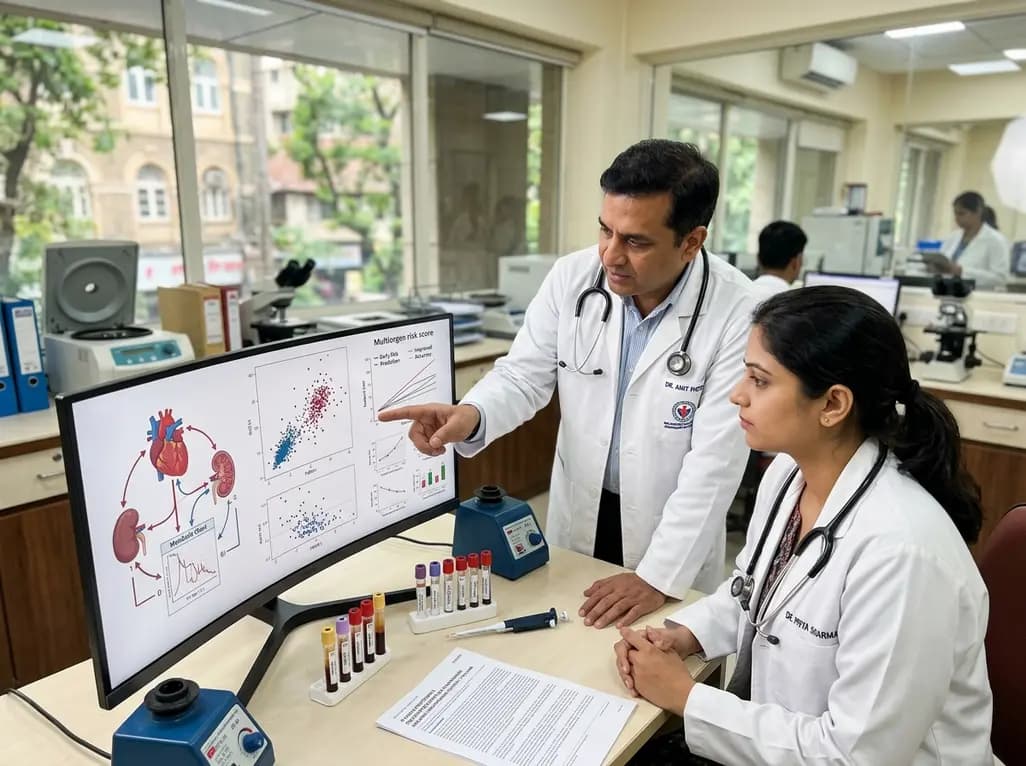
A large UK Biobank study reveals that plasma proteomic signatures capture preclinical organ damage and improve multiorgan risk prediction across early CKM syndrome stages 0 to 2 beyond traditional PREVENT clinical models.
Today
A narrative review investigates whether the articularis genus muscle functions as an independent anatomical entity or blends with the vastus intermedius. We evaluate its morphology, role in retracting the suprapatellar bursa, and direct clinical significance in anterior knee pain and arthroplasty.
Today

A Bayesian multilevel meta-analysis reveals that aerobic training combined with moderate carbohydrate restriction modestly lowers HbA1c in type 2 diabetes. However, sparse data and very low certainty leave incremental benefits over exercise or diet alone unproven, highlighting the need for individualized care.
Today
