.webp&w=384&q=75)

Loading, please wait...
Loading, please wait...
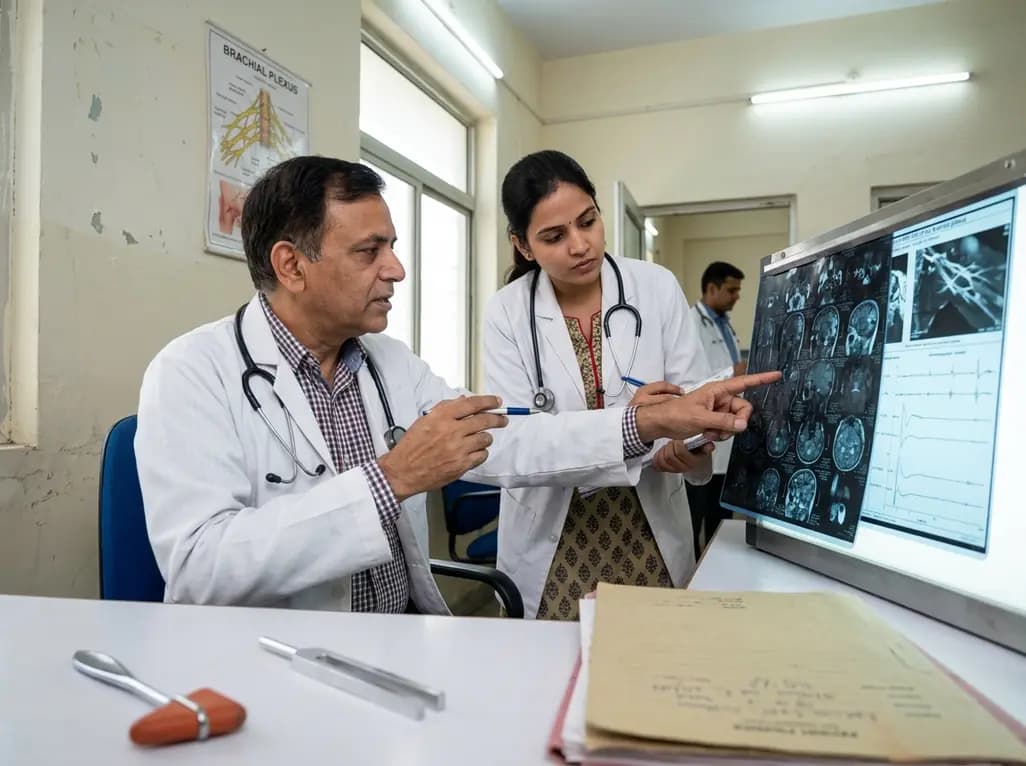
Parsonage-Turner syndrome recovery remains a complex clinical topic for neurologists, physiatrists, and peripheral nerve surgeons. Neuralgic amyotrophy, or Parsonage-Turner syndrome (PTS), classically presents with acute neuropathic pain followed by severe multifocal paresis and muscular atrophy. Consequently, clinicians often face challenging management decisions when electromyography demonstrates complete denervation with absent motor-unit activation. Historically, severe cases raised concerns regarding irreversible axonal damage, prompting questions about surgical exploration versus conservative monitoring. In contrast, severe traumatic brachial plexopathy (TBP) typically requires prompt microsurgical nerve reconstruction to restore functional motor units. Therefore, comparing long-term motor-unit reinnervation and patient-reported functional outcomes between these distinct etiologies provides vital prognostic clarity for clinicians managing severe upper extremity weakness.
Recent long-term comparative evidence demonstrates that muscles affected by severe PTS possess a remarkable capacity for spontaneous reinnervation. Even when baseline needle electromyography reveals absent voluntary motor-unit activation, spontaneous reinnervation occurs in approximately 86% of affected muscles without surgical intervention. Furthermore, recovery rates remain consistently high across distinct anatomical distributions, reaching 88% in shoulder girdle musculature, 71% in the arm, and 87% in the forearm and hand. However, this regenerative process requires considerable patience from both clinicians and patients. The median time to electrodiagnostic reinnervation is approximately 344 days, spanning nearly a full year. Consequently, recognizing this extended biological timeline prevents premature operative interventions and reassures patients during prolonged rehabilitation.
Although traumatic brachial plexopathy shares overlapping nerve territories, functional outcomes differ substantially from non-traumatic neuralgic amyotrophy. Patients recovering from severe PTS achieve far greater functional improvement, as reflected in Disabilities of the Arm, Shoulder, and Hand (DASH) scores. Specifically, mean DASH scores in PTS improve dramatically from a baseline of 54.1 down to 9.4, representing a substantial functional restoration. Conversely, surgically managed traumatic plexopathy patients show more modest improvements, shifting from 60.4 to 50.6. Traumatic traction and avulsion injuries involve extensive scar formation, severe disruption of connective tissue scaffolding, and multi-level root damage. Thus, intact internal architecture in inflammatory brachial plexopathy supports superior long-term axonal guidance compared to traumatic nerve disruptions.
High-resolution magnetic resonance neurography has generated significant debate regarding the true prevalence and clinical relevance of focal nerve constrictions. Some surgical series suggested that hour-glass constrictions routinely impede recovery in PTS, arguing for routine neurolysis or resection. However, rigorous blinded re-evaluations demonstrate that high-grade focal nerve constrictions occur in only about 4% of electrodiagnostically severe cases. Moreover, clinical outcomes among patients with identified constrictions vary considerably regardless of surgical intervention. Therefore, routine surgical exploration solely to release suspected constrictions is generally unwarranted for most patients. High-resolution magnetic resonance neurography remains a useful diagnostic tool, but clinicians should interpret structural findings alongside physiological disease trajectories.
While conservative management dominates PTS care, traumatic brachial plexopathy demands well-timed, aggressive microsurgical reconstruction. In severe traumatic lesions showing electrical silence, nerve-reconstructed muscles achieve significantly higher reinnervation rates than non-reconstructed muscles, reaching 73% versus 33%. Furthermore, surgical timing serves as a decisive determinant of final motor recovery. Reconstructing proximal targets within early therapeutic windows optimizes motor endplate preservation before irreversible muscular fibrosis occurs. Neurotization strategies, nerve grafting, and targeted fascicular transfers remain indispensable techniques for traumatic injuries. Consequently, distinguishing acute inflammatory plexopathies from mechanical disruptions ensures that surgical candidates receive timely interventions while inflammatory cases avoid unnecessary operative morbidity.
Despite high overall reinnervation rates, a subset of patients with neuralgic amyotrophy experiences persistent impairment and incomplete functional return. Residual upper extremity disability, defined by follow-up DASH scores of 15 or greater, strongly correlates with broader baseline multi-nerve distribution and disease recurrence. Additionally, recurrent attacks can compromise previously reinnervated motor territories, compounding cumulative functional deficits. Patients exhibiting extensive bilateral involvement or lower trunk distribution warrant closer functional monitoring and comprehensive multidisciplinary rehabilitation. Physical therapy focusing on scapular stabilization, compensatory movement mitigation, and neuropathic pain control remains essential throughout the lengthy reinnervation timeline.
Spontaneous motor-unit reinnervation in severe Parsonage-Turner syndrome requires substantial time. Long-term electrodiagnostic studies indicate a median time to initial reinnervation of approximately 344 days, or nearly twelve months. Clinicians should educate patients that clinical and electrical recovery is a gradual biological process, requiring consistent physical therapy and supportive care while axons regenerate across affected nerve segments.
No, blinded neuroimaging evaluations show that high-grade focal hourglass constrictions occur in only about 4% of severe cases. While microscopic torsion and fascicular constrictions can occur, they are relatively uncommon. Most patients achieve successful spontaneous axonal regeneration without undergoing exploratory microsurgical neurolysis or nerve resection procedures.
Functional recovery is markedly superior in Parsonage-Turner syndrome compared to surgically repaired traumatic plexopathy. PTS patients typically experience extensive functional restoration, with average DASH scores dropping to normal or near-normal levels. Traumatic injuries carry higher permanent disability rates due to extensive nerve root avulsion, severe mechanical disruption, and permanent motor endplate loss.
Disclaimer: This content is for informational and educational purposes only and does not constitute medical advice. Clinicians should evaluate individual patient circumstances and refer to the latest local and national guidelines for clinical practice.
References

Read summarized clinical updates, watch expert medical content, and earn CME certifications right from your smartphone.
Open your smartphone camera to scan and install.





A landmark study evaluates motor-unit reinnervation and functional outcomes in severe Parsonage-Turner syndrome compared with surgically repaired traumatic brachial plexopathy, highlighting spontaneous recovery patterns and the limited prevalence of focal nerve constrictions.
4 weeks back

A systematic review of 41 preclinical studies reveals that baicalin dampens systemic inflammation, inhibits NF-κB and NLRP3 pathways, and improves organ preservation in sepsis models. However, substantial study heterogeneity and a complete lack of human clinical trials highlight the need for further translational research.
Today
Discover the crucial distinctions between mesonephric and mesonephric-like proliferations of the female genital tract. Learn the key histomorphologic, immunohistochemical, and molecular differences essential for accurate diagnosis and clinical management.
Today
A large UK Biobank study reveals that plasma proteomic signatures capture preclinical organ damage and improve multiorgan risk prediction across early CKM syndrome stages 0 to 2 beyond traditional PREVENT clinical models.
Today
A narrative review investigates whether the articularis genus muscle functions as an independent anatomical entity or blends with the vastus intermedius. We evaluate its morphology, role in retracting the suprapatellar bursa, and direct clinical significance in anterior knee pain and arthroplasty.
Today

A Bayesian multilevel meta-analysis reveals that aerobic training combined with moderate carbohydrate restriction modestly lowers HbA1c in type 2 diabetes. However, sparse data and very low certainty leave incremental benefits over exercise or diet alone unproven, highlighting the need for individualized care.
Today
