.webp&w=384&q=75)

Loading, please wait...
Loading, please wait...
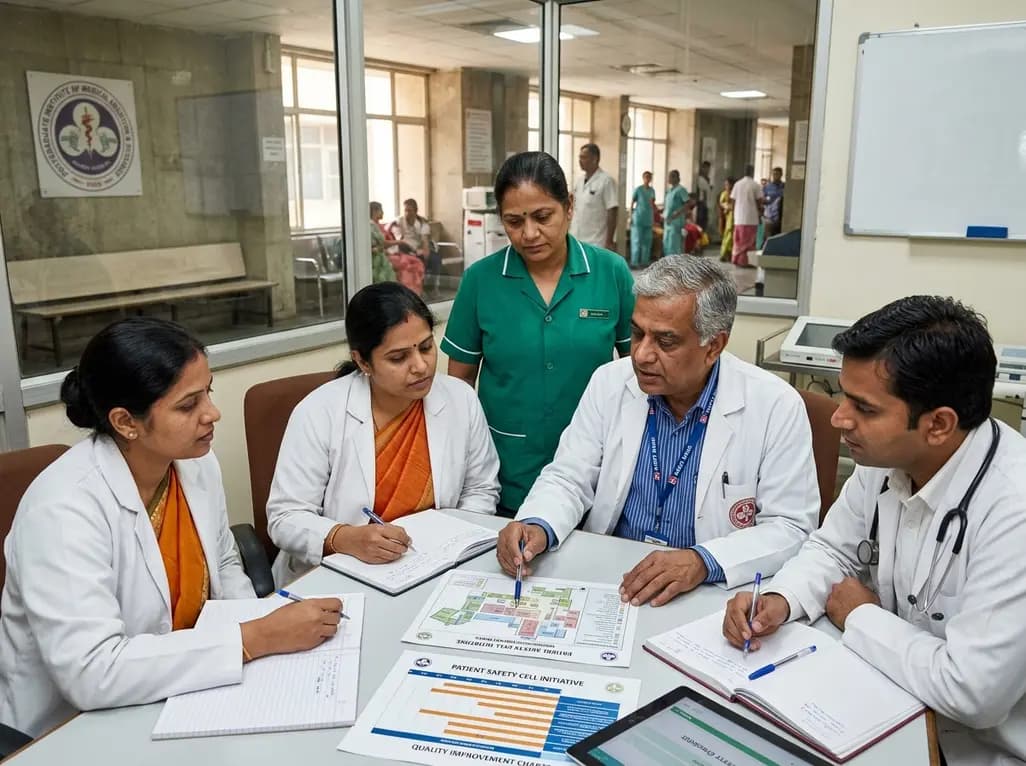
Recent regulatory directives emphasize the importance of patient safety in hospitals across India. According to Union Health Ministry records, clinical lapses cause nearly 52 lakh preventable injuries annually. Consequently, the National Medical Commission directed medical colleges to institute structured safeguards and modern reporting frameworks.
India faces an immense clinical challenge regarding preventable patient complications in tertiary and secondary facilities. Specifically, national records indicate that medical lapses cause approximately 5.2 million injuries annually. These unintended adverse events range from inadvertent drug overdoses to catastrophic surgical site infections. Furthermore, hospital-acquired infections remain a leading contributor to prolonged hospital stays and inflated treatment expenses. In addition, unsterile clinical equipment and inadequate nursing turnarounds frequently produce debilitating bedsores among critical patients. Such systemic vulnerabilities inflict substantial emotional and financial hardships upon vulnerable families. Therefore, institutional leaders cannot view these figures as mere statistical abstractions. Instead, administrators must recognize them as indicators of urgent systemic vulnerabilities across tertiary centres. Clinical teams frequently face severe staffing constraints and high patient volumes. Nevertheless, unchecked systemic deficits invariably compound clinical risks. Healthcare providers must consequently transition from passive acceptance to rigorous error tracking. By identifying recurrent operational failures early, clinicians can prevent adverse outcomes effectively. Ultimately, acknowledging this heavy burden represents the foundational step toward building safer clinical environments nationwide. Moreover, transparent discussions around clinical mistakes dismantle the counterproductive culture of silence.
To mitigate widespread treatment hazards, the National Medical Commission issued explicit directives to academic healthcare institutions. Specifically, the regulatory body mandated that every medical college must designate a qualified patient safety nodal officer. This official assumes direct operational responsibility for coordinating safety agendas and standardizing institutional operating procedures. Furthermore, institutions must establish a multidisciplinary safety committee with senior faculty representation from clinical, diagnostic, and administrative departments. This governing body must consistently monitor adverse events and near misses across all inpatient wards. In addition, the committee must formulate preventive strategies and track compliance with clinical protocols over time. Consequently, institutional leaders can swiftly identify systemic vulnerabilities before they compromise patient outcomes. Clear documentation pathways allow medical staff to report critical incidents without facing administrative harassment. Moreover, designated officers must liaise with the National Patient Safety Secretariat under the Ministry of Health and Family Welfare. Such centralized coordination aligns individual hospital practices with national benchmarks and performance standards. Thus, medical institutions build reliable protective systems rather than relying purely on individual diligence. Structured accountability ensures that departments adhere to rigorous safety standards during routine clinical workflows.
The central mandate strategically divides clinical risk management across eleven core operational domains. Foremost among these domains are medication safety and surgical precision. For example, surgical teams must enforce strict time-out protocols to eliminate wrong-site surgeries and anesthesia discrepancies. Concurrently, medication administration requires rigorous double-checking protocols to avert fatal dosing miscalculations. Another essential domain targets hospital-acquired infections and antimicrobial stewardship. Clinicians must curb improper antibiotic prescribing patterns to contain emerging resistant pathogens across critical care units. Additionally, the regulatory framework addresses blood transfusion safety through robust bedside recipient verification systems. Diagnostic and laboratory procedures constitute another high-stakes domain requiring stringent quality control checkpoints. Faulty diagnostic equipment or mislabeled specimens can delay vital therapeutic interventions significantly. Furthermore, medical device tracking and facility infrastructure maintenance form vital protective pillars. Institutions must ensure uninterrupted emergency power, reliable biomedical gas systems, and sterile air filtration in operating suites. Finally, safe vaccine administration and injection techniques prevent bloodborne pathogen transmission among patients and healthcare personnel alike. By addressing these eleven focal areas collectively, hospitals establish comprehensive clinical safeguards against preventable hazards. Consequently, clinical departments achieve seamless interoperability.
Historically, fear of liability and professional ostracization has hindered incident disclosure among medical professionals. Healthcare workers frequently conceal errors because traditional institutional hierarchies penalize honest missteps. However, modern clinical governance demands a decisive transition toward non-punitive incident reporting systems. The newly proposed safety cells emphasize learning from near misses rather than assigning individual fault. When staff members log near misses transparently, quality teams can rectify underlying systemic flaws immediately. For instance, modifying confusing medicine labels prevents subsequent administration errors across entire pharmacy divisions. Moreover, routine root-cause analysis uncovers equipment deficiencies and staffing imbalances before severe harm occurs. Consequently, junior residents and nursing staff feel empowered to speak up regarding potential procedural dangers. Institutional leaders must cultivate an environment where staff view error logging as a shared ethical duty. Furthermore, teaching hospitals must integrate non-punitive incident reporting directly into undergraduate and postgraduate medical curricula. Training future physicians in root-cause analysis prepares them to lead high-reliability organizations. Ultimately, fostering open clinical communication transforms institutional vulnerabilities into invaluable learning opportunities for all medical professionals. In this manner, medical centers foster enduring transparency while securing patient trust.
Implementing the directives requires operational realignment across hospital leadership, clinical staff, and allied teams. First, hospital leaders must officially notify the National Patient Safety Secretariat regarding their chosen nodal officer. Simultaneously, facilities must draft clear terms of reference delineating the exact review cadence of their safety cells. Monthly case evaluations must analyze sentinel events, adverse drug reactions, and localized infection outbreaks across wards. Furthermore, departments must display standardized clinical checklists conspicuously in high-acuity environments, including intensive care units and operating rooms. Nursing superintendents must supervise sterile technique adherence rigorously, ensuring that healthcare workers maintain strict hand hygiene standards. Additionally, pharmacy directors must institute electronic prescribing safeguards to minimize transcription discrepancies and improper dosing regimens. Routine simulation drills can also train emergency personnel to manage crisis scenarios without committing critical cognitive errors. Moreover, hospital governing boards must allocate sufficient budgetary resources for essential safety infrastructure and modern biomedical maintenance. Regular multidisciplinary audits ensure sustained alignment with national safety benchmarks. Through leadership commitment and structured team communication, healthcare institutions can dramatically reduce preventable injuries. This organized approach safeguards patients while protecting staff from avoidable clinical controversies.
Q1: Why did the National Medical Commission mandate patient safety cells in medical colleges?
The National Medical Commission issued this directive after health ministry data revealed 52 lakh annual injuries from preventable medical lapses. These errors encompass adverse drug events, surgical slip-ups, and hospital-acquired infections. By establishing dedicated safety cells and appointing nodal officers, the regulatory authority aims to institutionalize incident reporting. This initiative will eliminate recurring procedural hazards, elevate clinical outcomes, and restore public trust in teaching hospitals.
Q2: Which clinical domains must the new institutional safety cells oversee?
The safety cells must oversee eleven critical operational domains outlined by the National Patient Safety Secretariat. These domains encompass medication safety, surgical protocols, blood transfusions, and medical device tracking. Furthermore, the committees monitor diagnostic laboratories, hospital-acquired infection control, antimicrobial stewardship, and facility safety. Lastly, they supervise vaccine safety, therapeutic injection practices, and high-risk procedures to guarantee comprehensive operational protection throughout inpatient wards.
Q3: How does non-punitive incident reporting reduce medical errors in hospitals?
Non-punitive reporting replaces workplace blame with transparent, system-level analysis. When staff report near misses without fearing disciplinary retaliation, institutions identify systemic operational deficiencies before patient harm occurs. Quality committees subsequently conduct root-cause investigations, rectify confusing medication labeling, optimize clinical handover workflows, and upgrade faulty equipment. Consequently, this continuous learning cycle strengthens institutional safety defenses and protects healthcare professionals from recurring clinical hazards.
Disclaimer: This content is for informational and educational purposes only. It does not constitute medical advice or replace professional judgment. Refer to the latest local and national guidelines for clinical practice.
References

Read summarized clinical updates, watch expert medical content, and earn CME certifications right from your smartphone.
Open your smartphone camera to scan and install.





The National Medical Commission has directed all medical colleges and teaching hospitals in India to establish dedicated patient safety committees and appoint nodal officers across 11 key clinical domains. This regulatory measure responds to alarming data revealing 52 lakh preventable medical injuries each year.
Today

A UK multicentre prospective study published in the European Respiratory Journal reveals distinct oral and sputum microbiota dysbiosis in severe post-COVID patients. These microbial alterations correlate significantly with systemic inflammation, persistent neurocognitive deficits, and gastrointestinal symptoms.
Today

A landmark biomechanical study demonstrates that sports bra support and running shoe cushioning interact significantly to influence tibial acceleration, breast motion, and comfort in female runners, providing crucial insights for clinical counseling in sports medicine and women's health.
Today

The Delhi High Court declined immediate relief to PepsiCo regarding fresh manufacturing of products using the energy drink label. As regulatory bodies enforce strict standards on caffeinated beverages, medical professionals must evaluate the cardiovascular, metabolic, and pediatric risks linked to excessive intake.
Today

This review explores advances in antibacterial photothermal therapy, highlighting photothermal agents across NIR-I and NIR-II windows. By overcoming biofilm defenses and multidrug resistance without conventional antibiotics, these biomaterial platforms offer transformative options for complex clinical infections.
Today

A landmark Monte Carlo simulation study reveals widespread perchlorate and chlorate exposure through vegetables and drinking water, presenting significant thyroid disruption risks in young children. Learn the physiological mechanisms, dietary drivers, and preventive strategies for clinical practice.
Today
