

Loading, please wait...
Loading, please wait...

Clinicians frequently wonder whether intense mental effort can trigger neuropsychological testing seizures in individuals with epilepsy. For decades, practitioners noticed that emotional tension and prolonged cognitive exertion could increase cortical excitability. Consequently, some epileptologists hypothesized that formal testing battery components might directly provoke acute epileptic seizures. This clinical question holds great importance for comprehensive epilepsy centers, especially during rigorous presurgical diagnostic pathways. Patients undergoing comprehensive presurgical evaluations often face several hours of exhaustive psychometric batteries. These assessments demand focused concentration, visual search, verbal retention, and problem-solving. If specific mental challenges reliably trigger ictal activity, clinicians must modify testing schedules to preserve patient safety. Furthermore, acute seizures disrupt testing validity and require immediate rest, which complicates diagnostic interpretation. Historical studies offered conflicting views regarding cognitive triggers. Some earlier case series reported seizure clusters during complex mental calculations or reading. In contrast, other investigators argued that these occurrences represented mere coincidence rather than true reflex mechanisms. Therefore, determining whether mental exertion reliably provokes ictal episodes requires rigorous analysis in large, representative patient cohorts. Clarifying this association helps clinicians differentiate between genuine reflex epileptogenesis and incidental background seizure events.
To resolve this debate, investigators evaluated a massive cohort of 2000 standardized neuropsychological examinations conducted in 1444 patients with epilepsy. The study cohort presented with a mean age of 46 years, and 48% of the participants were female. Importantly, focal epilepsy represented the vast majority of cases, comprising approximately 95% of the overall patient sample. The research team systematically collected demographic characteristics, detailed clinical features, and exact seizure onset zones from electronic records. In addition, the investigators analyzed standardized test protocols, including the Verbal Learning and Memory Test and the Diagnosticum für Cerebralschädigung-Revised. Across all 2000 completed examinations, seizures occurred in only 36 testing sessions, representing a minimal incidence of 1.8%. These 36 ictal events involved just 34 unique patients, translating to an overall patient occurrence rate of 2.4%. Significantly, test-related seizures occurred exclusively in patients diagnosed with focal epilepsy. No individual with generalized epilepsy experienced an ictal event during psychometric testing. Furthermore, repeated seizures occurred across different testing appointments in only two individuals. If cognitive tasks functioned as true reflex triggers, clinicians would anticipate consistent, repeatable seizures across successive test sessions. Thus, the extremely low overall incidence strongly indicates that formal neuropsychological batteries do not elevate baseline seizure risk.
The study examined whether specific cognitive domains exhibited higher vulnerability to ictal disruption than others. Interestingly, the researchers observed that 58% of all recorded test seizures occurred during memory assessments. Specifically, the Verbal Learning and Memory Test accounted for 33.3% of the observed events. Meanwhile, the Diagnosticum für Cerebralschädigung-Revised, which assesses visual memory and visual learning, accounted for 19.4% of seizure occurrences. When analyzing anatomical localization, regression analysis demonstrated a significant association between seizure occurrence during verbal memory tests and temporal lobe onset zones. Both left-sided and right-sided temporal epileptogenic networks showed this relationship. Conversely, the authors found no statistically significant association between visual memory tasks and specific anatomical seizure onset zones. Furthermore, no other clinical characteristics—such as age, sex, seizure frequency, or etiology—showed a meaningful link with test-related seizures. Although memory tasks involved the highest number of ictal events, temporal lobe epilepsy also represents the most common diagnosis in presurgical candidates. Consequently, these tasks simply occupy a large portion of the standard test battery. Therefore, the numerical concentration of events during memory evaluations reflects testing duration and patient demographics rather than specific neurochemical trigger mechanisms.
To interpret these results correctly, clinicians must understand the neurobiology of reflex epilepsy versus incidental seizure generation. In genuine reflex epilepsies, external sensory inputs or precise mental tasks consistently produce hypersynchronous neuronal discharges within seconds or minutes. For example, reading epilepsy or praxis-induced epilepsy reliably causes paroxysmal activity whenever the patient engages the specific cortical circuit. However, cognitive reflex epilepsy remains extraordinarily rare in clinical neurology. The investigators highlighted that almost all patients who experienced an event did not experience seizures during subsequent testing sessions. Moreover, statistical modeling showed that seizure occurrence matched the expected baseline background frequency of drug-resistant focal epilepsy. Patients with active epilepsy often experience sporadic events during daytime waking hours regardless of their immediate activity. While acute emotional stress can transiently lower seizure thresholds, normal psychometric effort does not appear to trigger ictogenesis directly. In addition, extensive cortical activation during problem-solving often generates desynchronized electroencephalographic rhythms. Desynchronization generally hinders hypersynchronous seizure recruitment rather than facilitating it. Consequently, the authors concluded that seizures occurring during neuropsychological examinations represent coincidental events. The observed data do not support the hypothesis that targeted cognitive tasks provoke acute epileptic seizures.
These definitive findings provide significant reassurance for multidisciplinary epilepsy management teams worldwide. Clinicians frequently evaluate candidates for resective surgery, responsive neurostimulation, or deep brain stimulation using extensive neuropsychological batteries. Prior concerns that challenging cognitive examinations might endanger fragile patients or provoke status epilepticus appear largely unfounded. Therefore, neuropsychologists and clinical neurologists can administer standardized psychometric batteries without undue apprehension. Patients do not require prophylactic medication adjustments, preventative sedative pre-medication, or truncated testing protocols solely due to seizure fears. Nevertheless, testing teams must maintain vigilance because drug-resistant patients inevitably experience spontaneous seizures at baseline rates. When an unexpected seizure occurs during an examination, cognitive results for that specific domain become invalid. Postictal confusion, transitory dysphasia, and memory blanks distort psychometric baseline scores. As a result, clinicians must pause the examination immediately and ensure patient safety. Practitioners should reschedule the incomplete cognitive modules after the patient returns to their cognitive baseline. Furthermore, clinical teams must document the event meticulously in electronic records to guide future scheduling and interpretation.
Establishing practical safety protocols within neurocognitive laboratories ensures seamless patient care during unforeseen ictal events. Neuropsychology staff must receive thorough training in basic seizure recognition and postictal management. For example, staff should know how to guide a patient safely to the floor and position them in the recovery position. Additionally, testing suites should maintain clear pathways, padded examination chairs, and rapid access to medical emergency teams. Clinicians must advise patients before testing to reassure them that mental exertion remains completely safe. Informing individuals that cognitive testing does not trigger seizures alleviates baseline performance anxiety. Reduced anxiety improves patient engagement and enhances the diagnostic accuracy of the psychometric profile. If an examination is interrupted by an ictal event, clinicians should wait at least twenty-four hours before resuming memory assessments. This delay prevents postictal deficits from masquerading as permanent neurocognitive impairments. In conclusion, rigorous evidence demonstrates that cognitive activities during neuropsychological testing do not provoke acute seizures. Neuropsychological evaluations remain an exceptionally safe, indispensable component of modern clinical epilepsy care.
Standard cognitive activities during testing do not trigger acute seizures in most patients. Although mental stress can subtly alter seizure thresholds, true reflex seizures provoked by thinking are exceptionally rare. Extensive clinical data indicate that seizures occurring during formal examinations are coincidental events reflecting baseline disease activity.
Seizures appear most frequent during memory evaluations primarily because memory tasks constitute a substantial portion of testing time. Furthermore, temporal lobe epilepsy represents the most common condition evaluated in presurgical cohorts. The clustering of events during memory testing reflects these clinical realities rather than a direct causative trigger mechanism.
Clinicians must immediately prioritize patient safety by halting testing, clearing sharp objects, and maintaining an open airway. Testing should not resume immediately because postictal confusion invalidates cognitive results. Teams should reschedule remaining psychometric modules after the patient fully recovers, typically after at least twenty-four hours have passed.
Disclaimer: This content is for informational and educational purposes only and should not be considered medical advice. Always consult a qualified healthcare professional regarding any medical condition or before making healthcare decisions. While evidence-based, clinical judgment should guide management. Refer to the latest local and national guidelines for clinical practice.
References

Read summarized clinical updates, watch expert medical content, and earn CME certifications right from your smartphone.
Open your smartphone camera to scan and install.





A landmark study evaluated 2000 neuropsychological evaluations to examine whether cognitive testing triggers acute seizures. Findings reveal that seizure occurrence during testing is rare (1.8%) and largely coincidental, reassuring clinicians about the cognitive safety of routine presurgical assessments.
Today

A real-world cross-sectional study in Thailand reveals that a web-based bone health self-assessment tool effectively captured clinical risk profiles, prompting DXA recommendations in 37% of users—over half of whom were below standard screening ages due to non-age clinical vulnerabilities.
Today

Researchers have engineered a sensitive electrochemiluminescent sandwich immunosensor utilizing silver nanoparticles and quantum dots to quantify placental growth factor, paving the way for rapid, accurate, and accessible early preeclampsia screening in clinical practice.
Today

This report reviews the successful off-pump surgical retrieval of a migrated patent ductus arteriosus closure device in an 8-week-old preterm infant, preventing cardiopulmonary bypass morbidity while relieving aortic obstruction.
Today
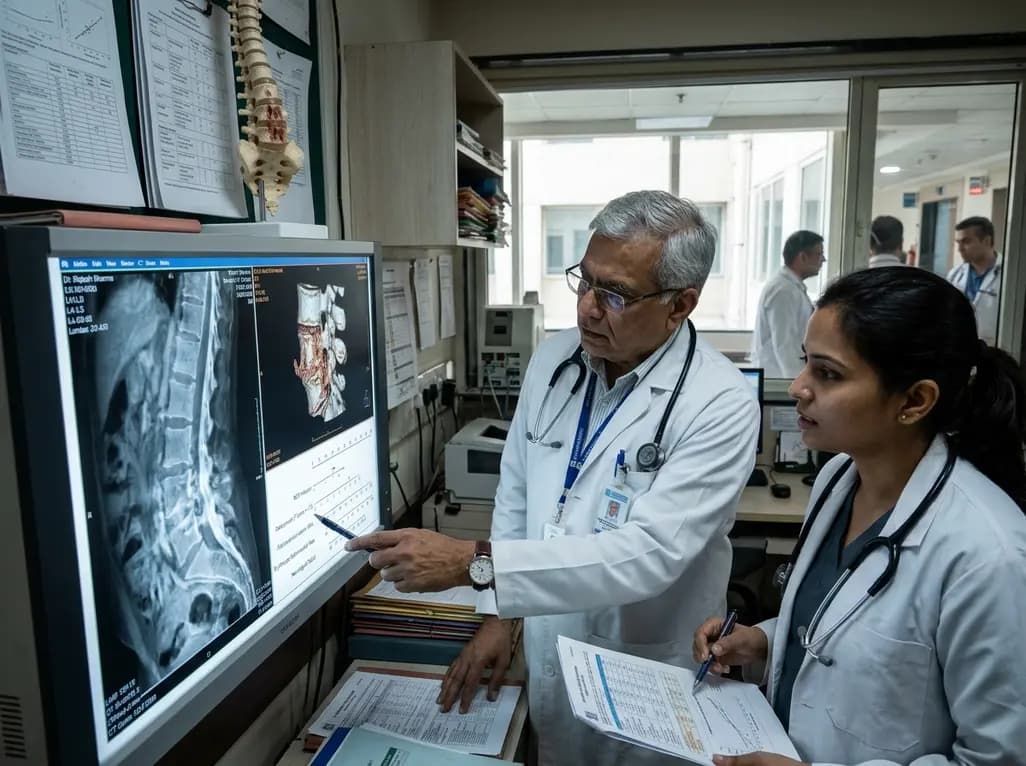
A new visual nomogram predicts postinfectious bone loss in spinal infection patients with high accuracy (AUC 0.946). Integrating markers like osteoporosis and MDR infection, the model aids early risk stratification to prevent spinal instability and deformity.
Today

As lifestyle diseases surge across India, clinicians face rising challenges from dietary misinformation and unmonitored therapies. Prioritising structured nutrition therapy, evidence-based self-care, and robust regulatory oversight offers a sustainable pathway to counter metabolic dysfunction and enhance patient health.
Today
